

How a Chinese Immigrant Laid the Foundation for the Computer Revolution
By H Y Nahm | 02 Apr, 2026
Physicist An Wang became the first Asian American tech billionaire by inventing the magnetic core memory to enable modern computing machines long before the birth of Silicon Valley.
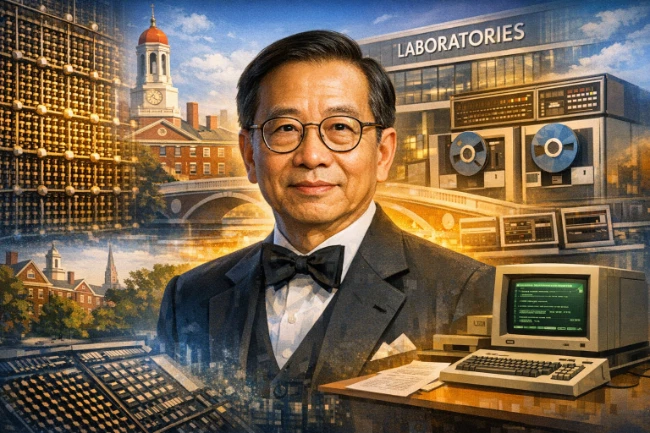
(Image by CoPilot)
When people think about the origins of Silicon Valley, they picture garages in Palo Alto, venture capitalists on Sand Hill Road, or hoodie-wearing founders pitching billion-dollar ideas. They forget that the computer ecosystem relies on breakthroughs made decades earlier by immigrants who never got the spotlight they deserved.
One of the most important is An Wang, a Chinese American inventor whose work helped make modern computing possible.
Wang’s story is really about persistence, timing, and the quiet, foundational kind of innovation that changes everything without publicity or credit. Long before Silicon Valley became synonymous with innovation, Wang was laying down the technical groundwork that would allow computers to evolve from room-sized curiosities into everyday tools.
Shanghai to Harvard
Born in Shanghai in 1920, Wang grew up in a China that was struggling with political instability and war. Even as a young man, he showed a knack for engineering and physics. After graduating from Shanghai Jiao Tong University, he left China in 1945 to pursue further studies in the United States.
Like many immigrants of his era, he arrived with little more than ambition and technical skill. He enrolled at Harvard University to study applied physics. It was there, in the late 1940s, that Wang made his most significant contribution: a refinement of vacuum tube technology that became critical to early computing.
Forerunner to Transistors
At the time, vacuum tubes were the backbone of electronic devices. They were the forerunners to transistors, controlling the flow of electrical current in radios, televisions, and the earliest computers. But they were bulky, generated heat, consumed a lot of power, and were unreliable. Early computers like ENIAC relied on thousands of these tubes, which meant frequent failures and constant maintenance.
Wang developed a crucial advancement known as the pulse transfer controlling device, which improved how electronic signals were processed and stored. More importantly, he patented a technique for magnetic core memory, which allowed data to be stored reliably and accessed quickly.
Magnetic Core Memory
Before magnetic core memory, computers relied on less stable forms of storage like delay lines or electrostatic memory, which were slow and prone to errors. Wang’s innovation made it possible for computers to retain information even when powered off and retrieve it with far greater speed and accuracy.
This meant computers could finally become useful for more than just experimental calculations. They could handle business data, scientific simulations, and eventually the kinds of tasks that would define the digital age.
Harvard initially owned the patent for Wang’s magnetic core memory, but in a move that would shape his future, Wang negotiated to acquire the rights. This decision proved pivotal. In 1951, he founded Wang Laboratories in Cambridge, Massachusetts.
Wang Laboratories
At first, the company focused on scientific instruments and electronic components. But as computing technology advanced, Wang Laboratories began developing calculators and word processing systems that would find their way into offices around the world.
By the 1970s, Wang Laboratories had become a major player in the computing industry. Its word processing systems, in particular, revolutionized office work. Before Wang’s machines, typing and editing documents was a painstaking process involving typewriters, correction fluid, and retyping entire pages for minor changes. Wang’s systems allowed users to edit text electronically, store documents, and print them on demand.
It’s hard to overstate its transformative impact. What spreadsheets did for finance, Wang’s word processors did for written communication. They didn’t just make work faster—they changed how people thought about work.
At its peak in the 1980s, Wang Laboratories employed tens of thousands of people and generated billions in revenue. For a time, An Wang was one of the richest men in America. Yet his name never became as widely recognized as those of later tech icons.
Forgotten Impact
Part of that comes down to timing. Wang’s most important contributions came before the personal computer revolution captured the public imagination. By the time Silicon Valley was producing household names like Apple, Intel, and Microsoft, Wang’s innovations had already been quietly integrated into the technological foundation on which those companies were built.
Another factor is that Wang’s company was rooted on the East Coast, far from the cultural mythology of Silicon Valley. Cambridge was a hub of innovation in its own right, but it didn’t have the same narrative appeal as Northern California.
Still, the influence is undeniable. Magnetic core memory became the standard for computer memory throughout the 1950s and 1960s. It was used in everything from early mainframes to NASA’s Apollo Guidance Computer, which helped land humans on the Moon.
Without reliable memory, none of those systems would’ve worked. And without those systems, the rapid evolution of computing in the following decades would’ve been impossible.
Pioneering Immigrant Innovator
Wang’s story also highlights the outsized role played by immigrants in the history of American innovation. Like many who came before and after him, Wang brought a different perspective, a deep technical education, and an intense drive to succeed. He didn’t just adapt to his new environment—he helped shape it.
Yet his journey wasn’t without challenges. As a Chinese immigrant in mid-20th-century America, Wang faced cultural barriers and limited recognition. Even as his company grew, he often remained a somewhat understated figure, more focused on engineering and business than on personal branding.
That's a sharp contraste with the tech leaders who followed him. Figures like Steve Jobs and Bill Gates became not just innovators but cultural icons. Wang, by comparison, operated in a quieter era, where breakthroughs mattered more than personalities.
The infrastructure he helped build became so fundamental that it became taken for granted. We don’t think about memory architectures or signal processing when we use a smartphone or a laptop. But those capabilities trace back to pioneers like Wang.
The Passing of an Era
Wang Laboratories eventually declined in the late 1980s and early 1990s, as the rise of personal computers eroded the company’s core business. Dedicated word processing machines were replaced by PCs running software like Microsoft Word. The shift was swift and unforgiving, and Wang’s company struggled to adapt.
Today, Silicon Valley stands as a global symbol of innovation, but its roots run deeper and wider than most people realize. They stretch back to university labs, to immigrant inventors, and to breakthroughs that didn’t always make headlines but changed the trajectory of entire industries.
An Wang’s legacy is a reminder that revolutions don’t happen overnight. They’re built piece by piece, often by people working far from the spotlight. His work on memory and electronic control systems helped turn computers from fragile experiments into reliable tools, setting the stage for everything that followed. So the next time you open a document, save a file, or power up a device, remember that a Chinese American physicist working in a Harvard lab was key to ushering in the digital age.
Articles
- Tomahawk Missile Delivery to Japan Diverted by Iran Demand
- OpenAI Buys Tech Talk Show TBPN in Surprise Move
- US Employment Rebounded in March but Jobs Under Pressure from Iran
- Trump's All-Caps Post Alarms Anxious Oil-Hungry World
- How a Chinese Immigrant Laid the Foundation for the Computer Revolution
- Automakers Unveil New EVs Despite US Sales Downturn
- Top 10 Favorite California UFO Hotspots
- Pope Leo Emerges As High-Profile Trump Critic
- Pam Bondi Fired from Attorney General Post
- China Adds 12 New Banks to Digital Yuan Program