

How AI Is Accelerating Anti-Aging Research and Therapy Approval
By Ben Lee | 01 Jun, 2026
AI-discovered compounds have dramatically increased success rates, with systems-level research expected to produce even bigger longevity gains.
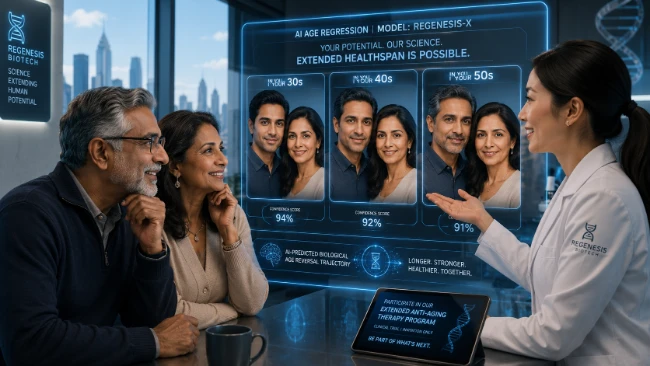
The biology of aging has long resisted clean solutions. For decades, researchers chipped away at individual pathways — a gene here, a protein there — without ever producing therapies that moved the needle on human lifespan in a clinically meaningful way.
That's changing fast. Artificial intelligence is compressing research timelines that once stretched across decades into years, identifying compounds that human scientists wouldn't have intuited, and enabling a systems-level understanding of aging that's already yielding approved therapies and promising late-stage candidates. The results aren't just encouraging — they're redefining what's considered possible.
Why AI Fits the Aging Problem So Well
Aging isn't a single disease. It's an interconnected collapse across multiple biological systems — genomic instability, telomere attrition, epigenetic drift, mitochondrial dysfunction, cellular senescence, chronic inflammation, and the gradual failure of intercellular communication. Any one of these hallmarks could anchor a career's worth of research. The challenge is that they don't operate independently. They feed and amplify one another in ways that produce outcomes no single-pathway model can predict.
That's precisely where AI excels. Machine learning models, particularly those trained on multi-omic datasets — genomic, proteomic, metabolomic, and transcriptomic data analyzed simultaneously — can detect cross-pathway signals that humans miss entirely. They can screen millions of candidate compounds against biological targets in silico, rank them by predicted efficacy and safety profiles, and flag interactions that would only emerge in a human trial years down the line. The result is a drug discovery funnel that's narrower at the top and far more likely to produce viable candidates at the bottom.
A 2024 analysis in Nature Aging found that AI-assisted drug discovery pipelines have achieved success rates roughly three times higher than traditional approaches in the longevity space, with a particularly dramatic improvement in the hit-to-lead conversion phase — the notoriously wasteful step where thousands of promising compounds get whittled down to a handful worth developing.
Senolytics: Clearing Out Zombie Cells
One of the most clinically advanced approaches in longevity medicine involves senescent cells — damaged cells that stop dividing but refuse to die, instead secreting a toxic cocktail of inflammatory signals called the senescence-associated secretory phenotype (SASP). As we age, these "zombie cells" accumulate and drive tissue dysfunction throughout the body.
Senolytics are drugs that selectively eliminate senescent cells, a space in which Unity Biotechnology has been one of the most visible players. Their lead candidate, UBX1325, targets the BCL-xL protein that senescent cells rely on for survival. In 2023, Phase 2 results showed meaningful improvements in vision for patients with diabetic macular edema and age-related macular degeneration — two conditions driven heavily by senescent cell accumulation in ocular tissue. Unity used AI-assisted target identification to home in on BCL-xL's specific role in ocular senescence, a choice that wouldn't have been obvious from traditional screening alone.
Oisín Biotechnologies is taking a more aggressive approach, using lipid nanoparticles to deliver a suicide gene that's selectively activated in cells expressing the senescence marker p16. Their AI-informed delivery platform is designed to ensure the payload reaches senescent cells without triggering off-target cell death — a precision problem the company's algorithms have proven remarkably good at solving in preclinical models.
Epigenetic Reprogramming: Turning Back the Clock
If senolytics are about removing damage, epigenetic reprogramming is about reversing it. Cells accumulate epigenetic changes over time — alterations in which genes are expressed, rather than changes to the underlying DNA sequence — and these changes are strongly correlated with biological aging. The Horvath clock and related epigenetic clocks can estimate biological age from methylation patterns with striking accuracy, and they've become indispensable tools for measuring whether a longevity intervention is actually working.
Altos Labs, a well-funded longevity company that recruited Nobel laureates and top aging researchers with eye-watering compensation packages, is betting heavily on partial reprogramming — using Yamanaka factors (transcription factors that can reset a cell's epigenetic state) to rejuvenate cells without fully reverting them to a pluripotent state, which would erase their identity and function. Their computational biology team uses AI to predict which combinations and doses of reprogramming factors produce rejuvenation without the cancer risk that full reprogramming can carry. Early results in mouse models have been dramatic, and human trials are anticipated within the next few years.
NewLimit, co-founded by Coinbase's Brian Armstrong, is also working on epigenetic reprogramming with a strong AI core. The company's platform uses foundation models trained on large epigenomic datasets to identify which epigenetic changes are causally related to aging — not just correlated with it. That's a harder problem than it sounds, and it's one where AI's ability to find causal structure in observational data is genuinely transformative.
mTOR Inhibition and Rapalogs: New Tricks to Try on Promising Paths
Rapamycin, an mTOR inhibitor originally developed as an immunosuppressant, is probably the best-characterized longevity compound in existence. It extends lifespan in every model organism where it's been tested, and it's been used off-label by longevity enthusiasts for years. The problem is that the immunosuppressive side effects make chronic use difficult to justify clinically.
That's where AI-informed medicinal chemistry is making a real difference. Ora Biomedical is running what's effectively a large-scale human trial of rapamycin and rapamycin analogs (rapalogs) in healthy adults, using AI to analyze biomarker data and identify which dosing regimens produce longevity benefits without the immunosuppressive downsides. Their platform continuously updates its models as trial data comes in, creating a feedback loop that's more like a learning system than a traditional clinical trial.
Pfizer's geroscience team has used machine learning to design next-generation rapalogs with improved target selectivity — compounds that inhibit the mTORC1 complex responsible for longevity benefits while sparing the mTORC2 complex more involved in immune regulation. It's a subtle distinction that would've been nearly impossible to exploit without AI-assisted molecular design.
NAD+ Boosters and Mitochondrial Health
Nicotinamide adenine dinucleotide (NAD+) is a coenzyme essential to mitochondrial function and DNA repair, and its levels decline sharply with age. NAD+ precursors like nicotinamide mononucleotide (NMN) and nicotinamide riboside (NR) have generated enormous consumer interest and serious scientific attention.
ChromaDex, which markets NR under the Tru Niagen brand, has partnered with academic institutions to run AI-assisted analyses of its clinical trial data, looking for subpopulations that respond particularly well to supplementation. Their approach — using machine learning to identify responder profiles from baseline metabolomics — is a good example of how AI can extract value from existing clinical data that would otherwise just sit in a database.
More ambitiously, Nuvation Bio and several academic groups are using AI to design novel NAD+ pathway modulators that go beyond simple precursor supplementation, targeting specific enzymes in the NAD+ biosynthesis and consumption pathway to maintain levels more effectively in tissues where decline is most consequential.
GDF11, Klotho, and the Blood Factors
One of the most intriguing threads in aging research involves circulating factors in the blood — proteins whose levels change with age and that appear to directly influence tissue health. GDF11 and Klotho are among the most studied, and the parabiosis experiments that demonstrated their importance (young mouse blood rejuvenates old mouse tissue) generated tremendous excitement a decade ago.
Alkahest, acquired by Grifols, has used AI to analyze plasma proteomics data and identify specific protein fractions from young plasma that drive the observed benefits, rather than using whole plasma. Their GRF6021 program, targeting neurological aging, is in clinical trials and represents a more refined version of the plasma fraction approach — one that wouldn't have been tractable without computational analysis of thousands of plasma proteins across thousands of donors.
Combining Strategies
The next frontier isn't any single pathway — it's interventions designed to address multiple hallmarks of aging simultaneously. AI makes this plausible in a way it wasn't before, because systems-level models can predict how targeting one pathway will affect others, allowing researchers to design combination therapies that work synergistically rather than running interference on each other.
Several companies, including Juvenescence and Longevity Biotech, are building explicit multi-target pipelines — not just using AI for target discovery, but using it to compose combinations of compounds that work together across pathways. The computational complexity of this problem is immense, which is exactly why it wasn't seriously attempted before machine learning made it tractable.
Most of the most exciting work is still in preclinical or early clinical stages. Translating mouse results to humans has a long history of disappointment in aging research specifically. But the tools are genuinely different now. The speed of iteration, the quality of target identification, and the ability to analyze human aging data at a systems level all represent real advances. AI isn't a guarantee that longevity medicine will deliver on its promises — but it's made the possibility of it delivering far more credible than it's ever been.
Recent Articles
- How AI Is Accelerating Anti-Aging Research and Therapy Approval
- Asia Factory Output Expands as Firms Stockpile Buffers over Iran War Risks
- Masayoshi Son's SoftBank Passes Toyota to Become Japan's Most Valuable Firm
- Japan Seeks World Cup Breakthrough After High-Profile Wins
- Changpeng Zhao's Binance Expands into US Stocks, ETFs
- India's Viral 'Cockroach' Youth Group Plans Street Protest in Challenge to Modi
- Nvidia Launches New AI Chip for Personal Computers
- AI Optimism Counters US-Iran War As Wall Street Opens Near Record Highs
- US Manufacturing Activity Hits Four-Year High in May
- Honeywell's Quantinuum Eyes $14.3 Billion Valuation in Upsized US IPO