

Trump Economy Sets New Record Low in Consumer Sentiment
By Reuters | 10 Apr, 2026
The stiffest inflation in four years caused early April consumer sentiment to drop among consumer segments across all ages, incomes and political parties, with Republicans showing the biggest slide.
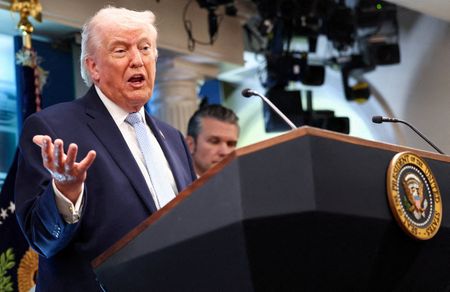
FILE PHOTO: U.S. President Donald Trump, flanked by Secretary of Defense Pete Hegseth, speaks during a press conference in the James S. Brady Press Briefing Room at the White House in Washington, D.C., U.S., April 6, 2026. REUTERS/Kevin Lamarque/File Photo
Americans are souring on the U.S. economy to a degree never before seen, with the stiffest inflation in four years exacerbating the political risk for President Donald Trump, who some administration officials worry has lost focus on affordability problems for voters as he trains attention on the war against Iran.
Few issues resonate with U.S. voters more deeply than price increases, and the latest inflationary upswing is unsettling key insiders at the White House worried about their Republican Party's prospects in critical midterm elections less than seven months away.
Republican lawmakers and senior White House aides have for months urged Trump to focus more on the economy, which is the top concern for voters. Trump has struggled, however, to show that he feels Americans' pain and has repeatedly declared victory over inflation, despite official data showing otherwise.
Data from the Labor Department on Friday showed inflation soared in March, the first full month of the war the U.S. and Israel launched against Iran on February 28, which resulted in Tehran choking off a fifth of the world's oil supply from flowing through the critical Strait of Hormuz.
The resulting upward spike in crude oil prices drove a record-setting increase in gasoline costs across the U.S., Bureau of Labor Statistics data showed, and that pushed headline inflation up by the most since June 2022 when the post-COVID pandemic price surge that ravaged former President Joe Biden's political prospects hit its peak.
Alongside that, household sentiment over the economy took a nosedive, with the University of Michigan's benchmark Consumer Sentiment Index sliding to a record low at the beginning of April.
"Demographic groups across age, income, and political party all posted setbacks in sentiment, as did every component of the index, reflecting the widespread nature of this month’s fall," survey Director Joanne Hsu said in a statement.
And it was not just Trump's perennial critics among Democrats giving low marks to the state of the economy now and its prospects for the future. The biggest decline was recorded among the survey's self-identified Republicans, whose sentiment score now sits near its lowest since Trump returned to office in January 2025 after winning back the White House on promises to lower the high prices that dogged Biden through most of his presidency.
Indeed, some top Trump administration officials, including White House Chief of Staff Susie Wiles, have become increasingly alarmed that not enough effort is being spent on bringing down high prices.
Wiles has privately urged advisers to be more declarative on the economic and political downsides of the war, a White House official told Reuters this week on condition of anonymity to discuss sensitive deliberations.
Beyond the University of Michigan survey, public opinion polling shows that Americans are increasingly losing confidence in Trump's stewardship of the economy, which political analysts say could hurt his Republican Party as it fights to retain slim majorities in Congress in the November midterms.
"President Trump has always been clear about short-term disruptions as a result of Operation Epic Fury, disruptions that the administration has been diligently working to mitigate," White House spokesman Kush Desai said Friday on social media as the White House made an effort to shift focus from gasoline prices. "Prices of eggs, beef, prescription drugs, dairy and other household essentials are falling or remain stable thanks to President Trump's policies."
Indeed, food prices were unchanged last month and egg prices have fallen 45% in the last year, the most ever, a fact Trump frequently cites.
But economists do worry that energy costs - unless lowered by a deal with Iran to reopen the strait and restart the flow of oil - could start feeding into a wider inflation breakout if they remain elevated for much longer.
Diesel fuel costs that have been pushed to within 20 cents a gallon of their record high are a critical cost input for truckers and farmers, and those costs could soon be passed along to consumers in the form of higher food costs.
(Reporting by Nandita Bose; Writing by Dan Burns; Editing by Andrea Ricci )
Recent Articles
- What Is the 25th Amendment and How Might It Fit the Moment?
- Coachella Draws Asian Power Attendees with Global Talent
- Vance Leaves for Islamabad, Iran Renews Demands, Trump Trash Talks
- ICE Launches Probe of Birth Tourism Schemes
- Trump Economy Sets New Record Low in Consumer Sentiment
- OpenAI CEO Sam Altman's Home Targeted with Molotov Cocktail, Suspect Arrested
- Next-Gen Nuclear Power Gets Boost from Big Tech Amid AI Boom
- Trump's Temporary 10% Global Tariffs Under Fire at US Trade Court
- Snap's Specs AI Smart Glasses to Use Qualcomm Chips
- Chile Copper Convention Draws Lithium Industry