

Meet the MIT Lifer Who Invented the Battery Likely to Be in Your Next EV
By Ben Lee | 14 Apr, 2026
Yet-Ming Chiang's LFP battery has become the dominant chemistry used in EVs around the world.
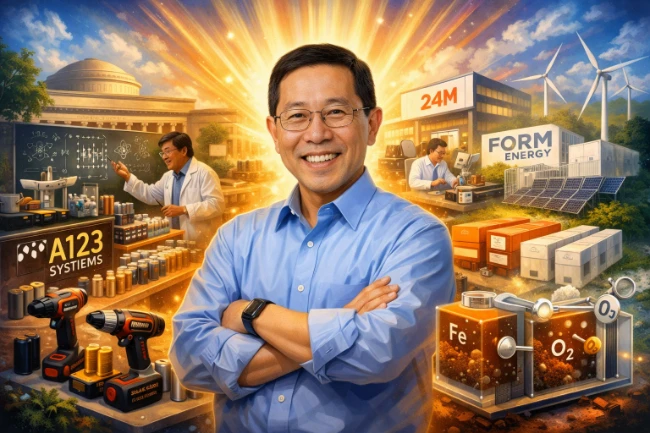
(Image by ChatGPT)
When you plug in your EV tonight, there's a better-than-even chance the battery storing that charge owes its existence to a soft-spoken MIT professor who grew up in Brooklyn, raised bees on a farm outside Boston, and spent decades doing something his academic peers rarely attempt: turning laboratory discoveries into world-changing businesses. His name is Yet-Ming Chiang, and the lithium iron phosphate battery he helped commercialize has quietly become the backbone of the global EV revolution.
Kaohsiung to Cambridge
Yet-Ming Chiang was born in Kaohsiung, Taiwan, on April 25, 1958, and emigrated to the United States with his family when he was six years old. He grew up in Brooklyn before moving to New Jersey and later Connecticut, becoming a naturalized US citizen at 16. From an early age, he was drawn to the physical world — how things were made, what they were made of, and why they behaved the way they did.
He didn't stray far when it came time for college. Chiang earned both his SB in 1980 and his ScD in 1985 from MIT, working under the direction of W. David Kingery, a legendary figure in ceramics whose influence shaped Chiang's instinct for finding practical applications in fundamental materials science. He joined the MIT faculty the same year he completed his doctorate and has never left. Chiang describes himself as an "MIT lifer" — he studied there, became a professor there, met his wife there, and started several of his companies with MIT colleagues.
That loyalty to one institution hasn't made him a narrow thinker. If anything, the opposite is true. Colleagues describe him as someone who moves fluidly between the theoretical and the practical, between the laboratory bench and the boardroom, with an ease that's genuinely rare in academic science. One journalist who spent considerable time with him described him as a man who speaks in a soft, even cadence and is prone to finishing his sentences with a disarming, open-jawed grin — unassuming, but tremendously driven, with a science-centered business sense that has earned tens of millions of dollars for his investors.
The Battery That Changed Everything
The story of the LFP battery begins not with Chiang but with John Goodenough, the Nobel Prize-winning chemist at the University of Texas at Austin who first identified lithium iron phosphate as a promising electrode material in 1995. Goodenough had given his lab researchers an assignment: take a lithium-ion battery cell and swap out different metals to see if they could hold more energy without catching fire. LFP passed that test — but it had a serious problem. It didn't conduct electricity well enough to be commercially useful.
That's where Chiang came in. He realized that coating or otherwise treating the material wasn't enough to solve the issue, and began working on ways to alter the compound itself by adding small amounts of metal and using special techniques to process it. The result was a breakthrough: nanoscale phosphate cathode material with high electronic conductivity that enabled high power, safe chemistry, long life, and environmental soundness, at a relatively low cost.
The key finding, as Chiang later described it, was extraordinary: cells with cathodes made from doped lithium-transition metal-phosphate nanoparticles had vastly increased charge-discharge rates, as fast as once every three minutes. That really was the key observation that led us to believe that there was a technology that could be built around this.
The discovery was published in Nature Materials in 2002 and ignited both excitement and controversy. Some researchers, including prominent chemist Linda Nazar, challenged whether Chiang's doping genuinely explained the conductivity improvements he'd observed. The question at the core was whether Yet-Ming Chiang had transformed the compound that Goodenough patented into a new and more useful material, or whether his compound was essentially the same as what had come before. The patent battles that followed were protracted and expensive. But the batteries themselves kept working — and the market eventually delivered its verdict.
Building A123 — And Watching It Fall
Chiang didn't wait for the scientific dust to settle before trying to bring his discovery to market. In early 2001, a 26-year-old entrepreneur named Ric Fulop started knocking on doors at MIT hoping to find someone to help him start a battery company. One of the people who answered was Yet-Ming Chiang. Together with materials scientist Bart Riley and executive Dave Vieau, they founded A123 Systems.
Chiang has been candid about the role Fulop played in pushing him to act. "As the academic researcher, I wasn't involved in A123 for my business acumen," he recalled. "What happened was that my other co-founder, Ric Fulop, catalyzed the whole thing by coming to my office one day and announcing to me that he was interested in developing a venture based on new battery technology... What he really did when he arrived at my office was to prompt me to start to commercialize things that I might otherwise have waited longer to do."
A123 had its first major customer in Black & Decker, which began producing DeWalt-brand power tools using A123's batteries — devices said to recharge to 90 percent in just five minutes. By 2006, A123 was producing nearly six million cells per year. The company went public in 2009 in what was then the biggest IPO of the year, raising $380 million and generating enormous excitement about America's ability to compete in the battery industry.
It didn't last. A123 issued a battery recall that cost the company $55 million — a conservative move that Chiang later said wasn't actually justified by the battery failure rates. But it caused a cash-flow crisis that led to a bankruptcy filing. The company was ultimately acquired by China's Wanxiang Group. Politicians seized on the collapse as a symbol of government waste. Chiang himself, though, emerged with his reputation intact — widely seen as a scientist who'd been ahead of his time in a market that simply wasn't ready yet.
Vindication of Chemistry
The deeper irony of A123's failure is that Chiang's underlying chemistry wasn't wrong — it was just early. Today, lithium iron phosphate batteries dominate the EV market, particularly in China, where CATL uses LFP chemistry in the majority of its cells. Tesla adopted LFP for its standard-range vehicles. BYD, the world's best-selling EV brand, builds almost exclusively on LFP. The battery Chiang helped unlock is now manufactured at a scale of hundreds of gigawatt-hours per year globally.
Ric Fulop, who went on to found Desktop Metal — itself a billion-dollar 3D printing company — has noted that Chiang possesses something rare: the ability to see past the immediate commercial obstacles to the long-term technical truth. "Most researchers are more conservative than most entrepreneurs," Chiang himself has observed. "They need a little bit of a pull to get things out when they don't yet think it's ready to go out. But the entrepreneur says, 'No, now's the time. Let's go.' That's what I needed in the case of A123."
Lifelong Inventor: 24M and Form Energy
Chiang didn't pause after A123's collapse. In 2010, he founded 24M Technologies, this time focused not on battery chemistry but on the manufacturing process itself. His insight was that ingenious manufacturing, rather than an ingenious leap in battery chemistry, might usher in the new electric age. 24M's "semisolid" electrode technology dramatically reduces the number of steps in battery production, potentially cutting costs by a significant margin and making gigafactory construction far more capital-efficient. The company has licensed its technology to manufacturers in Japan, South Korea, and Europe.
But Chiang's most audacious venture may be Form Energy, which he co-founded in 2017. The premise: the electric grid doesn't just need better batteries, it needs batteries that can store energy for days at a time — long enough to bridge stretches of cloudy, windless weather. Lithium-ion can't do that economically. So Chiang went back to basics and landed on a material so humble it bordered on absurd: rust.
Iron-air batteries capture energy and turn it into electrical current — then recharge by reversing the reaction, essentially "unrusting" the iron and returning it to its metallic form. The economics are compelling. "Air is still free," Chiang said with a laugh, "and iron is one of the most widely produced, lowest cost materials in the world."
True to form, Chiang's attitude toward skepticism is characteristically direct: "We expect people to think that this is a totally crazy idea," he has said. "If they didn't, I'd be a bit disappointed — because if people don't think something is totally crazy at first, it probably isn't going to be that revolutionary."
Form Energy has raised more than $2.5 billion to scale its iron-air battery technology, and has broken ground on a manufacturing facility in Weirton, West Virginia — a former steel town whose industrial workforce and infrastructure make it a natural home for a company that works with iron at massive scale.
A Legacy in Progress
Beyond batteries, Chiang has pushed into territory that might surprise those who know him only as a battery pioneer. He co-directs MIT's flagship Climate Grand Challenges project on decarbonization of industrial materials production, including electrochemical approaches to cement manufacturing — one of the most carbon-intensive industries on earth. He co-founded SpringLeaf Therapeutics to apply battery-derived technology to controlled drug delivery through transdermal patches. He's working on batteries for electric aviation. He's exploring electrochemical mining of industrial waste streams.
Chiang has co-founded seven companies based on work from his MIT research laboratory, holds more than 80 US patents, and has published more than 300 scientific papers — all while keeping his day job as the Kyocera Professor of Materials Science at MIT, where he's been on the faculty since 1985.
The EV in your driveway represents one chapter in that story. The grid battery that will one day store a week's worth of solar power may represent another. Yet-Ming Chiang, wiry and quietly grinning, is already working on the one after that.
© 2026 by Asian Media Group Inc.
Recent Articles
- 'I Love the Inflation,' Trump Says of Prices Rising Amid Iran War
- China's JUNO Neutrino Detector Advances Precision in Mass-Ordering Quest
- Only 11% of Europeans View US as Ally, Survey Shows
- BYD Will Be World's Biggest Automaker in 5 Years Says Its Chairman
- US Consumer Prices Increase at Fastest Pace in 3 Years
- Traders Keep Bets on Fed Rate Hike by October
- Drone Risks Keep World Cup Security Planners Frantic
- Bill Gates to Face Congress in Probe of Epstein Case Handling
- Musk’s xAI, SpaceX Hit with Class Action over Data Center ‘Nuisance’
- Downed Chopper Prompts US to Launch New Strikes on Iran