

How Don Can Make the US and the World Whole at the Beijing Summit
By Tom Kagy | 08 May, 2026
Trump still has the grip over Congress to balance the woes he bestowed on the world during his disastrous first 16 months by unlocking the economic miracle of a symbiotic relationship between the US and China.
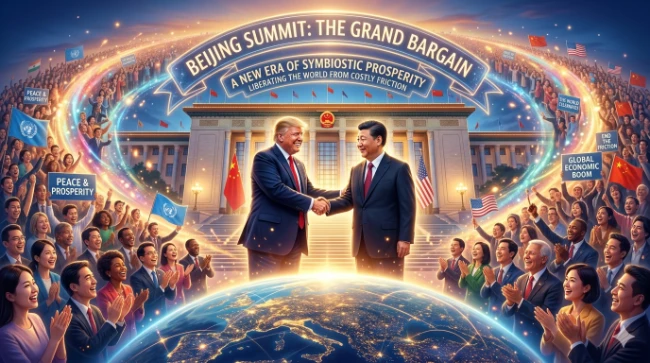
(Image by Gemini)
The motorcade in Beijing is a chance for Don the Dealmaker to fix the engine of the global economy—and compensate Americans and the rest of the world for the ill effects of the poor decisions earlier in his term. For the last 16 months, the world has watched a return to high-stakes protectionism, "Liberation Day" tariffs, and a tech war that has felt less like a strategy and more like a stalemate.
But as Donald Trump touches down for this summit, he holds a unique hand. Despite the chaos, his influence over the GOP-led Congress remains absolute. He can do what no one else can: pivot from a stance of pure confrontation to a grand bargain that doesn't just "contain" China, but harnesses its massive industrial engine to fuel an American comeback in key industrial sectors.
If Don wants to leave a legacy of having made the world whole, he needs to move past the zero-sum rhetoric of 2025. The path to a global economic boom—and a historic win for the American taxpayer—lies in five specific, pragmatic agreements. These aren’t concessions; they are the keys to unlocking a symbiotic future.
1. Unshackling Silicon: Ending the AI Chip Ban
For too long, the "national security" label has been used as a blanket to stifle one of America’s most lucrative exports: advanced AI chips. While the intent was to keep high-end compute out of the hands of the Chinese military, the result has been a strangulation of revenue for firms like Nvidia and AMD—money that should be flowing back into American R&D.
By ending the broad ban on sales of advanced AI chips to China, Trump can secure a massive capital injection for the US tech sector. We aren't talking about giving away the blueprints; we’re talking about selling the product. China is hungry for compute power to fuel its domestic commercial AI industry. If they can’t buy American, they will build their own, and once they achieve parity, that’s a market lost forever.
Opening these floodgates would see hundreds of billions of dollars flow into Silicon Valley. This capital is the lifeblood required to fund the next generation of American research and the construction of new domestic foundries. It ensures that while China uses the chips, America remains the one designing them. It's a "sell them the hammer to build their house" strategy that keeps the US at the top of the value chain.
2. Solar Symbiosis: The 50:50 Joint Venture Model
The world needs cheap, renewable energy, and China is the only nation with the manufacturing scale to provide it at bargain prices. However, the US has spent years building a tariff wall around Chinese solar panels to "protect" a domestic industry that has struggled to match China's pace.
The fix is simple: Open the US to imports of Chinese solar panels, but only from makers who form 50:50 joint ventures with US firms. This is precisely the strategy China used to advance its manufacturing capacity from 3rd-world levels to actually surpass the US.
This is the ultimate win-win. US firms get an immediate infusion of world-class manufacturing technology and capital, while Chinese firms get access to the massive American market. By mandating these joint ventures, we ensure that the jobs created by the installation and maintenance of these panels stay in the US, and that the profits are shared equally. This would slash the cost of the green transition for American consumers overnight, liberating their spending power for other parts of the economy while accelerating our climate goals without the massive price tag.
3. The EV Revolution: Building Together on American Soil
The story is the same with Electric Vehicles. Chinese EV makers like BYD are currently producing high-quality, affordable cars that the rest of the world is buying in droves. Meanwhile, American consumers are stuck with high prices and limited options.
Trump should offer a deal: Chinese EV firms can enter the US market, provided they do so through 50:50 joint ventures with American carmakers. Imagine a Ford or a GM partnering with a Chinese powerhouse to produce affordable, high-tech EVs in revamped Midwest factories.
This isn't about letting China "take over" the auto industry; it's about forcing them to build here, with American workers and American partners. It saves the legacy US auto industry from obsolescence by giving them access to the best battery tech in the world. For the American worker, it means job security in the factories of the future. For the consumer, it means an EV that actually fits the family budget.
4. The Grand Swap: Tariffs for Rare Earths
The trade war has been a cycle of tit-for-tat. We slap on a tariff; they restrict rare-earth minerals. These minerals are essential for everything from smartphones to fighter jets, and China currently holds the cards on their export.
At the Beijing Summit, Trump can cut the Gordian knot: Drop all US tariffs in exchange for China dropping all licensing requirements on exports of rare-earth minerals to the US.
Tariffs are essentially a tax on the American consumer. Removing them would be a massive, immediate stimulus to the U.S. economy, lowering the cost of living for every household. In exchange, securing an unfettered supply of rare earths removes the single biggest strategic bottleneck for American high-tech manufacturing. It provides the "raw fuel" for our industrial base to run at full throttle, ensuring that the "Made in America" tag can actually be applied to the hardware of the 21st century.
5. Ending 3rd Nation Overreach and Regaining Allies
One of the most friction-inducing parts of US policy has been the "Foreign Direct Product Rule"—the practice of sanctioning third-party nations (like the Dutch or the Japanese) for exporting technology to China that contains even a fraction of US intellectual property. This has alienated our allies and created a global compliance nightmare.
Ending the sanctions regime against third nations for exporting "sensitive" technology to China is a move toward global stability. It acknowledges that the world is interconnected and that trying to police every transaction on the planet is a recipe for isolation.
By stepping back from this extraterritorial overreach, Trump can restore trust with our European and Asian partners. It allows global supply chains to normalize, reducing the "uncertainty tax" that has hindered international investment for years. It signals that the U.S. is ready to lead through innovation and partnership, rather than through global financial policing.
The Payoff: A Global Economic Boom
The impact of this Grand Bargain would be staggering. We are looking at a future where the US and China aren't just competitors, but the twin engines of a new era of prosperity.
By unlocking these five gates, hundreds of billions of dollars more would flow to US firms. This isn't just "profit"; it's the funding for the next decade of American breakthroughs. We stay ahead in the tech race not by hiding our chips, but by out-earning and out-innovating everyone else with the capital we gain from being the world's premier tech provider.
On the other side, allowing China to use its incredible manufacturing capacity to provide green tech and consumer goods at bargain prices does something miraculous: it gives the global consumer a raise. When the cost of a car, a solar array, or a smartphone drops, people have more money to spend on services, education, and local businesses.
This isn't a retreat; it's a strategic realignment. It’s Don using his unique brand of disruptive diplomacy to fix what was broken and build something bigger. At the Beijing Summit, he has the chance to make the world "whole" by proving that the two largest economies on Earth are far more powerful when they are working in a symbiotic, managed relationship than when they are trying to tear each other down. It’s time for the ultimate deal.
Recent Articles
- How Don Can Make the US and the World Whole at the Beijing Summit
- Trump Plans Smaller CEO Delegation to Beijing Summit
- US Image Sinks Below Russia's Under Trump, Survey Finds
- Stellantis, Leapmotor to Become Joint Venture in Europe EV Production
- Sony, TSMC Plan New Japan Joint Venture for Next-Generation Image Sensors
- Chinese Fireworks Makers See Trump Visit Auguring Spectacular July 4 Celebrations
- Hybrid Car Sales Soar in US Along with Gas Prices
- Trump Crackdown on China-Linked Solar Firms Stalls US Factory Boom
- DOGE Termination of 1,400 Humanities Grants Were Unlawful, Discriminatory
- Trump Insists Ceasefire Still Holds Despite Fresh Strikes by Both Sides