

Hikaru Nakamura Dominates World-Class Chess with Lightning Moves and a Brash Mouth
By Ben Lee | 06 Apr, 2026
The 5-time US Champion and consistent top-5 in the world is also the game's most charismatic and outspoken streamer and podcaster.
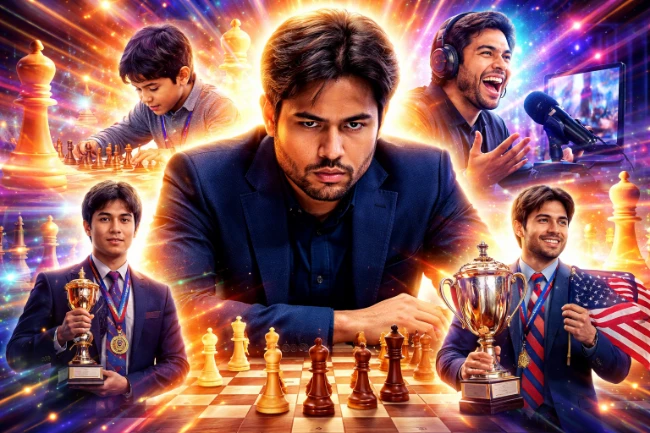
(Image by ChatGPT)
Hikaru Nakamura’s story doesn’t start in a hushed European chess hall or a Soviet training school. It starts in Japan, in a city most chess fans couldn’t point to on a map, with a kid who’d grow up to play the game faster, sharper, and louder than almost anyone who’s ever touched a board.
He was born in 1987 in Hirakata, Japan, to a Japanese father and an American mother. Chess wasn’t exactly a mainstream pursuit there, and Nakamura didn’t stay long anyway. His parents split when he was young, and by age two he was already on a plane to the US, where his life—and his relationship with chess—would take shape.
His chess origin story begins with his stepfather, Sunil Weeramantry, a Sri Lankan-born chess master and legendary scholastic coach in New York. Hikaru didn’t just stumble into chess; he grew up inside it.
“We didn’t force him,” Weeramantry has said. “But he was surrounded by it, and he took to it immediately.”Nakamura picked up the game around age seven, which is actually a bit late by prodigy standards. But once he got going, he didn’t just catch up—he blew past everyone. Within a couple of years, he was beating adults. Within a few more, he was tearing through national scholastic events like they were warmups.
“I just liked winning,” Nakamura once said, with characteristic understatement. “Chess was something I could get really good at, really fast.”
Master of Chaos
There was nothing delicate about his style, even as a kid. Where other young players were cautious, methodical, almost polite, Nakamura was already playing like someone who wanted to bend the game to his will. He attacked. He improvised. He thrived in chaos. You could already see the future blitz king in the way he handled time pressure—calm for him, panic for everyone else.
By age 10 he was the youngest American to defeat a grandmaster. By 15 he’d become a grandmaster himself, one of the youngest in US history at the time. The prodigy label stuck, but it didn’t quite capture what made him different. Plenty of kids get called prodigies. Very few develop into something this durable, this distinctive.
What set Nakamura apart wasn’t just talent. It was a kind of stubborn independence. He didn’t come out of the traditional pipeline of elite European coaching. He didn’t model himself after one school of play. He built his game in pieces—tactics here, intuition there, speed everywhere.
“I never really tried to copy anyone,” he said. “I just played what I thought made sense.”
That approach made him unpredictable, and unpredictability at the top level is a weapon. By his late teens, Nakamura was already one of the strongest players in the US, winning his first US Championship in 2005 at just 17. It wasn’t a fluke. He’d go on to win it multiple times, establishing himself as a fixture at the top of American chess.
The Global Stage
But the global stage was another matter. For a while, Nakamura hovered just outside the absolute elite. He was strong—very strong—but not yet in that Carlsen-Caruana tier where world championship matches are decided.
And then something clicked.
Through his 20s, he refined his game without losing its edge. He got better in positions that used to frustrate him. He became more patient, more controlled. But he never lost that instinct to complicate things, to drag opponents into positions where calculation and nerve mattered more than textbook precision.
“Hikaru is incredibly dangerous because he’s willing to go where others won’t,” one grandmaster said. “He’ll take you into positions that are objectively dubious but practically very hard to play.”
By the mid-2010s, he was a consistent top-5 player in the world. His rating pushed past 2800, that invisible barrier that marks the absolute elite. He was winning supertournaments, beating world champions, and making it clear he wasn’t just an American star—he was a global force.
Still, if you want to understand Nakamura, you can’t just look at classical chess. You have to look at speed.
Blitz and Bullet Chess
Blitz and bullet chess—games where players have minutes or even seconds—are where Nakamura becomes something else entirely. The board doesn’t slow him down; it accelerates him. Moves come instantly, almost reflexively, but they’re not random. They’re grounded in a kind of pattern recognition that’s been built over tens of thousands of games.
“I don’t calculate everything,” he’s said. “At some point, you just know.”
In blitz, he’s widely considered the best in the world, or at worst one of the top two or three. He’s won countless online events, dominated speed chess championships, and routinely beats players who outrank him in classical formats.
Magnus Carlsen, not exactly prone to handing out compliments, once put it simply: “Hikaru is probably the toughest opponent in blitz.”
What makes him so good? It’s not just speed. Plenty of players are fast. Nakamura is fast and accurate, which is a much rarer combination. He thrives in messy positions, spots tactical shots instantly, and rarely freezes under pressure.
“He’s like a machine when the clock is low,” another top player said. “You think you’re holding, and suddenly everything collapses.”
Big Streaming Personality
But Nakamura’s modern identity isn’t just about what he does over the board. It’s also about what he does in front of a camera.
When the chess world went online—especially during the pandemic—Nakamura didn’t just adapt. He took over. Streaming on Twitch, he turned high-level chess into something accessible, entertaining, and, yes, loud.
This is where the other side of him comes out. The brash, talkative, sometimes polarizing personality that doesn’t fit the old stereotype of the quiet, brooding grandmaster.
“I say what I think,” he’s said. “Sometimes people like it, sometimes they don’t. That’s fine.”
On stream, he’ll play dozens of games in a row, comment on his own moves in real time, joke with viewers, and occasionally vent when things go sideways. It’s raw, unscripted, and very much him.
“Hikaru made chess cool online,” one commentator noted. “He showed you don’t have to be silent to be serious.”
He’s also taken that energy into podcasting and broader media, where his style can be described, depending on your taste, as either refreshingly honest or unapologetically blunt.
“I’m not here to sugarcoat things,” he said in one interview. “If I think something, I’ll say it.”
That openness has made him one of the most recognizable figures in chess, even beyond the usual fanbase. He’s not just competing; he’s shaping how the game is seen and consumed.
Of course, not everyone loves it. Some traditionalists prefer their chess players quiet and reserved. Nakamura isn’t interested in that.
“I’m not trying to be anyone else,” he said. “I’m just being me.”
And that, more than anything, might be the through line of his career. From a kid in Japan to a prodigy in New York, from a fast-rising talent to a top-5 player in the world, from a blitz monster to a streaming star—he’s done it his own way.
Still a Kid Who Likes to Win
He’s had ups and downs, like anyone who’s spent decades at the top of a brutally competitive field. There were periods where he slipped in the rankings, moments where it seemed like the next generation might pass him by. But he keeps coming back, adjusting, evolving.
“I still feel like I can compete with anyone,” he said recently. “As long as I believe that, I’m not going anywhere.”
That belief shows up every time he sits down at the board, especially when the clock starts ticking faster. Because for all the analysis, all the rankings, all the commentary, Nakamura at his core is still that kid who liked winning—and found a way to get really, really good at it.
And when the game speeds up, when the position gets messy and the clock dips under a minute, there’s still no one quite like him.
“He’s chaos,” one rival said, half-admiring, half-exasperated. “And somehow, he makes it work.”
That’s Hikaru Nakamura. Not just one of the best players in the world, but one of the most distinctive. A grandmaster who doesn’t just play the game—he bends it, speeds it up, and, in his own loud, unmistakable way, brings everyone along for the ride.
© 2026 by Asian Media Group Inc.
Recent Articles
- 'I Love the Inflation,' Trump Says of Prices Rising Amid Iran War
- China's JUNO Neutrino Detector Advances Precision in Mass-Ordering Quest
- Only 11% of Europeans View US as Ally, Survey Shows
- BYD Will Be World's Biggest Automaker in 5 Years Says Its Chairman
- US Consumer Prices Increase at Fastest Pace in 3 Years
- Traders Keep Bets on Fed Rate Hike by October
- Drone Risks Keep World Cup Security Planners Frantic
- Bill Gates to Face Congress in Probe of Epstein Case Handling
- Musk’s xAI, SpaceX Hit with Class Action over Data Center ‘Nuisance’
- Downed Chopper Prompts US to Launch New Strikes on Iran