

Commercial Fusion Power Faces 3 More Epic Tech Hurdles
By Goldsea Staff | 18 Dec, 2025
The sheer amount of time and money needed to overcome these hurdles may relegate fusion power to the permanent status of an expensive scientific toy of a bygone era.
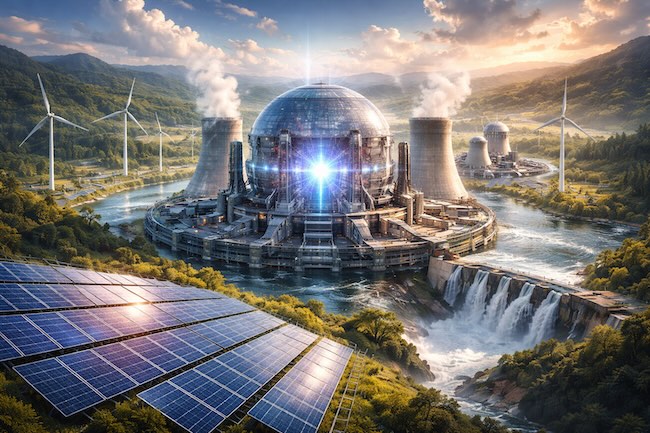
(Image by ChatGPT)
The recent surge of enthusiasm over fusion power as a potentially limitless clean energy source masks a stubborn reality: three formidable engineering challenges must first be overcome for fusion to become a cost-effective and reliable commercial power source.
Each of these hurdles will likely decades, not years. That explains why most sober fusion engineers expect true commercial fusion power to arrive, at best, in the 2040s or 2050s—and possibly much later. Or never. Given the economic reality of competing, virtually limitless clean energy sources that face few, if any, major hurdles.
Hurdle Number 1: Sustained Plasma Stability at Power-Plant Scale
Fusion requires confining a plasma of charged particles at temperatures exceeding 100 million degrees Celsius. No solid material can touch it. The plasma must be suspended and shaped entirely by magnetic fields, typically in donut-shaped devices known as tokamaks or in more complex stellarators.
In laboratory experiments, scientists have demonstrated impressive plasma performance. Some machines have held plasmas stable for minutes. Others have achieved bursts of fusion power approaching break-even. These are genuine scientific achievements.
But a commercial power plant demands something far more mundane and far more difficult: stable operation for hours, days, and eventually months at a time, without violent disruptions or damaging instabilities.
Plasmas are inherently restless. They kink, ripple, and erupt under subtle changes in pressure, temperature, or magnetic field geometry. At small scales and short durations, these instabilities can be tolerated. At power-plant scale, they become unacceptable. A single uncontrolled plasma disruption can damage reactor walls, halt operations, and require lengthy repairs.
Modern fusion research increasingly relies on sophisticated sensors, real-time feedback systems, and even machine learning to tame plasma behavior. These tools are improving rapidly, and this is the area where progress is arguably fastest. Control algorithms can be upgraded. Magnets can be strengthened. Designs can be refined.
Still, moving from experimental stability to the near-perfect reliability demanded by an electricity grid remains a monumental step. Grid operators expect availability rates above 90 percent. They expect predictable output and controlled shutdowns. They do not tolerate frequent surprises.
Achieving that level of plasma stability at full power isn't a single breakthrough but a slow, iterative process of learning how plasmas behave over long periods in large machines. That alone will likely consumes at least another decade, even under optimistic assumptions.
Hurdle Number 2: A Closed Tritium Fuel Cycle
Practical fusion relies on fusing deuterium and tritium, two heavy forms of hydrogen. Deuterium is abundant in seawater. Tritium isn't. It's radioactive, short-lived, and exists naturally only in trace amounts.
For fusion to work at scale, reactors must breed their own tritium fuel internally. This is done by surrounding plasma with lithium-containing “breeding blankets” that absorb fusion neutrons and convert lithium into tritium.
This process is straightforward in theory. In practice, it's extraordinarily complex.
A commercial fusion reactor must achieve a tritium breeding ratio greater than one, meaning it produces more tritium than it consumes. It must extract that tritium continuously, purify it, store it safely, and reinject it into the plasma with minimal losses. All of this must happen inside a high-radiation environment where maintenance is difficult and leaks are unacceptable.
Tritium is a form of hydrogen, which means it permeates metals easily and escapes through microscopic flaws. Managing it safely and efficiently is one of the most delicate aspects of fusion engineering. Regulatory limits on tritium release are strict, and public tolerance for radioactive leaks is low.
No fusion experiment to date has demonstrated a fully closed, self-sustaining tritium fuel cycle. ITER, the massive international fusion project under construction in France, will test breeding blanket modules, but it will not operate as a self-sufficient tritium system.
Without a proven fuel cycle, fusion remains dependent on limited external tritium supplies produced by fission reactors. That isn't a viable path for global deployment.
Hurdle Number 3: Materials that Can Survive Neutron Bombardment for Decades
If plasma control is the most visible challenge, materials science is the most unforgiving one. Fusion reactions produce a torrent of high-energy neutrons that slam into the surrounding reactor structure. These neutrons are far more energetic than those typically encountered in today’s fission reactors.
Over time, neutron bombardment displaces atoms, swells materials, causes embrittlement, and even changes one element into another through nuclear transmutation. Components that look pristine at first can gradually weaken from the inside out, eventually cracking or failing without obvious warning.
The most exposed parts of a fusion reactor—the first wall and divertor that face the plasma—must endure not only neutron damage but also extreme heat loads and thermal cycling. Tungsten, often proposed as a plasma-facing material, has excellent heat resistance but becomes brittle and prone to cracking under neutron irradiation.
The brutal truth is that no existing material has been proven to survive a full fusion neutron spectrum for decades of operation. Testing materials under realistic fusion conditions takes time, because the damage accumulates slowly. You cannot compress thirty years of neutron exposure into a few months of laboratory testing without losing essential information about long-term degradation.
Even when promising materials are identified, qualifying them for use in nuclear power plants is a long, conservative process. Regulators require extensive data on failure modes, lifetime behavior, and safety margins. This qualification pipeline alone can take decades.
This requires early fusion plants to be designed around frequent component replacement using remote-handling robots. That may be technically feasible, but it raises serious questions about cost, downtime, and economic viability. Until materials lifetimes stretch into decades, fusion plants would lose in economic competition against other energy sources.
Why These Hurdles Will Take 30 Years or More
Each of these challenges—plasma stability, tritium breeding and materials durability—is difficult but potentially solvable. The problem is that the trio are perniciously coupled. Improving plasma performance increases neutron flux, which worsens materials damage. Changing materials affects heat handling and tritium behavior. Fuel cycle design influences reactor geometry and plasma control.
There is no shortcut where one breakthrough suddenly makes fusion easy. Progress must be made incrementally, with full-scale machines operating for long periods to reveal problems that only time exposes.
Energy infrastructure also moves slowly by nature. Even once a workable design exists, building, licensing, financing, and deploying fusion plants will take many additional years. Utilities are cautious. Regulators are conservative. Investors demand predictability.
Taken together, these realities make it hard to imagine widespread commercial fusion power arriving before mid-century. That doesn't mean fusion research is pointless. Fusion may eventually play a role in humanity’s energy mix, especially in niches requiring dense, carbon-free baseload power.
But the notion that fusion is a near-term solution to climate change or energy scarcity is increasingly difficult to defend.
Fusion’s greatest challenge may not be scientific at all, but economic. The world’s energy system is transforming rapidly through renewables, storage, grids, and efficiency. Those technologies improve every year and can already be deployed at massive scale. Fission power plants, too, are becoming smaller, cheaper and safer each year.
Fusion, by contrast, must systematically conquer three enormous technical hurdles that don't yield to speed, money, or optimism. They yield only to time.
And time is precisely what fusion does not have in abundance in the face of competing energy sources already in the process of being built out.
Recent Articles
- Your Answers to These 7 Questions Will Reveal Whether You're Sane or a Closet Lunatic
- US Oil Companies Profit from Strait of Hormuz Closure Says Russian Oil CEO
- Trump Faces New Republican Resistance in Congress as Midterms Approach
- SpaceX IPO Already Two Times Oversubscribed
- SpaceX Signs Google As AI Compute Client After Landing Anthropic
- $1 Trillion in Stock Market Valuation Erased by AI Chip Selloff
- Anthropic Urges Industry Pause As AI Nears Recursive Self-Development
- Trump's South Lawn UFC Birthday Bash to Mix Politics with Punches
- Trump Policies Targeting 39 Nationalities of Immigrants Invalidated
- One Man Holds Back the World's Progress toward Green Energy Sufficiency and Prosperity