

The Dominance of Chinese Humanoid Robotics and a Rare Bi-Partisan Congressional Bill
By J. J. Ghosh | 09 Apr, 2026
The American Security Robotics Act may be about national security, but probably also about protecting lagging US sectors and making political noises that can hurt real Asian Americans.
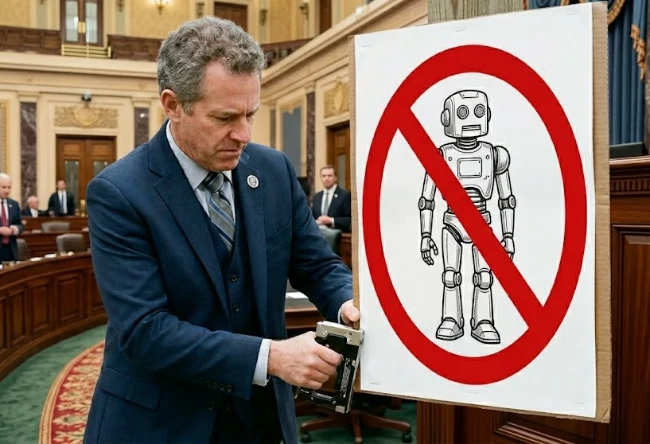
I rolled my eyes when I saw that arch conservative Arkansas Senator Tom Cotton was introducing a bill to ban the US government from purchasing humanoid robots made in China.
Per Cotton, speaking in support of his American Security Robotics Act, “Robots made by Communist China threaten Arkansans’ privacy and our national security. Our bill will ban the federal government from buying and operating these devices made in countries that wish us harm."

Unitree robotic dog
I assumed this was just another unnecessary piece of legislation created to drum up anti-Chinese sentiments under the guise of protecting national security.
Hearing about a companion bill in the US House by New York’s Republican firebrand Congresswoman Elise Stefanik only furthered my belief in what this legislation really is.
These are, after all, the people who spent the pandemic referring to COVID as "the China Virus," which directly contributed to a spike in anti-AAPI hate crimes.
But then I saw that Cotton’s bill has a co-sponsor: Democratic Senate Leader Chuck Schumer.
So I am now convinced that one of the following is true:
This is actually a legitimate bill that will further the interests of America’s national security. Or this is bipartisan bigotry.
Let’s find out.
What the Bill Actually Does

The bill's co-sponsors Sen. Chuck Schumer (L) and Sen. Tom Cotton (R)
The American Security Robotics Act would, in plain terms, make it illegal for any federal agency to buy or use ground-based robots — including humanoid robots, robot dogs, and autonomous patrol machines — if those robots were made by a company connected to a foreign adversary.
It also goes further than just direct purchases. Federal agencies couldn't use these robots through a contractor either, and couldn't funnel grant money toward using them. If the bill passes, agencies would have one year to phase out any Chinese-made robots they're already running.
The bill does carve out an exception for the military and law enforcement, allowing them to purchase Chinese robots for research purposes — meaning they can take one apart and study it, they just can't deploy it on the job.
To be clear: this doesn't touch private citizens or companies. Your Amazon purchase of a robot dog remains entirely legal. The line being drawn here is specifically around what the government itself can buy and operate.
Crucially, while China is the primary target of this bill, it technically applies to any country the U.S. has officially designated as an adversary. This is an important distinction which leads me to believe that the language being used to support it is more problematic than the bill itself.
National Security
So is there an actual security concern here that requires a legislative solution?
From what I can tell, the answer is yes.
The main target of the bill is a Chinese company called Unitree Robotics, which makes some of the most popular and affordable robot dogs and humanoid robots on the market. They’re sold on Amazon and used in American university labs.
Alarm bells in the US started really going off when China's state broadcaster aired footage of these robots carrying assault rifles in joint military exercises between the Chinese and Cambodian armed forces — two years after Unitree had signed an open letter pledging not to weaponize its machines.
And while the visual nature of the footage was enough to instill fear in all of us, the concerns run much deeper.
Researchers have discovered that Unitree had pre-installed a hidden backdoor on its popular Go1 robot dogs that allowed anyone to surveil customers around the world. Anyone who found the right web address could see where these robot dogs were located — and if the robot was connected to the internet, they could pull up a live camera feed without even needing a password.
It gets worse.
In September 2025, it was discovered that the Unitree G1 Humanoid robot collects and reports multi-modal sensor data without notifying the operator. Researchers also published a vulnerability that allows an attacker in close proximity to gain full control of Unitree's robots over Bluetooth — and infected robots would in turn be able to compromise other nearby robots.
Finally, Scale AI estimated that China now controls approximately 90 percent of the commercially available robotics AI data market.
Robots learn from data — the more they operate in real environments, the smarter they get. If Chinese companies are quietly collecting that data from robots deployed across America, they are building an intelligence picture of American spaces, routines, and infrastructure that has real strategic value.
This all sounds…not great.
The Part That Should Make Us Uncomfortable
And yet...
The way this bill is being sold — the language, the framing, the choice of co-sponsors like Stefanik — is doing something beyond simply restricting government procurement. It's contributing to a political and cultural atmosphere in which Chinese and Chinese American people are treated as presumptively suspect.
The bill's sponsors are careful to say they are targeting the Chinese Communist Party, not Chinese people. But the political oxygen that this kind of legislation breathes — the "Communist China" rhetoric, the "standard playbook" framing, the steady drumbeat of Chinese technology as inherently threatening — does not stay neatly contained to federal procurement policy. It leaches out. It shapes how Chinese American researchers are treated on university campuses. It shapes how federal investigators approach a Chinese postdoctoral student's work. It shapes, in ways both large and small, how Asian Americans are perceived in this country.
Chinese critics raised a point worth considering: some industry players are invoking so-called security concerns as a means to attack competitors amid declining competitiveness, rather than enhancing their own capabilities to compete in the market.
Boston Dynamics, which is owned by Hyundai, has its own remotely controllable robots. The question of what data American-made robots collect and where it goes is not one Congress has shown much interest in asking.
TikTok 2.0?
There’s also a credibility problem that Congress has largely brought on itself.
The US government's handling of the TikTok ban was, to put it charitably, a mess: years of congressional hearings featuring senators who demonstrably did not understand how the internet works, followed by a ban that was signed into law only for both parties —including the incoming President who had tried to ban TikTok during his first term — to balk at actually enforcing it.
The episode did not inspire confidence that Washington's national security concerns about Chinese technology are being evaluated on the merits rather than on the political convenience of the moment.
When the government that produced that spectacle tells you that a robot dog is a national security threat, you are forgiven for asking whether they actually know something or whether they are simply looking for the next Chinese boogeyman.
The Verdict
So — is this a legitimate national security bill or just more anti-China theater?
It's both, and that's the honest answer.
The backdoors are real. The military-civil fusion pipeline is real. The data collection risks are real. A government ban on deploying these systems in federal operations is a reasonable, defensible policy response. On the narrow merits, the bill holds up.
Putting aside the rhetoric, there is at least one downside to this legislation:
Chinese robotics companies have built an enormous market lead partly by making excellent, affordable products. Banning them from federal use does not make American alternatives better or cheaper. It just makes American research more expensive. In the medium term, that could harm U.S. competitiveness in the very field the bill claims to protect.
And ultimately, Cotton, Schumer, and Stefanik are also using it as a vehicle for something broader: a political narrative in which China is the villain of every technology story, and in which toughness on Chinese tech substitutes for actually investing in American capability.
That narrative has real casualties — not robots, but people. Chinese American researchers who find themselves on the wrong side of someone's political moment. Communities that absorb the ambient hostility of legislation that talks about Communist China but whose rhetoric lands on everyone who looks like they might be from there.
You can support the narrow policy and still be troubled by the broader climate it both reflects and feeds.
Schumer co-sponsoring the bill doesn't resolve that tension. It just confirms that when it comes to China, the bipartisan instinct in Washington is to reach for the loudest possible language and call it leadership.
Bigotry being bipartisan and the bill being legitimate are not, it turns out, mutually exclusive.
© 2026 by Asian Media Group Inc.
Crucially, while China is the primary target of this bill, it technically applies to any country the U.S. has officially designated as an adversary. This is an important distinction which leads me to believe that the language being used to support it is more problematic than the bill itself.
Recent Articles
- 'I Love the Inflation,' Trump Says of Prices Rising Amid Iran War
- China's JUNO Neutrino Detector Advances Precision in Mass-Ordering Quest
- Only 11% of Europeans View US as Ally, Survey Shows
- BYD Will Be World's Biggest Automaker in 5 Years Says Its Chairman
- US Consumer Prices Increase at Fastest Pace in 3 Years
- Traders Keep Bets on Fed Rate Hike by October
- Drone Risks Keep World Cup Security Planners Frantic
- Bill Gates to Face Congress in Probe of Epstein Case Handling
- Musk’s xAI, SpaceX Hit with Class Action over Data Center ‘Nuisance’
- Downed Chopper Prompts US to Launch New Strikes on Iran