

Asian Ships Expected to Cross Hormuz Before Western
By Reuters | 22 Apr, 2026
Asian ship owners have a higher risk tolerance and can pay tolls unlike sanctions-complying Western firms, said shipping executives at the FT Commodities Global Summit Wednesday.
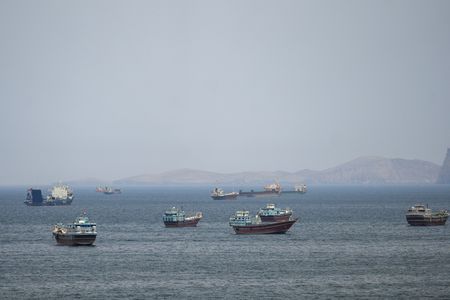
Ships and boats in the Strait of Hormuz, Musandam, Oman, April 22, 2026. REUTERS/Stringer
Asian ship owners might begin to sail through the Strait of Hormuz soon amid a fragile U.S.-Iran ceasefire as they have a higher risk tolerance and can manage paying tolls unlike sanctions-complying Western firms, shipping executives said at the FT Commodities Global Summit on Wednesday.
Hundreds of tankers and other ships have been stuck inside the Middle East Gulf unable to cross the strait since the end of February, hitting global oil and liquefied gas supply in the world's largest ever energy supply disruption.
Some tankers and cargo ships managed to escape the Gulf last Saturday, but Iran quickly pulled the plug on the move by firing shots and telling other vessels to return to the Gulf. At least three container ships were hit by gunfire in the strait on Wednesday.
"For companies that are happy not to comply with OFAC sanctions, the safety part is still there. But, if that has been resolved by government to government communication, can the Indian navy send a convoy through, can a Chinese convoy go through? Yeah, probably so," Mercuria's global head of freight Larry Johnson said. OFAC is the U.S. Department of the Treasury’s Office of Foreign Assets Control.
The ships which have transited have tended to be government-owned vessels benefitting from government-to-government communications with Iran or naval support, which merchant traders do not have, he added.
"Certain parts of the world will be able to pass through and the odds are that in the next few weeks you're going to see more of that, and we won't be able to," said Peter Weernink, CEO of SwissMarine, listing Indian, Iraqi and Chinese vessels.
TOLLS
Tehran has also sought to tighten its grip over the strait by charging tolls in conjunction with Iran's Islamic Revolutionary Guard Corps, a sanctioned entity.
Increased costs and lingering safety concerns could continue to impact Hormuz traffic, said Andrew Jamieson, co-head of Gunvor shipping arm Clearlake, with the Advanced War Risk Premium set to rise in the short-term, and as crews may not be willing to take the risk, or seek higher payment to do so.
"If your crew doesn't want to go, they don't need to go if they feel unsafe," he said.
The global shipping fleet could react quickly to a reopening of Hormuz, Clarkson's Chief Commercial Officer Roger Horton said, even though many vessels left the Middle East in the wake of the crisis to take on business in the Atlantic Basin given high freight rates.
(Reporting by Dmitry Zhdannikov and Robert Harvey in Lausanne; Editing by Kim Coghill)
© 2026 by Asian Media Group Inc.
Recent Articles
- Qantas Bets on Sleep and Light Science to Sell 20-Hour Flights
- High-Wire Diplomacy Delivered US-Iran Deal but the Tricky Part's to Come
- Pentagon Asks for $80 Billion for Iran War Bills
- Ukrainian Drone Makers Zero in on Demand Created by Taiwan Tensions
- Bedtime Story: Tenali Raman and the Thieves
- Fujimori Edges Toward Peruvian Presidency as Sanchez Calls for Protests
- Republicans Blast Trump's Iran Agreement as Details Emerge
- SK Hynix Veteran Seok-Hee Lee Tapped to Lead Intel Foundry Packaging Push
- Mamdani Plans to Air World Cup for Free Throughout New York
- Myra Molloy Parlays Historic Broadway Success into a Leading Film Role