

The Quiet Power Behind Taiwan's Unmatched Industrial Efficiency
By H Y Nahm | 12 May, 2026
An educational system that prioritizes industrial competence over prestige signaling has built Taiwan into an invulnerable fortress of hi-tech manufacturing prowess.
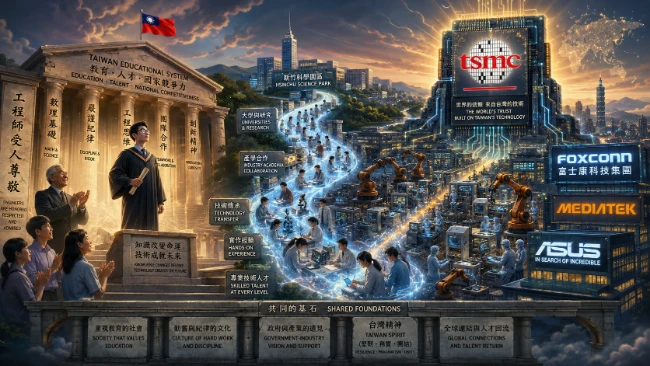
(Image by ChatGPT)
How does an island nation of 23 million surpass the per capita GDP of the mighty United States? That's right, in 2025 on a purchasing-power-parity basis Taiwan had a per-capita GDP of $90,233, above the $89,991 for the US and far above Germany's $70,004 or Japan's roughly $50,000, according to the IMF.
So what's the secret to besting not only the resource-rich US but as well all other industrial powers?
Taiwan’s educational system. It's the unglamorous but decisive factor behind Taiwan Semiconductor Manufacturing Company's unshakable global chipmaking dominance. It's also why Taiwan consistently punches way above its weight in other precision industries like electronics, optics, machine tools, and advanced manufacturing.
Taiwan is the only nation that built an education pipeline targeting industrial competence over prestige signaling. Its product has been an unusually deep layer of technically disciplined workers, engineers, technicians, suppliers, and manufacturing managers. TSMC’s success rests on that human infrastructure as much as on EUV lithography or capital spending.
Engineering Competence Wins Social Prestige
In Taiwan, top students have long been steered toward electrical engineering, materials science, chemistry, physics, and manufacturing-oriented disciplines. That sounds simple, but culturally it’s huge.
In many wealthy societies, elite students increasingly drift toward finance, consulting, law, media, or software platforms. Taiwan retained a much older industrial-development mentality in which building hard technology was considered a national mission.
At schools like National Taiwan University, National Tsing Hua University, and National Yang Ming Chiao Tung University, semiconductor engineering became one of the highest-status tracks for mathematically talented students.
(Image by ChatGPT)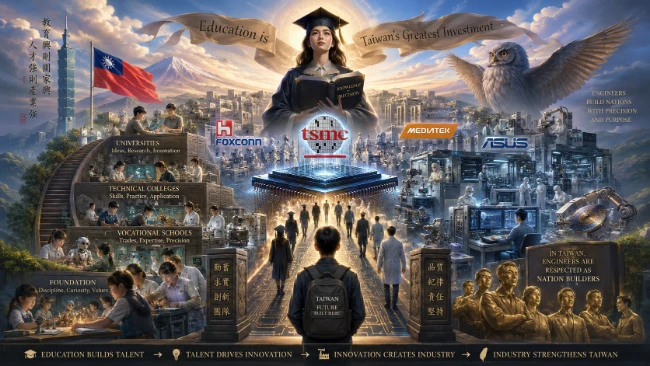
That created a steady stream not just of geniuses, but of something arguably more important to semiconductor manufacturing: extremely competent upper-middle-tier engineers.
Semiconductor fabrication is not mainly about isolated brilliance. It’s about maintaining near-perfect execution across tens of thousands of process steps. That requires armies of highly trained people who are methodical, quantitative, patient, and process-oriented.
Taiwan’s education system became extraordinarily good at producing exactly those people.
Exam Rigor and Technical Fundamentals
Taiwan inherited a highly exam-oriented East Asian educational culture. Western observers often criticize these systems for rote learning, and sometimes fairly. But there are advantages when the target industry is precision manufacturing.
Chipmaking rewards:
* mathematical fluency
* process discipline
* tolerance for repetition
* error minimization
* procedural rigor
* delayed gratification
* technical stamina
Taiwan’s schools historically reinforced many of these habits from an early age.
A fab environment like TSMC’s is almost a civilizational expression of this mindset. Tiny process variations measured in nanometers can destroy yields. Workers and engineers must internalize exacting standards until they become instinctive.
That mentality doesn’t emerge overnight at age 25. It reflects educational conditioning accumulated over years.
Density of Engineering Talent
The true advantage is not just elite talent at the top. It’s density.
TSMC requires:
* process engineers
* equipment engineers
* chemical engineers
* materials scientists
* industrial engineers
* optics specialists
* packaging engineers
* yield analysts
* reliability engineers
* precision machinists
* metrology experts
* automation specialists
And not just at TSMC itself.
A semiconductor ecosystem depends on thousands of supplier firms and subcontractors. Taiwan developed an educational ecosystem capable of continuously replenishing that broader industrial web.
That’s one reason countries trying to replicate TSMC often underestimate the challenge. They focus on building fabs while ignoring the decades-long accumulation of technical human capital behind them.
You can buy ASML EUV machines. You cannot instantly buy a society with 40 years of semiconductor manufacturing culture.
Tight Linkage Between Universities and Industry
Taiwan’s system evolved unusually close relationships between universities, government institutes, and industry.
A central player was Industrial Technology Research Institute (ITRI), which helped incubate Taiwan’s semiconductor sector in the 1970s and 1980s. Engineers trained abroad — especially in the United States — returned home and transferred knowledge into Taiwan’s universities and firms.
This created a feedback loop:
1. Universities trained engineers.
2. Industry absorbed them.
3. Industry identified needed skills.
4. Universities adapted curricula.
5. Government research institutes accelerated technology transfer.
The result was not merely education in the abstract, but education synchronized with industrial strategy.
Hsinchu: The World's Most Important Educational-Industrial Cluster
The region around Hsinchu Science Park is effectively Taiwan’s version of a manufacturing-oriented Silicon Valley.
What makes it extraordinary is the proximity of:
* top engineering universities
* semiconductor fabs
* suppliers
* research institutes
* precision equipment makers
* packaging firms
* chip designers
Students often intern directly into the ecosystem. Professors collaborate with industry. Engineers move fluidly among firms. Knowledge diffuses quickly.
This geographic concentration compounds educational advantages enormously.
Importance of Vocational and Technical Education
One overlooked aspect is that TSMC and similar firms do not run solely on PhDs.
Taiwan maintained strong technical institutes and vocational pathways capable of producing:
* tool technicians
* clean-room specialists
* manufacturing operators
* maintenance personnel
* automation technicians
High-precision industries collapse if only the top layer is competent. The middle technical layer is crucial.
Germany and Japan historically excelled at this too. Taiwan adapted similar strengths into electronics manufacturing.
A Culture that Supports Manufacturing Intensity
TSMC became famous for brutal execution standards:
* long hours
* around-the-clock fab operations
* constant process optimization
* obsessive yield management
Educational culture reinforced this by normalizing intense academic competition and endurance.
That’s controversial and has downsides. Taiwan’s education system is often criticized for stress, conformity, and excessive pressure. But from the standpoint of semiconductor manufacturing, some of those same traits translated into industrial reliability.
This is one reason reproducing Taiwan’s semiconductor ecosystem in countries with different labor expectations may prove difficult.
Elite Overseas Education
Taiwan’s system alone wasn’t enough. A crucial ingredient was the overseas Taiwanese engineering diaspora.
Many leading figures trained in the United States at places like:
* Massachusetts Institute of Technology
* Stanford University
* University of California, Berkeley
Including Morris Chang himself, who worked for Texas Instruments before founding TSMC.
Taiwan’s advantage came partly from combining:
* American frontier research culture
with
* East Asian manufacturing discipline.
That fusion turned out to be exceptionally powerful.
Beyond Semiconductors
The same educational characteristics helped Taiwan excel in:
* precision electronics
* advanced connectors
* PC hardware
* optics
* machine tools
* servers
* networking equipment
* advanced packaging
Firms like:
* Foxconn
* MediaTek
* ASUS
* Acer
all emerged from the same broader educational-industrial ecosystem.Why Other Nations Despair
Many governments now want “their own TSMC.”
But fabs are the visible part of the iceberg.
Underneath lies:
* decades of STEM emphasis
* societal respect for engineering
* rigorous technical education
* industrial clustering
* supplier ecosystems
* technician training
* manufacturing culture
* diaspora knowledge transfer
* state coordination
* institutional continuity
Taiwan’s educational system is therefore not merely supportive of TSMC. It is one of the foundational conditions that made TSMC possible.
Without that pipeline of disciplined technical talent at every layer — from elite PhDs to equipment technicians — TSMC would likely have remained just another contract manufacturer rather than becoming the central pillar of the global semiconductor industry.
Recent Articles
- Google, SpaceX Mull Partnering on Data Centers in Orbit
- Altman Mocks Musk's 'Stealing a Charity' Allegation
- Google-Spinoff Isomorphic Raises $2.1 Billion to Scale AI-driven Drug Discovery
- The Quiet Power Behind Taiwan's Unmatched Industrial Efficiency
- Zendaya Helps Sportswear Maker On's Asia Growth Soar
- Mayor Eileen Wang Pleads Guilty to Acting as Chinese Propaganda Agent
- EBay Rejects GameStop's $56 Billion Bid as 'Neither Credible nor Attractive'
- Pyongyang Streets Jammed with Chinese Cars Amid New Auto Boom
- CEOs Accompanying Trump Seek Key Business Goals in Beijing Summit
- JD.com Reports Beats with 5% Q1 Revenues