

The Laughable Naiveté of 'I Will Accept Only Unconditional Surrender'
By Tom Kagy | 06 Mar, 2026
Trump is far more impressed with aerial firepower than is the Iranian regime which will outlast US ordinance supplies.
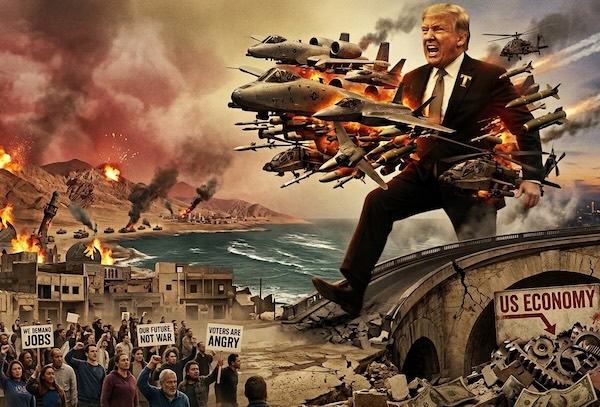
(Image by Gemini)
Sadly we have a self-styled Strongman Negotiator who believes that if you lean into the microphone, look the camera in the eye, and demand "unconditional surrender," an enemy will fold. It’s the kind of imagery that can only appeal to a naive mind with the memory of a dory fish.
When Donald Trump talks about Iran, he relishes the aesthetics of power. He loves the flyovers, the carrier strike groups, and the sheer, unadulterated "oomph" of a Tomahawk missile strike. To a real estate guy who spent a lifetime thinking in terms of leverage and total victory, the US military looks like the ultimate closer. The problem is, Trump is far more impressed with American aerial firepower than the Iranian regime.
And that gap in perception—that fundamental misunderstanding of what keeps a revolutionary government in power—is exactly how you stumble into a bad end that will soon strain the US treasury and outrage the American public.
Myth of the "Shock and Awe" Collapse
The "unconditional surrender" mentality ignores forty years of history. The Iranian regime didn't just sprout up yesterday; it was forged in the furnace of the Iran-Iraq War—a conflict that saw their cities leveled and their youth sent into human-wave attacks. They have a high pain threshold. More importantly, they have spent the last few decades "hardening" their position. They aren't sitting in glass houses waiting for a stone; they are dug into the mountains, buried under layers of concrete, and distributed across a proxy network that spans the entire Middle East.
When you demand "unconditional surrender" from a regime like that, you aren’t negotiating but shouting at a wall. And when the wall doesn't move, Trump's only options will be to walk away looking weak or to continue flailing with whatever armaments remain available until they're taken away from him by more balanced minds.
The Math of Ordnance vs. Endurance
Self-styled Strongman types don't like to accept the material reality that we are actually quite bad at the logistics of a long, conventional slog.
American firepower is surgical, high-tech, and incredibly expensive. A single interceptor missile or a precision-guided bomb can cost more than a small-town hospital. We have "exquisite" inventories, but we do not have infinite ones. In a scenario where the US tries to bomb Iran into submission, we would be burning through our stockpile of high-end munitions at a rate that would make a CBO accountant weep.
Meanwhile, Iran doesn't need to win a dogfight or sink a carrier to win. They just need to outlast our patience and our magazine depth. They have mastered the art of asymmetric endurance. They use cheap drones, old-school mines, and localized militias to create a chaotic, expensive environment for the US.
Trump sees a B-2 Spirit and thinks, "Game Over." The Iranian leadership sees a B-2 Spirit and thinks, "That sortie cost them $250,000 an hour; let's see if they can do it for six months while oil prices double and the global economy tanks."
The Art of the Deal Meets the Art of the Long Game
The naiveté of Trump's "unconditional" stance is that it treats geopolitics like a one-time transaction in which he has all the bargaining power.
But Iran isn't a distressed asset but a nation-state with a survival instinct and a clock that moves much slower than an American election cycle. When we demand total capitulation, we remove any incentive for the "moderates" or the pragmatists within the Iranian system to speak up. If the only options are "total surrender" or "fight to the death," people usually choose the latter.
By setting the bar at "unconditional," you back yourself into a corner where anything less than the total dismantling of the Iranian state looks like a loss. And since the US public has zero appetite for a full-scale ground invasion and occupation of a country three times the size of Iraq, the "unconditional" demand is a check we can't actually cash.
And this reality has already played on American news broadcasts multiple times in the recent past.
1. The Taliban in Afghanistan (2001): In December 2001, just two months after the U.S. invasion, the Taliban were broken. Their leadership, including Mullah Omar, reportedly sent a delegation to a U.S. Special Forces camp near Kandahar offering to disband, disarm, and retire from politics in exchange for their safety.
It was a win. But the Bush administration, riding high on "Shock and Awe" and the rhetoric of total eradication, flatly rejected the deal on the logic that we don't negotiate with terrorists; we accept only their total destruction.
The result? Deprived of a way to surrender, the Taliban went into the mountains, reorganized, and spent the next twenty years bleeding the U.S. treasury and military. Two decades later, the U.S. ended up negotiating a deal with that same group from a position of much lower leverage, eventually watching them retake the entire country.
2. Iraq (2003): Breaking the State to Save It: In Iraq the US didn't just demand the surrender of the military; it demanded the "unconditional" dissolution of the entire Ba’athist power structure. This was the policy of de-Ba'athification.
By demanding that every member of the ruling party and the entire Iraqi army disappear into the night with no pension, no job, and no path back into society, the US created a massive, armed, and highly trained insurgency overnight. We "won" the conventional war in weeks, but by refusing to leave any part of the existing structure intact for the sake of "purity," we bought ourselves a decade of sectarian civil war and gave Iran a golden ticket to expand its influence in the region.
3. Libya (2011): The "Regime Change" Bait-and-Switch: The Libyan intervention began as a humanitarian mission to "protect civilians," but quickly shifted into a demand for Muammar Qaddafi’s total removal. There was no middle ground, no "golden bridge" for the dictator to retreat across, and no negotiated transition.
The result? Qaddafi fought to the bitter end, the state collapsed into a vacuum of warring militias, and the country became a warehouse for high-end weaponry that flooded the black market across Africa. The demand for total victory created a total catastrophe that still hasn't been fully resolved fifteen years later.
The Bad End
So, what does the "bad end" look like in Iran? It’s not a glorious victory parade but a forever-skirmish.
It’s a world where the US spends billions on a bombing campaign that degrades some facilities but fails to topple the regime. Where the Persian Gulf becomes a no-go zone for shipping, sending the global economy into a tailspin. Where Iran, pushed to the brink and seeing no diplomatic off-ramp, finally decides that the only way to prevent "unconditional surrender" is to achieve "unconditional deterrence"—also known as a nuclear weapon.
The irony is that the "tough" stance actually makes the world more dangerous for the US. By refusing to engage in the messy, unsatisfying, incremental work of traditional diplomacy, we leave ourselves with only two gears: "Ignored Sanctions" and "Total War."
Reality Check
The Iranian regime is repressive, adversarial, and complicated but not stupid. They know that not even Trump’s MAGA base will support another Middle Eastern quagmire. They know that American "firepower" is terrifying but all too finite.
The belief that we can simply shout our way to a total Iranian collapse is the ultimate laughable naiveté that makes Trump seem like a clown out of his depth. It’s an approach based on the aesthetics of strength rather than the mechanics of real power. If we keep insisting on a movie-ending "unconditional surrender," we’re going to find out the hard way that the credits don't roll just because we want them to.
Recent Articles
- Your Answers to These 7 Questions Will Reveal Whether You're Sane or a Closet Lunatic
- US Oil Companies Profit from Strait of Hormuz Closure Says Russian Oil CEO
- Trump Faces New Republican Resistance in Congress as Midterms Approach
- SpaceX IPO Already Two Times Oversubscribed
- SpaceX Signs Google As AI Compute Client After Landing Anthropic
- $1 Trillion in Stock Market Valuation Erased by AI Chip Selloff
- Anthropic Urges Industry Pause As AI Nears Recursive Self-Development
- Trump's South Lawn UFC Birthday Bash to Mix Politics with Punches
- Trump Policies Targeting 39 Nationalities of Immigrants Invalidated
- One Man Holds Back the World's Progress toward Green Energy Sufficiency and Prosperity