

Quantum Computing Is the Next Great Disruptor
By James Moreau | 30 Dec, 2025
From simulating complex cancer-fighting molecules to threatening global encryption, the quantum era is arriving faster than the AI revolution.
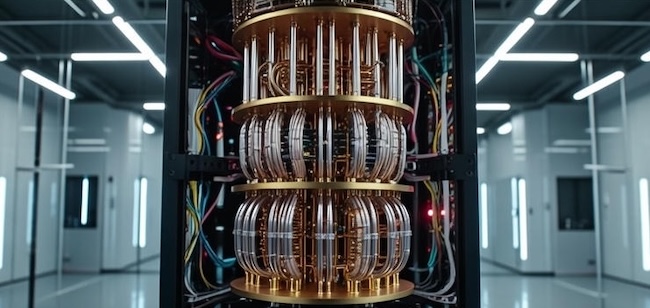
Quantum computing is poised to be the next great disrupter after blockchain and AI.
Google CEO Sundar Pichai noted, “quantum is entering the same acceleration curve AI hit five years ago.”
Pichai’s observation suggests that quantum computing has passed the “lab experiment” phase and is only a handful of years from becoming commercially viable in the way that AI went from academic prototypes to large language models and advanced image generation.
In late 2024 Google’s Willow chip achieved a major milestone by demonstrating exponential error reduction, proving that quantum systems can become more reliable as they scale. This hardware breakthrough enabled the “Quantum Echoes” technique, which solved a complex physics simulation 13,000 times faster than the world’s top supercomputer and provided data essential to the next generation of deep learning models.
A quantum computer with 300 physical qubits could theoretically perform more simultaneous calculations than there are atoms in the observable universe.
Companies are rapidly scaling qubit counts with Fujitsu and RIKEN planning a 1,000-qubit machine in 2026 and IBM setting its sights on 100,000 qubits by 2033.
Fueled by massive private sector investment, this hardware-driven acceleration unlocks implementation across multiple fronts. These systems excel at solving complex logistics, high-speed financial modeling, and simulating complex molecules. The latter will enable revolutionary drug discovery and the development of targeted cancer treatments – a stated goal amongst the top quantum pioneers.
While these achievements are historic, the same power used to cure diseases could in the wrong hands dismantle the encryption protecting our banks, governments and personal privacy.
Quantum’s ability to crack digital codes poses a major threat to older cryptocurrency wallets and the privacy of stolen data – a looming catastrophe known as “Q-Day.” This risk is already causing some hedge funds to price in a future crypto bear market. However, optimists believe blockchains can simply “upgrade their locks” by switching to new advanced cryptographic frameworks that even quantum machines can’t solve. If such measures fail, the quantum threat will go beyond crypto to the security of digital life itself.
Recent Articles
- Oshkosh, Basic Fun, Others Begin Receiving Tariff Refunds
- Google, SpaceX Mull Partnering on Data Centers in Orbit
- Altman Mocks Musk's 'Stealing a Charity' Allegation
- Google-Spinoff Isomorphic Raises $2.1 Billion to Scale AI-driven Drug Discovery
- The Quiet Power Behind Taiwan's Unmatched Industrial Efficiency
- Zendaya Helps Sportswear Maker On's Asia Growth Soar
- Mayor Eileen Wang Pleads Guilty to Acting as Chinese Propaganda Agent
- EBay Rejects GameStop's $56 Billion Bid as 'Neither Credible nor Attractive'
- Pyongyang Streets Jammed with Chinese Cars Amid New Auto Boom
- CEOs Accompanying Trump Seek Key Business Goals in Beijing Summit
Asian American Success Stories
- Asian American Polls
- Asian American Parenting
- Personalities
- Identity
- The 130 Most Inspiring Asian Americans of All Time
- 12 Most Brilliant Asian Americans
- Greatest Asian American War Heroes
- Asian American Digital Pioneers
- New Asian American Imagemakers
- Asian American Innovators
- The 20 Most Inspiring Asian Sports Stars
- 5 Most Daring Asian Americans
- Surprising Superstars
- TV’s Hottest Asians
- 100 Greatest Asian American Entrepreneurs