

Why the Silicon Chip Was Most Likely Inspired by UFO Debris
By Goldsea Staff | 04 Feb, 2026
Within months of the July 1947 Roswell UFO crash the transistor emerged and evolved quickly into microchips, supporting insider accounts of alien inspiration for human entry into the silicon age.
The leap from the clunky, heat-spewing vacuum tube to the elegant, microscopic architecture of the integrated circuit wasn't just a step forward; it was a quantum jump that defies the traditional pace of industrial evolution.
The history of human innovation is generally a steady, upward climb—a linear progression of trial, error, and incremental improvement. We transitioned from steam to internal combustion, and from vacuum tubes to transistors, through the sheer grit of earthly genius.
But when one examines the specific timeline of the mid-20th century, a jarring anomaly appears.
In the summer of 1947, a purported weather balloon crashed in the high desert of Roswell, New Mexico. W ithin months, the trajectory of human computing changed forever.
Skeptics dismiss the Roswell incident as Cold War hysteria, but a growing contingent of researchers and former military officials point to the silicon microprocessor as the "smoking gun" of extraterrestrial inspiration.
The 1947 Anomaly: A Timeline Disrupted
To understand why the microprocessor feels alien, one must look at the state of technology in the early 1940s. The world’s first general-purpose electronic computer, ENIAC, was a behemoth. Completed in 1945, it weighed 30 tons, occupied 1,800 square feet, and utilized nearly 18,000 vacuum tubes. These tubes were essentially lightbulbs—fragile, inefficient, and prone to burning out every few hours.
The scientific community knew that solid-state physics was the future, but they were stuck. The theoretical groundwork for semiconductors existed, yet practical application remained elusive. Then came July 1947.
In December 1947—barely six months after the Roswell crash—William Shockley, John Bardeen, and Walter Brattain at Bell Labs demonstrated the first working point-contact transistor. While Bell Labs had been researching semiconductors for years, the sudden breakthrough in late 1947 possessed an almost "overnight" quality. The transistor did exactly what the vacuum tube did, but it used solid materials, required a fraction of the power, and could be shrunk to a microscopic scale.
Colonel Philip J. Corso: The Messenger
The most compelling, albeit controversial, evidence for this theory comes from Colonel Philip J. Corso. A highly decorated officer who served on Eisenhower's National Security Council and later headed the US Army's Foreign Technology desk at the Pentagon, Corso made a deathbed confession in his 1997 book, The Day After Roswell.
Corso claimed that his job in the early 1960s was to take "salvaged" debris from the 1947 crash and "seed" it into the American industrial complex. According to Corso, the debris wasn't just scrap metal; it included fiber optics, night vision equipment, and, most importantly, small, wafer-like "circuit boards" that functioned without wires.
Corso described these items as "EBE" (Extraterrestrial Biological Entity) artifacts. He claimed he funneled these items to major research hubs like Bell Labs, Motorola, and Texas Instruments under the guise of "foreign technology" captured from the Soviets. The goal was simple: reverse-engineer the artifacts to ensure the United States won the technological arms race.
The Silicon Connection: Why Not Copper or Gold?
If you were to design a brain for a spacecraft capable of interstellar travel, you wouldn't use wires. Wires add weight, generate heat, and are prone to breakage. You would use a system where the "wiring" is etched directly into the substrate of the material itself.
The silicon microprocessor is essentially a city of logic carved into a stone. It uses the semiconducting properties of silicon to create gates—switches that turn on and off. The leap from a mechanical switch to a "junction" of silicon atoms is arguably the most significant transition in human history.
Critics argue that the development of the integrated circuit (the precursor to the microprocessor) by Jack Kilby and Robert Noyce in the late 1950s was a natural evolution. But consider the jump: in 1947, we were struggling with glass tubes; by 1971, Intel released the 4004, a single chip with 2,300 transistors. The sheer density of information and the mastery over the atomic structure of silicon suggest a blueprint that may have been "inherited" rather than invented.
The Cold Logic of Reverse Engineering
Reverse engineering is a standard military practice. If an enemy plane crashes, you take it apart to see how it flies. If a craft from a non-human intelligence crashed, the primary goal wouldn't be to fly it—we wouldn't have the fuel or the physics for that yet. The goal would be to understand its "brain."
If the Roswell debris contained a "computer" that functioned on a molecular level, Bell Labs scientists wouldn't have been able to copy it immediately. Instead, they would have been inspired by the concept of the solid-state junction. The transistor wasn't a direct copy of an alien chip; it was a human attempt to replicate a function seen in an alien artifact using the materials and manufacturing techniques available in the 1940s.
This explains why the technology didn't appear all at once. It took decades to shrink the transistor and perfect the etching process (photolithography). We were learning to walk by looking at a creature that could already fly.
The Philosophical Gap
There is a distinct otherness to the microprocessor compared to every other human invention. A wheel is an extension of a rolling log. A steam engine is a high-pressure tea kettle. But a microprocessor? It is a piece of sand that "thinks." It operates on the level of quantum tunneling and electron flow.
When we look at the rapid-fire succession of the "Silicon Age"—from the transistor in 1947 to the integrated circuit in 1958, to the microprocessor in 1971—the timeline is compressed in a way that mirrors no other technological era. We spent thousands of years perfecting the sail and the sword, but only 25 years going from a vacuum tube to a computer on a chip.
Silence of the Military-Industrial Complex
If the microprocessor was indeed seeded from alien tech, why the secrecy? The answer lies in the Cold War. In 1947, the U.S. was terrified of the Soviet Union. Admitting that we had found alien technology would have created a global panic and invited every Soviet spy to target our labs.
By hiding the origin of the silicon wafer, the US government allowed private corporations to take the credit (and the patents), ensuring the technology integrated into the economy as a natural American achievement. This created a dual-benefit: it bolstered the US economy and gave the military a massive edge in guidance systems, encryption, and radar—all powered by the new silicon chips.
The Stone That Changed Everything
We often imagine alien technology as giant lasers or anti-gravity drives. But perhaps the most profound gift from the stars was something far smaller and more subtle. The silicon microprocessor allowed us to digitize our world, explore the moon, and connect the entire planet through the internet.
Whether the Roswell crash happened exactly as the legends say is almost secondary to the undeniable fact that the world before 1947 and the world after 1947 are two different civilizations. We entered the Silicon Age with a suddenness that suggests we had help. If Philip Corso was right, then every time you look at your smartphone or power up your laptop, you aren't just using human ingenuity—you are holding a refined copy of a product produced by a civilization capable of traveling interstellar distances.
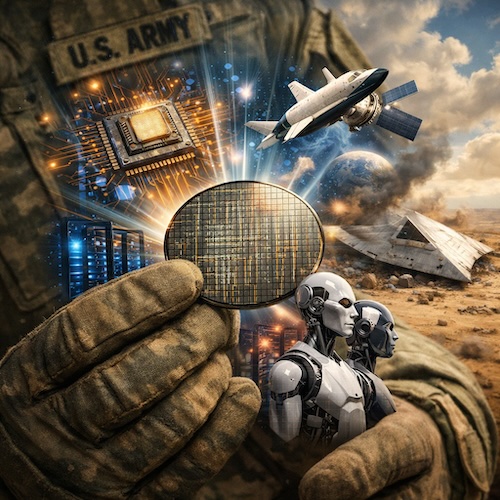
(Image by ChatGPT)
Articles
- Why the Silicon Chip Was Most Likely Inspired by UFO Debris
- Trump Attacked Pillars of Democracy Says Human Rights Watch
- Dem-Favoring California Redistricting Map Allowed by SCOTUS
- How SFFA Changed Asian American Enrollment in Leading Universities
- The Simplistic Beliefs Taking the US Down the Road to Poverty, Isolation and Global Scorn
Asian American Success Stories
- The 130 Most Inspiring Asian Americans of All Time
- 12 Most Brilliant Asian Americans
- Greatest Asian American War Heroes
- Asian American Digital Pioneers
- New Asian American Imagemakers
- Asian American Innovators
- The 20 Most Inspiring Asian Sports Stars
- 5 Most Daring Asian Americans
- Surprising Superstars
- TV’s Hottest Asians
- 100 Greatest Asian American Entrepreneurs
- Asian American Wonder Women
- Greatest Asian American Rags-to-Riches Stories
- Notable Asian American Professionals