

Americans Brace for Pricey Summer Travel with Fuel Costs Near Multi-Year Highs
By Reuters | 22 May, 2026
American travelers are still taking to the road as the summer driving season kicks off this weekend but some are planning shorter trips to cut costs as average US gas costs around $4.50.
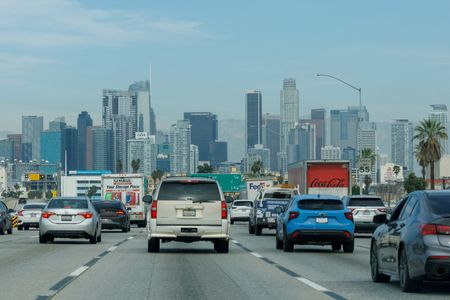
FILE PHOTO: Traffic makes its way into downtown Los Angeles, California, U.S., February 24, 2026. REUTERS/Mike Blake/File Photo
Soaring gasoline prices and a looming fuel crunch from the Iran war are not stopping American travelers from taking to the road as the U.S. summer driving season kicks off this weekend, although some are planning shorter trips to cut down on costs.
U.S. average retail gasoline prices have been hovering above $4.50 since early May, about 45% higher than levels before the United States and Israel launched attacks on Iran in late February. Prices for crude oil used to make gasoline have also surged, along with many goods, as the conflict has led to the effective closure of the Strait of Hormuz, a key trade conduit through which roughly 20% of the world's oil consumption flows.
The $4 per gallon mark, breached more than a month ago in most parts of the U.S., is widely seen as a major psychological barrier for consumers. That milestone was last reached in August 2022 after Russia invaded Ukraine.
President Donald Trump is facing mounting political pressure ahead of November's midterm elections as households grapple with rising costs. The Iran war has pushed consumer inflation to its highest level in almost three years, with increasing energy prices acting as a main driver.
Several states are already suspending gas taxes to ease the pain at the pump, and similar discussions about reducing the 18.4-cent federal gasoline tax are underway.
HIGHER COSTS, SHORTER TRIPS
The upcoming Memorial Day holiday, a three-day weekend when many Americans take to the road, will kick off the summer travel season. A record 39.1 million people are expected to travel by car despite high gas prices, according to American Automobile Association (AAA) data. But that marks the smallest annual increase in more than a decade, spokesperson Tiffany Wright said, adding that higher fuel prices and persistent inflation may lead some travelers to take shorter trips, delay travel plans or stay closer to home.
Still, travelers are planning to drive fewer miles this summer, reflecting the financial strain that prolonged high energy prices have on American motorists.
Just 56% of Americans now plan to drive more than two hours this summer, compared with 69% last year, according to a GasBuddy survey. Cost is now the dominant travel consideration, with 67% saying gas prices are directly affecting their driving plans and 36% saying rising costs are causing them to take fewer road trips, the survey shows.
"This is the most volatile summer at the pump in years, and the Strait of Hormuz closure is at the center of it," said Patrick De Haan, head of petroleum analysis at GasBuddy, adding that Americans are going to pay billions more to get where they're going this summer, and even after the Strait reopens. It could take a year or more for prices to fully recover, he added.
Despite prices at the pump hovering at their highest level in four years, gasoline consumption remained relatively strong, analysts said, although they warned that a supply shortage could be on the horizon with the summer travel season approaching.
"Gasoline storage has fallen for fourteen weeks in a row, and every week during the war in Iran, and we are going to stagger into Memorial Day weekend, the start of the summer driving season, within striking distance of the 11-year low," said Bob Yawger, director of energy futures at Mizuho. "We are in big trouble as far as gasoline is concerned," he said.
U.S. gasoline inventories stood at 214.2 million barrels last week, down about 11.4 million barrels from the same period last year, the Energy Information Administration said on Wednesday. In late April, the stockpiles shrank 7% over a 28-day period, the biggest fall in more than five years.
On top of uncertainty that still looms over the Middle East, recent refinery outages, the approaching Atlantic hurricane season and tightening global inventories will add further upward pressure on fuel costs.
The national average price of gasoline is projected to be $1.48 more expensive on this Memorial Day compared to last year, a GasBuddy forecast on Wednesday showed, adding that if traffic through the Strait of Hormuz remained restricted for much of the summer, prices could cross the $5 per gallon mark.
"We have to be very concerned that globally we're drawing inventories at a terrific pace, and global demand is finding its way here not just for crude, but for refined products," said John Kilduff, partner at Again Capital.
(Reporting by Nicole Jao in New York; Additional reporting by Georgina McCartney in Houston; Editing by Stephen Coates and Edmund Klamann)
Recent Articles
- Thai Business Groups Urge Action on Worker Shortages as Costs Soar
- Northeast Asia Ships First Jet Fuel to Europe Since Iran War
- Pakistan's Lucky Motors Partners with China's GAC to Bet on EV Switch
- China to Expand Public Service Access for Migrant Workers
- Mexico, EU to Sign Stalled Trade Deal as They Aim to Diversify from US
- Americans Brace for Pricey Summer Travel with Fuel Costs Near Multi-Year Highs
- US-Sanctioned Industrial Giant Hengli Was Built from Scratch by Husband and Wife
- Greenlanders Demonstrate Against Trump as US Diplomats Open New Consulate
- North Carolina Sues Vietnam's VinFast over Delayed EV Project
- US and Iran Remain Opposed on Key Issues but Pay Lip Service to "Progress"