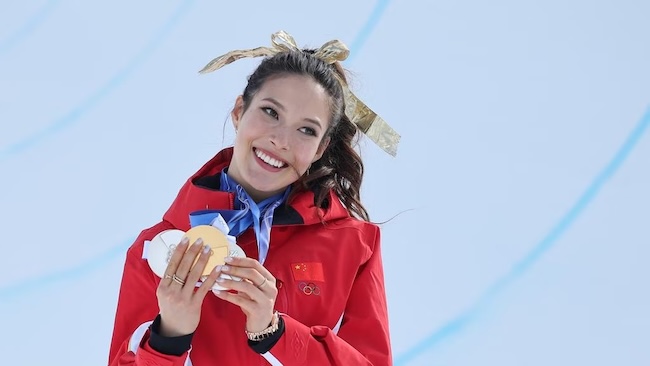

Eileen Gu’s Gold Medal Gauntlet
By James Moreau | 27 Feb, 2026
Between record-breaking gold medals and luxury fashion deals, Eileen Gu navigates the complex intersection of global capitalism and cultural identity.
Eileen Gu cemented her status as the most decorated Olympic freeskier in history with 3 gold medals and 3 silver medals across the past two Winter Games.
The U.S.-born-and-raised phenom has faced scrutiny for representing China, with critics citing the nation’s human rights record as a moral dealbreaker. However, this public sentiment is far from monolithic as others celebrate her for pioneering the borderless athlete archetype. Ultimately, much of the American backlash feels less like a geopolitical stance and more of a grievance that her 6 medals were not attributed to the red, white, and blue.
The 22-year-old’s Olympic journey began with her mother, Yan, an immigrant from China who first introduced Eileen to the slopes when she was just a toddler. As a single mother raising Eileen in San Francisco’s Sea Cliff neighborhood, Yan frequently ventured with her to Lake Tahoe on the weekends to catch some fresh powder.
Questions regarding Gu’s citizenship have been spotlighted as China doesn’t allow dual citizenship. She has stated, “I’m American when I’m in the U.S. and I’m Chinese when I’m in China.”
Gu was reportedly paid millions of dollars by the Beijing Municipal Sports Bureau as part of China’s recruiting campaign to attract elite athletes from the global diaspora.
Many who champion the virtues of global capitalism – idolizing corporate billionaires whose companies outsource jobs for cheap labor – have become vocal detractors once the young woman capitalized on representing her heritage, and a place she spent her summers growing up.
Gu is not the only athlete to make this leap. Zhu Yi, the Los Angeles-born figure skater, faced a harsher reality. Her debut for China in 2022 included multiple falls keeping her off the podium. She faded from the spotlight and did not return for the 2026 Games.
In contrast some athletes remained unswayed by the CCP’s recruitment efforts, most notably team USA figure skater Alysa Liu. The 20-year-old Bay Area native, whose father sought asylum in the U.S. following the Tiananmen Square protests, captured two gold medals in 2026 to much patriotic fanfare. In another inevitable effort to pit successful women against one another, Liu is frequently cast as the “good” Chinese American in direct opposition to Gu.
Choosing between the “good” and “bad” Chinese Americans feels particularly hollow when juxtaposed with recent social media trends. The viral TikTok trend “I’m in my Chinese era,” exemplifies the concept of “Eating the Other,” where elements of a marginalized culture are consumed as a temporary aesthetic without any of the lived political weight. Similarly, critics often reduce the complex stakes of Gu’s decision because they are viewing her life through a flattened, Western lens.
Though the discourse surrounding Gu feels fresh, her commitment is long-standing – first choosing to represent China at age 15. She has consistently maintained that “sport can bring cultures together; not divide them.” Her decision also sought to be a trailblazer for Chinese girls who have traditionally seen low rates of athletic participation, with especially low representation in winter sports.
Gu’s popularity in China was visceral during the 2022 Winter Olympics. Following her Big Air gold medal victory the sheer volume of traffic from fans temporarily crashed the social media platform Weibo.
She was dubbed the “Snow Princess” – fitting for a fashion model who has graced the cover of Vogue and walked the runway for Louis Vuitton.
A favorable online contingent has shown admiration for Gu’s “unreal face card,” poise at press conferences, and academic success in addition to athletic achievements.
After scoring a near-perfect 1580 on the SATs, Gu achieved early admission to Stanford. Currently an international relations major she took a gap year to focus on this year’s Olympics.