

Did Krishnamoorthi Lose Huge Lead to Identity or Stratton's Rousing 'F*** Trump' Message?
By J. J. Ghosh | 18 Mar, 2026
Once widely considered the frontrunner, IL Rep. Raja Krishnamorthi, an Indian American, lost to Lt. Governor Juliana Stratton on Tuesday.
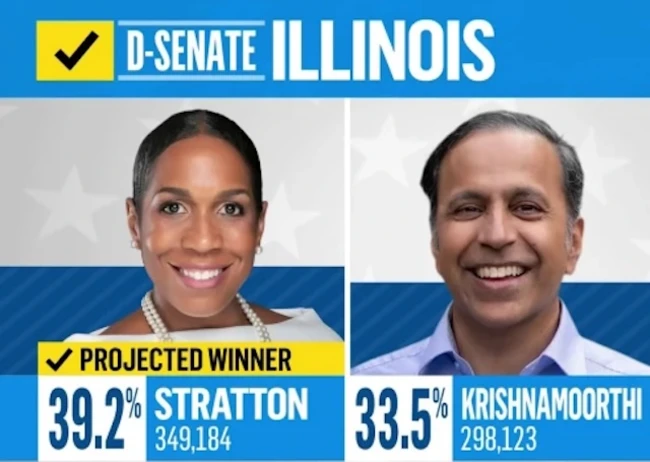
Months ago, Rep. Raja Krishnamoorthi appeared poised to win the Democratic nomination for Illinois's Senate seat, making him a near shoo-in to win the general election in November and become the second Indian American in history elected to the US Senate.
Throughout 2025, polling consistently had Krishnamoorthi up over his main opponent, Illinois Lieutenant Governor Juliana Stratton, by between 20 and 25 points.

Krishnamoorthi once ran an ad poking fun at his own last name and encouraging voters to "Just call me Raja"
On Tuesday night, Stratton defeated Krishnamoorthi by 7 points.
Political pundits are now searching for a narrative that explains the comeback victory.
While Stratton's victory may not necessarily be boiled down to a single factor, there are a few key differences between the two candidates that help explain why Krishnamoorthi's campaign may have failed to meet this political moment.
An Indian Man
Let's start with an obvious fact: an Indian man and a Black woman were bound to appeal to different audiences.
Krishnamoorthi, whose full name is Subramanian Raja Krishnamoorthi — 29 letters long — has never been shy about his Indian American identity.
"I have a long name and a short time to introduce myself," he declared in his first ever campaign ad, released in 2016 when seeking the Democratic nomination for Illinois's 8th Congressional District. The ad featured constituents attempting to pronounce Krishnamoorthi before he interjected to say "Just call me Raja."
While he was born in New Delhi to Tamil parents, Krishnamoorthi has spent just about his entire life in the US. His family moved to the States when he was three months old so that his father could attend graduate school in Buffalo, New York. After years spent relying on public housing and food assistance, they settled in Peoria, Illinois, where his father became a professor.
Raja went on to attend Princeton for undergrad and Harvard Law School before serving as a policy director for a young Barack Obama. He ran for office and lost twice before ultimately making it to Congress in 2016.
The South Asian community was, by a wide margin, Krishnamoorthi's most loyal and financially invested constituency. Roughly half of his campaign contributions over his congressional career have come from fellow Indian Americans. The Indian American Impact Fund put nearly $1 million into the race on his behalf.
But the South Asian support wasn't without its complications. Some fellow members of the Indian American community criticized him for accepting contributions from figures aligned with India's Hindu ultra-right-wing, and generally anti-Muslim, nationalist movement. Krishnamoorthi pushed back against the criticism, arguing that any implication of dual loyalties was "frankly, racist" — a charge that did not necessarily land given that the criticism was coming largely from the South Asian community itself.
A Black Woman

Lt. Gov Pritzker (L) appears in Stratton's (R) add, which features people saying "F*** Trump"
While Krishnamoorthi benefitted from his relationship with the South Asian community, Stratton hoped for similar backing from the Black community.
A South Side native raised in the Pill Hill neighborhood, Stratton had deep roots in Chicago's Black community long before she entered politics, and those roots showed up in her endorsement list. Former Senator Carol Moseley Braun — who in 1992 became the first Black woman ever elected to the US Senate — backed Stratton, as did former Congressman Bobby Rush and Congressman Danny K. Davis, three of the most storied names in Chicago Black political history. Former Wisconsin Lieutenant Governor Mandela Barnes, himself a prominent young Black Democrat, also lent his support.
But she was unable to fully consolidate Black support. The involvement of a third candidate, Robin Kelly — also a Black woman — significantly complicated things for Stratton. Not only did the Congressional Black Caucus endorse Kelly, but CBC chair Yvette Clarke had strong words for Governor Pritzker, who had endorsed Stratton, stating that "A sitting governor shouldn't be heavy-handing the race. Quite frankly, his behavior in this race won't soon be forgotten by any of us."
And here's where things get particularly problematic.
Per New York Magazine: "Some pro-Krishnamoorthi donors appear to be diverting some of their dollars to pro-Kelly advertising, presumably in order to split the Black vote."
It's always tough to separate a candidate from his supporters, and who is to say whether Krishnamoorthi had anything to do with the strategy. Regardless, it didn't work.
"I want to thank this country, the greatest country on Earth, for giving an immigrant kid and his family the chance to live the American Dream. Only in this country could my story happen, and only in this country could a kid like me serve in the halls of Congress," he declared in his concession speech on Tuesday night.
Demographics
The geographic breakdown of Tuesday's results tells a pretty clear story about how identity shaped the race. Krishnamoorthi held his ground in the collar counties — the suburban Chicago ring that includes his own 8th Congressional District, where he had been winning elections for a decade.
That's where his name recognition was strongest, and where the largest concentrations of Indian American and South Asian voters live. It was, for all intents and purposes, home turf.
But home turf wasn't enough. Stratton outperformed Krishnamoorthi in the Metro East region, Sangamon County, Chicago, and some suburbs of Cook County — effectively surrounding him. Chicago in particular was devastating. A city with a substantial Black population and a deeply rooted tradition of Black political organizing turned out decisively for Stratton, whose South Side roots and connections to the city's Black establishment proved far more powerful than Krishnamoorthi's ad spending.
Downstate Illinois, meanwhile — largely white, largely unfamiliar with either candidate — broke for Stratton as well, with Pritzker's backing giving her instant credibility in parts of the state where Krishnamoorthi was essentially unknown. The collar counties gave Krishnamoorthi his base. But a base isn't a majority.
Stratton built a coalition. Krishnamoorthi built a stronghold.
Campaign Strategy
As a Hindu, Raja Krishnamoorthi does not eat red meat.
Ironically, it may have been "red meat" — a term for campaigns that focus primarily on exciting and mobilizing the base rather than attracting those with different views — that swung the election.
On February 19, still behind in the polls, Lieutenant Governor Stratton released her first TV ad. The spot, which went viral on social media, depicted everyday Americans looking directly into the camera to say "F*** Trump."
Stratton ultimately appears at the end to declare: "They said it. We're all thinking it."
It was a far cry from the type of campaign Krishnamoorthi had been running — one that emphasized his confidence and experience as a legislator.
Ultimately, Illinois's Democratic voters appear to have wanted someone who would make taking on Trump their top priority. Stratton campaigned as that candidate in other ways as well, like openly stating that she would not vote for Chuck Schumer to continue as Democratic Leader in the Senate. Schumer has been heavily criticized by members of his own party for not doing enough to stand up to Trump.
Krishnamoorthi also carried the baggage of having sponsored the bill that would ultimately ban TikTok in the US — a move that, one can argue, directly led to the company being purchased and run by Trump supporters who may now use it to push their own right-wing political views.
It's also worth noting that the inner workings of a primary in a state like Illinois, which is deep blue, differ significantly from those of a state like Texas, where Democrats face an uphill battle in the general election. Earlier this month, James Talarico — a white man who more closely resembles Krishnamoorthi in style — defeated Rep. Jasmine Crockett, who ran a more base-energizing campaign. Texas Democrats understand that unlike in a blue state, nominating the most partisan candidate could hurt their prospects in November.
None of this is to say that race and ethnicity weren't a factor. Simply that it would be unwise to assume they were the primary ones.
Krishnamoorthi's concession speech line — "Only in this country could my story happen" — was gracious, and he meant it.
It would be wise to assume that there are plenty more chapters to come.
As a Hindu, Raja Krishnamoorthi does not eat red meat. Ironically, it may have been "red meat" — a term for campaigns that focus primarily on exciting and mobilizing the base rather than attracting those with different views — that swung the election.
Articles
- Takaichi Pressed to Join Hormuz Escort Service with Pearl Harbor Comparison
- Xiaomi's Lei Jun Quadruples AI Budget to $8.7 Billion As MiMo-V2-Pro Excites Developers
- Samsung to Supply HBM4 Chips for OpenAI's Custom Processor Project
- OpenClaw Craze Turns Ordinary Chinese into 'Lobster' Farmers
- Rivian Gets $1.25 Billion Injection from Uber in Robotaxi Deal
- Xiaomi Unveils Updated SU7 at $31,870 in Challenge to Tesla
- Ben & Don Begin Parting Company As Don Seeks Elusive Off-Ramp
- Angry Kpop Fans Crash S. Korea's Pension Fund Support Server
- Mystery AI Model Was Xiaomi's, Not DeepSeek's
- Did Krishnamoorthi Lose Huge Lead to Identity or Stratton's Rousing 'F*** Trump' Message?