

Vinfast's India EV Plant Open to Sourcing More Components Locally
By Reuters | 04 Aug, 2025
The first overseas factory of the Vietnamese EV firm has begun operations in its India plant with the goal of producing 50,000 EVs a year for sale in the region.
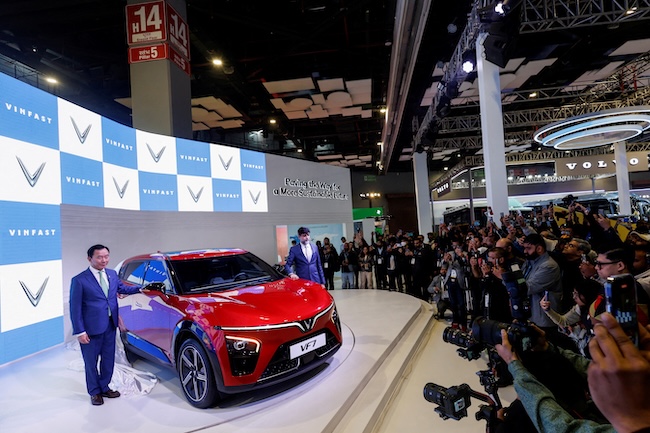
Pham Sanh Chau, VinFast's Asia CEO, and Ashwin Patil, Deputy CEO of VinFast India, pose with the newly launched VF 7 electric vehicle (EV) at India's five-day auto show in New Delhi, India, January 18, 2025. REUTERS/Priyanshu Singh/File Photo
Vietnamese electric vehicle maker VinFast began operations at a new plant in India, its first overseas factory, on Monday, and said it hopes to source more parts locally and that it had received orders from Sri Lanka, Nepal and Mauritius.
The loss-making carmaker has struggled to break into developed Western markets and its foray into India, the world's third-largest auto market, will be a key test of its vehicles' popularity and its business acumen.
The plant in Thoothukudi in the southern state of Tamil Nadu has an initial capacity to build 50,000 EVs annually, scalable to 150,000. Its first vehicles will be two premium electric SUVs, the VF 7 and VF 6.
VinFast has talked with several of its component suppliers, and some want to shift part of their production to the industrial park in India, VinFast Asia CEO Pham Sanh Chau told Reuters.
The company plans to roll out cars to Indian showrooms later this month, he added. The pricing of the vehicles has not been disclosed.
Though the orders from other nations mean the plant could evolve into an export hub, VinFast's immediate focus remains on Indian customers, Chau said.
Last year, VinFast agreed with Tamil Nadu state to invest $500 million over five years and to work towards up to $2 billion in investment.
Success in India will be key if it is to meet its global delivery target of 200,000 cars for 2025. It sold about 72,100 in the first half of the year, primarily in its home market.
Backed by Vietnam's largest conglomerate Vingroup, VinFast plans for a plant in Indonesia to be up and running by the end of the year, Chau said. Production in the U.S. has, however, been delayed until 2028.
The company also said it plans to eventually expand its other businesses to India, including its electric ride-hailing service.
(Reporting by Praveen Paramasivam in Thoothukudi and Chandini Monnappa in Bengaluru; Editing by Sonia Cheema, Jamie Freed and Edwina Gibbs)
Recent Articles
- Senate GOP Blocks Another Bid to Check Trump Iran War Powers
- Self-Sabotage Strategies for Talented Hardworking Professionals
- Bizarre Sneakers-to-AI Transition Makes Allbirds Stock Leap
- Sydney 'Great Jeans' Sweeney Makes Magic Again for American Eagle
- Japan Offers $10 Billion Oil Support for Asian Neighbors
- Carmakers Make Tricky Transition from EVs to Energy Storage Systems
- ASML Lifts Forecast on Surging AI Chip Demand
- Beijing Denies Giving Iran Spy Satellite to Target US Bases
- Robots, Drones Will Slash Food Delivery Cost to $1 Says Barclay
- Your Chats Can Be Used Against You Warn AI Lawyers