

S. Korea's New President Signals Tilt toward China
By Reuters | 24 Aug, 2025
As Lee Jae Myung prepares to cope with Trump's tariff offensive, he seeks to normalize ties with China which is already a more important trading partner than the US.
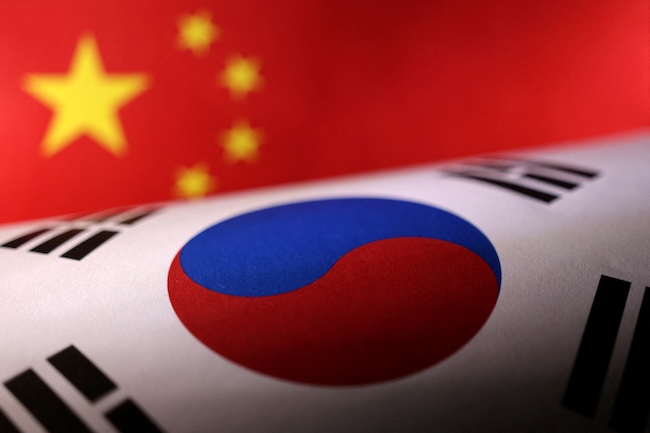
Printed Chinese and South Korean flags are seen in this illustration, July 21, 2022. REUTERS/Dado Ruvic/Illustration/File Photo
South Korea is hoping to normalise relations with China that have been strained in recent years, the leader of a high-level delegation from Seoul said during a visit to Beijing on Sunday, Yonhap News Agency reported.
South Korean President Lee Jae Myung sent the envoys to his country's main trading partner as he travels to Washington to meet U.S. President Donald Trump.
Former assembly speaker Park Byeong-seug, the head of the delegation, met Chinese Foreign Minister Wang Yi and handed over a letter from Lee to Chinese President Xi Jinping.
Diplomatic ties between the two countries have improved since a 2017 dispute over South Korea's deployment of a U.S. missile defence system, which Beijing opposed.
But they exchanged harsh words in 2023 about critical comments on Beijing by South Korea's last president, Yoon Suk Yeol.
Park told Wang Yi on Sunday he hoped the delegation would "open the door to normalising South Korea-China relations, which have been strained in recent years," Yonhap said.
(Reporting by Ju-min Park; Editing by Andrew Heavens)
Articles
- Chinese Farmers Cut Soy Protein Use with Amino Acids from Fermenting Corn
- Japan Loses Economic Momentum, Sees Early Signs of Iran Impact
- China's Qingming Holiday Spending Rises Over 2025
- US Strikes Military Target on Iran's Kharg Island
- Civilizational Extinction Promised by Latest Trump Threat
- Uber to Rely on Amazon's Custom Chips for AI Efforts
- Pakistan Remains Main Go-Between for US-Iran Talks
- Lip Bu Tan Links Intel with Musk's Ambitious Terafab AI Chip Project
- China Targets Taiwan's Chip Prowess to Avoid 'Containment' Says Taipei
- Nvidia's Buy of Main Supercomputer Software Raises AI Chip Neutrality Concerns