

PeopleIs Andrew Yang Running for President?
By J. J. Ghosh | 13 Apr, 2026
Six years after Andrew Yang stood on a presidential debate stage and nailed AI, robots and jobs, he's acting like someone who wants another shot at the White House.
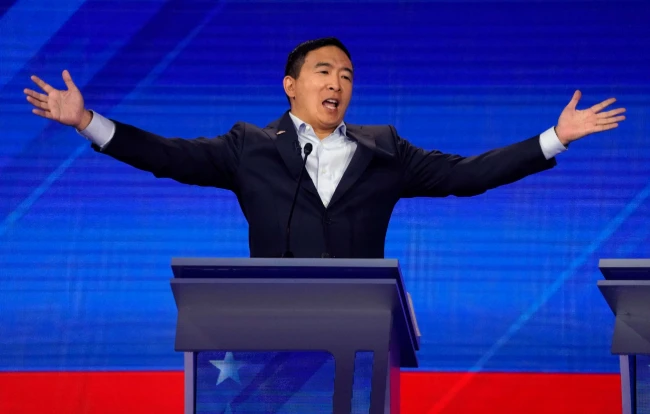
In 2019 Andrew Yang, who virtually nobody had ever heard of, walked onto a Democratic primary debate stage and told America that the robots were coming for their jobs.
He wasn’t talking metaphorically. He meant it literally: that automation and artificial intelligence were on the verge of displacing millions of American workers, that truck drivers would be the first to go, that the social safety net was completely unprepared for what was coming.

Yang is out with a new book that addresses his motivation to run for office
His solution: a Universal Basic Income — a monthly check of $1,000 to every American adult, no strings attached.
The other candidates smiled politely. The media mostly treated it as a quirky tech-bro talking point. We might have been likelier to believe that a global pandemic was headed our way in a year and would upend life as we all knew it.
Yang didn’t win the Democratic nomination. And while it was still too early to tell whether he was onto something with his iRobot fan fiction, his message about job security and a Universal Basic Income resonated enough to make him a well-known entity in the political world.
His name brand was even strong enough to enter the 2021 race for New York City Mayor as a frontrunner.
His Mayoral candidacy ultimately petered out. But for as long as AI and worker displacement continue to make headlines — which seems likely to be the case for the foreseeable future — Yang remains someone worth keeping an eye on.
And he’s making it easy for folks to do just that. Over the past few years, Yang has founded a political party, embarked on a book tour, continued to hit the speaking circuit, and rolled out several new business ventures.
A lot of this is the type of stuff that someone serious about running for President in 2028 would do.
What is Andrew Yang really up to?

Yang was in New Mexico last week to lunch the state's chapter of the Forward Party
"The F***ening"
Let’s start by giving him his due: much of what he said at the beginning of his Presidential campaign was viewed as alarmist.
But since then: ChatGPT launched, every major tech company restructured around AI, white-collar job postings collapsed in exactly the categories he predicted, and the CEO of Anthropic — the company that makes Claude — is now publicly warning about AI’s impact on the workforce in terms that would have sounded like Yang’s talking points in 2019.
It is of course unsurprising that he’s currently harping upon the very subject on which he’s now viewed as extremely credible.
One way he’s doing so is through his Substack.
In February, he authored a post about the displacement of the American worker, which he refers to as “The Fuckening.” In it, he outlined a new series of predictions.
Yang expects the number of white-collar workers to be reduced by 20 to 50 percent in the next several years.
He cited a conversation with the CEO of a publicly traded tech company who told him: “We’re firing 15% of workers right now. We’ll probably do another 20% two years from now. And then another 20% two years later.”
Yang also noted that the economic fallout would reach well beyond office workers: “When people lose their jobs, it affects dry cleaners, dog walkers, hairstylists, restaurants — all local businesses that see fewer people who are able to spend. Personal bankruptcies are going to surge.”
The data is starting to back him up. Job postings in several white-collar categories — including content writing, basic coding, data entry, and customer support — have declined measurably since the widespread adoption of tools like ChatGPT, Claude, and Gemini. Platforms like Indeed and LinkedIn have reported shifts in hiring patterns that suggest companies are not simply pausing recruitment but fundamentally rethinking headcount requirements.
A February 2026 YouGov poll found that 63% of Americans believe AI will reduce the number of jobs available in the United States. That number would have been unthinkable in 2019.
Yang now proposes taxing AI agents instead of labor to address the economic impact and the breach of the social contract caused by automation — an updated version of the VAT tax he proposed in 2020, designed for a world where AI is doing the work that people used to be paid for.
To be clear, pinpointing the problem is not the same as knowing the solution.
While solutions like this and a universal basic income are respectable, it remains to be seen whether they’re popular enough to get him elected this time around.
The Book Tour
Yang is also doing something that presidential candidates have done since time immemorial: he wrote a book, and he is taking it on the road.
The memoir is titled “Hey Yang, Where’s My Thousand Bucks?” — a callback to the most common taunt he received during his presidential campaign, which he has apparently decided to lean into rather than away from.
Part autobiography, part political retrospective, part therapy session, the book covers his childhood growing up as an Asian American, his 2020 presidential campaign, his New York mayoral run, and the years since.
It's also, depending on how you read the final chapter, a barely disguised presidential announcement.
On page 225, Yang writes: “Jokes aside, the odds of my running again are high. I like people. I love the country and those within it. And I have some ideas for how to campaign better next time.”
The book tour has taken him to New Jersey, Connecticut, Washington DC, Los Angeles, San Francisco, and Seattle — which is to say, a national tour hitting major media markets and donor corridors on both coasts.
For a man promoting a memoir, this is standard. For a man considering a presidential run, this is also standard. The overlap is, at minimum, convenient.
The Forward Party
Perhaps the most significant thing Yang has done since 2021 is founding a political party.
Blaming the Democratic Party for his losses in the Presidential and Mayoral races, he founded a political party.
Yang partnered with former Republican New Jersey Governor Christine Todd Whitman, who served as EPA Secretary under George W. Bush, to start The Forward Party.
The party’s pitch is straightforward: a home for voters who are done with both major parties, built around principles rather than ideology — ranked-choice voting, open primaries, and the basic idea that politicians should be accountable to voters.
That all sounds great on paper. But it’s easier said than done.
Third parties in America face structural barriers that are genuinely difficult to overcome, and the Forward Party has not yet produced the electoral breakthrough Yang envisioned. But Yang has been methodically state-by-state, doing the unglamorous work of party-building that precedes any serious national run.
Just this past Friday, Yang stood on the steps of the New Mexico state Capitol in Santa Fe to formally launch the Forward Party in the state.
He pointed to Utah, where the Forward Party is expecting to have more than 20 legislative candidates on the general election ballot this fall, including one incumbent who left the GOP to join the party.
New Mexico, he argued, is fertile ground for similar reasons — many Democrats in the state run completely unopposed, which Yang framed as a direct argument for the Forward Party’s purpose: “How could you vote against open primaries? They’re running unopposed. You see how that works?”
But despite keeping him in the public eye and building political connections, Yang’s founding of a political party could, frankly, be evidence for or against his plans for a presidential run.
The 2028 Question
Andrew Yang in 2019 was one of the few political players to correctly identify and speak up about the impending worker crisis as it pertains to automation.
And it didn’t go unnoticed: he built a national profile around it and has since been able to make money from speaking fees, a book, and other ventures like standup comedy and social mixers.
These may very well be the type of things he’d much rather continue doing than running for office. But if he does decide to run, he is in a position to say “I told you so” on a 2028 campaign stage.
The counterargument against a run is also valid.
Yang lost two major races and his Forward Party has not produced the third-party breakthrough he envisioned. Running as an independent remains historically very difficult.
And he left the Democratic Party, which means he’d either have to mount a longshot independent bid or return to a party he has spent years publicly criticizing.
But none of that is disqualifying.
And the political environment of 2028 is going to be shaped by exactly the issues Yang has been sounding the alarm about. If millions of white-collar workers lose their jobs in the next 18 months, the candidate who saw it coming and has been saying so for six years is going to have a very interesting story to tell.
Dave Chappelle once introduced him at a show by saying: “Here’s the guy who got everything right in 2020, but no one listened because he’s Asian.”
Unfortunately for Yang, even if American voters can come around to the Asian part, it’s not clear that they put a premium on being right.
Over the past few years, Yang has founded a political party, embarked on a book tour, continued to hit the speaking circuit, and rolled out several new business ventures. A lot of this is the type of stuff that someone serious about running for President in 2028 would do.
Recent Articles
- Keiko Fujimori Holds 3% Lead One Week Before Peru Presidential Runoff
- China's Already Loving Trump's 250th Birthday White House Cage
- Japan Becomes Hub for Regional Defense Ties as US Doubts Grow
- Experimental Novartis Radiopharma Drug Shows Promise Against Prostste Cancer Risk
- J&J Prostate Cancer Drug Dramatically Cuts Risk of Cancer Spread and Death in Late-Stage Study
- China Factory Activity Flat in May on Weakening Demand, High Costs
- Trump to Headline 250th Anniversary Fair Opening After Performers Drop Out
- Exclusive-From Lottery Draws to Fiscal Spending, China Broadens Digital Yuan Footprint
- India Signs Deal to Sell BrahMos Missiles to Vietnam
- Senate Republicans Face Crisis over Trump's 'Anti-Weaponization' Fund