

PeopleHow Charles and Sara Liang Survived One Scandal After Another to Build a $20-Billion AI Giant
By Goldsea Staff | 22 Mar, 2026
A mom-and-pop computer motherboard vendor has evolved into a leader in the booming AI data-center space without help from hyperscalers.
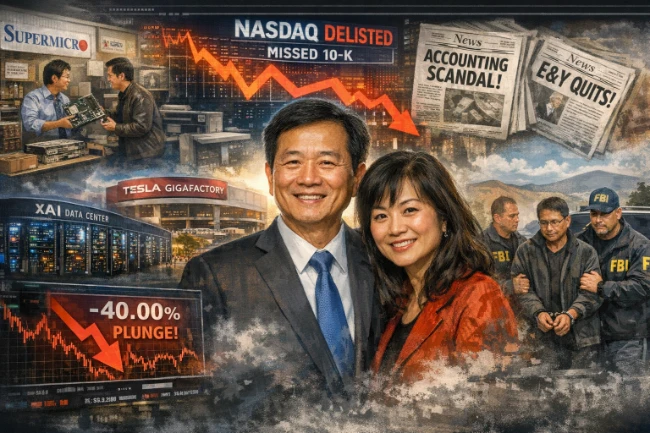
(Image by ChatGPT)
In 1993 a Taiwanese-born electrical engineer named Charles Liang and his wife Sara scraped together enough ambition — and presumably some savings — to launch a five-person computer motherboard company in San Jose, California. They called it Super Micro Computer, a name so literal it practically came with a user manual.
There was no venture capital. No famous co-founder with a TED Talk. No Silicon Valley pedigree. Just Charles, Sara, co-founder Wally Liaw, and a stubborn belief that they could out-engineer the competition by building smarter, more customizable server components than anyone else on the market.
Thirty-plus years later, Super Micro — now known as Supermicro — is a $20-plus billion revenue juggernaut sitting at the center of the AI data-center arms race. Getting there, though, required surviving some genuinely spectacular self-inflicted wounds along the way.
A Different Kind of Server Company
From the start, Liang's philosophy set Supermicro apart from rivals like Dell and HP. Rather than sell customers a rigid, pre-configured box and call it a day, he embraced what the company eventually formalized as "building block solutions" — a modular approach where customers could mix and match components to get exactly the server configuration they needed. Call it a Lego for data centers.
This strategy paid off handsomely with customers who needed customized, high-performance computing at a lower total cost than what the big boys were charging. Supermicro's reputation grew steadily through the 2000s and into the 2010s, particularly among companies building out specialized computing infrastructure. The company went public in 2007, raising its profile further and giving it the capital to scale operations globally, with manufacturing ultimately spanning the US, Taiwan and the Netherlands.
But while Liang was busy engineering his way to the top of the server market, the company's back office was quietly becoming a liability.
The First Big Stumble
By 2018 Supermicro had a problem that had nothing to do with its products. The company failed to file its financial statements on time — a breach serious enough that its stock was temporarily delisted by Nasdaq. For most publicly traded companies, a slipup like that is a near-death experience. Investors panic, customers get skittish, and the stock may take years to recover, if ever.
Supermicro survived only to face another crisis in 2020 when it was fined $17.5 million by the SEC for what it called "widespread accounting violations." Employees had been pulling revenue from future quarters into current ones — a classic earnings manipulation scheme that made results look better in the short term at the expense of accuracy and trust.
That kind of fine, paired with a delisting, would have been a death knell for many companies. But Charles Liang cleaned house, upgraded the finance team, and pushed forward. It was wounded but it survived.
Enter the AI Boom
Supermicro's poor governance track record was offset by its lucky business timing. As the artificial intelligence revolution went from concept to industrial-scale reality in the early 2020s, data centers became the new gold rush. Supermicro was sitting on a mountain of picks and shovels.
The company had spent decades refining its ability to build dense, power-efficient servers optimized for high-performance computing. When hyperscalers, cloud startups, and AI labs suddenly needed to erect enormous GPU clusters practically overnight, Supermicro's modular, customizable approach turned out to be exactly what the market needed.
Revenue told the story. From $3.56 billion in fiscal year 2021, Supermicro grew to $5.2 billion in 2022, $7.1 billion in 2023, $15 billion in 2024, and $22 billion in 2025. That isn't a growth chart but a launch trajectory. Few companies of Supermicro's size have ever grown that fast, and almost none of them were run out of San Jose by the same guy who co-founded them with his wife three decades earlier.
Supermicro had become one of the most successful mom and pop firms of all time.
A key piece of that growth was a contract most competitors would have killed for. In 2024, Elon Musk's AI startup xAI built the Colossus supercomputer — a 750,000 square-foot facility in Memphis — using servers sourced half from Supermicro and half from Dell. The whole thing came together in just 122 days. Supermicro also supplied Tesla's Gigafactory Texas with servers and, for a period, was Tesla's exclusive server vendor.
The Hyperscaler Gap
For all its success with AI startups, neocloud providers, and sovereign government customers, Supermicro has a glaring weakness: it's dramatically under-indexed with hyperscalers — the world's biggest tech companies.
Amazon AWS reportedly cut ties following delivery issues. Microsoft, Google, and Meta — the trio of hyperscalers who between them spend hundreds of billions on data center infrastructure — have not become the anchor customers Supermicro needs to cement its top-tier status.
Liang has acknowledged the gap openly, and the company has made winning more hyperscaler business a stated priority.
Fiscal year 2026 guidance calls for $33 billion in revenue, which would require meaningful wins from larger customers beyond its current neocloud base. In early 2025 the company announced a $20 billion deal with DataVolt, a Saudi Arabian data center company, to supply GPU platforms for AI campuses across the Middle East and the United States.
That kind of sovereign and international business helps, but it's not a substitute for landing the Amazons and Googles of the world.
The Second Big Stumble — and a Near-Miss Disaster
Just as it looked like the AI wave had lifted Supermicro permanently past its governance demons, 2024 brought another round. Short-seller Hindenburg Research published a report alleging fresh accounting irregularities and undisclosed related-party transactions. Supermicro delayed filing its annual 10-K. A Department of Justice investigation was reported, sparked by a whistleblower. And then, most dramatically, auditor Ernst & Young resigned — citing concerns it wasn't comfortable continuing the engagement.
Shares that had touched an all-time high above $122 cratered to below $18. The company was staring down a potential Nasdaq delisting for the second time in its history.
Liang moved fast. The company hired BDO USA as its replacement auditor, commissioned an independent review, and got its filings back in order. The independent review found no substantial concerns. The delisting was narrowly avoided.
Then, in March 2026, co-founder Wally Liaw was arrested and charged with conspiring to smuggle $2.5 billion in Supermicro servers containing Nvidia AI chips to China in violation of U.S. export control laws. Supermicro placed him on administrative leave immediately and stated his alleged conduct contradicted company policy. The stock dropped 33% on the news, erasing nearly $5 billion in market cap in a single day.
The Resilience Factor
The thing that makes Supermicro genuinely interesting as a business story is its habit of surviving crisis after crisis. The accounting violations, the delistings, the auditor drama, the short-seller attacks, the co-founder arrest — any one of those events might have finished a less operationally sound company. Supermicro weathers them, stumbles badly, and then recovers, because the underlying product and the underlying market demand are real.
Liang himself is the connective tissue. Now in his late 60s, he has run this company since the day it opened with five employees. With a passion for green computing, he founded a nonprofit called the Green Earth Foundation dedicated to reforestation and talks about Supermicro's energy efficiency with the intensity other CEOs reserve for market share. That positioning has suddenly become a big edge as the data center industry has come under enormous pressure for its power consumption.
The road ahead isn't without potholes. The Liaw arrest adds legal and reputational overhang. Margin compression is real, as competitors fight for the same AI server dollars, causing Supermicro's gross margin to slip below 10% for the first time in its history. And the hyperscaler gap remains Supermicro's most consequential strategic vulnerability.
But back in 1993 few would have bet that the little motherboard shop Charles and Sara Liang opened in San Jose would one day be racing toward $33 billion in annual revenue. Fewer still would have predicted it would get there despite several major errors, ignored by Silicon Valley's biggest players.
That it did says a lot about the current AI market, and even more about Charles Liang.
Recent Articles
- Keiko Fujimori Holds 3% Lead One Week Before Peru Presidential Runoff
- China's Already Loving Trump's 250th Birthday White House Cage
- Japan Becomes Hub for Regional Defense Ties as US Doubts Grow
- Experimental Novartis Radiopharma Drug Shows Promise Against Prostste Cancer Risk
- J&J Prostate Cancer Drug Dramatically Cuts Risk of Cancer Spread and Death in Late-Stage Study
- China Factory Activity Flat in May on Weakening Demand, High Costs
- Trump to Headline 250th Anniversary Fair Opening After Performers Drop Out
- Exclusive-From Lottery Draws to Fiscal Spending, China Broadens Digital Yuan Footprint
- India Signs Deal to Sell BrahMos Missiles to Vietnam
- Senate Republicans Face Crisis over Trump's 'Anti-Weaponization' Fund