

What's So Special About Japanese Rice Lager?
By J. J. Ghosh | 03 May, 2026
A beer lover explores why Japanese rice lagers are much more than just beer brewed with rice.
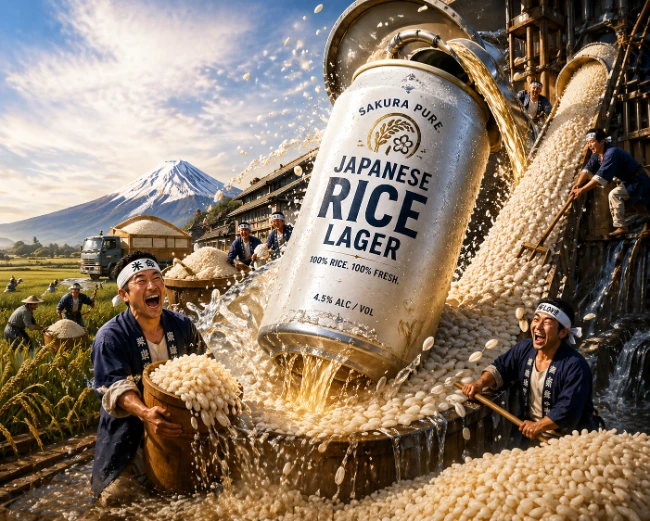
In the words of Supreme Court Associate Justice Brett Kavanaugh: I like beer.
I love beer, in fact, I love it on a hot day lounging by the pool or while catching up with friends during a happy hour. I love the feeling of one single beer after a long day of work or significantly more than one after a long week of work.
I like beers that are generally light and refreshing: a cerveza with a lime in it or a Belgian white with an orange slice.

An assortment of the top Japanese rice lagers
But there’s one beer that I almost always order when I see it on a menu, especially from a craft brewery: a Japanese rice lager.
Whether I’m drinking it with sushi, chugging it after dropping a shot of sake in, or drinking it in the same context I would any other beer, rice lagers simply hit differently.
I’ve long been convinced that unlike standard beers, there’s something about the rice that makes it taste cleaner, slightly sweeter, and more refreshing.

Japanese rice lager isn't solely about the key ingredient. Plenty of factors help differentiate a Sapporo from a Budweiser.
It recently occurred, however, that I never actually fact-checked this. And I’d be lying if I said there weren’t plenty of aspects of my life in which I’m susceptible to the placebo effect.
Is there actually something about Japanese beers that makes them taste different — better even — than all others?
Time to investigate.
What Even Is a Rice Lager?
Let’s start with the basics.
Beer in most countries is made with barley malt, which is derived from barley. What makes Japanese beer special is that rice is often used in the brewing process instead. This is because while Japan historically had limited barley supplies, there was an abundance of high-quality rice.
In brewing terms, rice is what’s called an adjunct — an ingredient other than malted barley that adds fermentable sugar to the beer-making process. In that regard, a rice lager is not too different from a beer created using corn.
Most brewers use rice in the first place because it’s typically used as a means of lightening the body without contributing much in the way of aroma, flavor, or color. It ferments cleanly, leaves little behind, and produces a beer that is lighter, drier, and crisper than an all-malt equivalent.
But here’s where I started to feel a little betrayed:
It turns out that Budweiser also uses rice. A significant amount of it, in fact.
Was I completely just imagining this made-up difference between rice and barley malt in my head?
Of course, not all rice beers are created equal. Even if some beers have the same ingredients, other factors contribute to the quality of the product.
Perhaps that’s why some craft breweries choose to use the term “Japanese rice lager” instead of just “rice lager”: it differentiates their beer from, say, Anheuser-Busch.
Japanese Beers
Japan’s large commercial brewers produce some of the best quality commercial beers in Asia. And no, they don’t taste like Budweiser.
The domestic market is dominated by four major players — Asahi, Kirin, Suntory, and Sapporo — all of which have been in business for over a century.
Given mainstream Japanese drinkers’ taste preferences, they tend to produce rice lager beers with a light sweetness and very restrained hoppiness. There’s also a Japanese concept called karakuchi — a dry, zingy finish that Asahi Super Dry has essentially made its entire personality.
Sapporo is the oldest beer brand in Japan, and its first brewmaster, Seibei Nakagawa, actually learned to brew in Germany before returning to Japan and applying European techniques to local ingredients. It’s the darkest and most carbonated of the bunch, and known as a good companion to ramen.
If you want to show off at a dinner party, you can let it be known that Kirin “Ichiban” means “first” in Japanese, and it’s brewed using only the first press of the wort. Watch them nod as if they follow.
Moving beyond Japan: Tiger, brewed in Singapore, is a light lager built for hot weather with a slightly sweet finish. Singha, from Thailand, is fuller-bodied with a stronger flavor profile — a better match for spicy food than something as stripped-down as an Asahi.
The Science
So is that rice beer taste just in my head?
The science behind what makes a good beer is actually more complicated than I might have expected. But keep in mind that my appreciation for beer far outweighs my scientific knowledge.
The short answer: rice as an ingredient makes a difference taste-wise but maybe not as much as you might think — and the type of rice matters more than the mere presence of rice.
And heads up, this is about to get pretty granular. Or riceular.
One Japanese homebrewer conducted blind triangle tests comparing a sticky rice lager to a flaked rice lager and found strikingly different results: the sticky rice version had a noticeable sulfur note reminiscent of authentic German Pilsners, while the flaked rice version had a neutral, almost Japanese milk bread-like aroma.
The mouthfeel also differed — sticky rice delivered a crisp bite while flaked rice leaned creamy.
But when researchers tested flaked rice against no rice at all — the comparison more relevant to the average bar-stool drinker — tasters in a blind experiment could not reliably distinguish an American lager made with 20% flaked rice from one made with just barley malt.
Only 11 out of the required 12 tasters identified the correct sample, falling just short of statistical significance.
What that actually means: the difference between a rice lager and a regular lager is real under controlled conditions, but subtle enough that most drinkers cannot reliably detect it blind.
What they can detect — and very clearly — is the difference between a well-made, carefully brewed Japanese lager and a cheap domestic. The rice is part of that story, but so is the water chemistry, the yeast strain, the hopping rate, and the brewing culture that treats these as precision products rather than commodities.
Real or Placebo?
In short, simply calling something a rice beer may give us little insight into how it’s going to taste. But if it truly is a Japanese-style rice lager, we should be able to identify it positively.
The crispness you taste in an Asahi or a Sapporo is real — it comes from the rice adjunct, the low hopping rates, and the dry finish that Japanese brewers deliberately engineer. That is a real and distinct flavor profile, not an illusion.
But the feeling that it tastes better at the sushi restaurant? That part is partially context.
Cold temperature amplifies crispness. The food pairing genuinely works — the clean, neutral profile of a rice lager doesn’t fight with delicate fish the way a hoppy IPA would. The ritual of the pour, the shape of the glass, the setting — all of it is doing real cognitive work on your palate. Context is real in beer.
None of this is accidental. They're engineered for a specific purpose: maximum refreshment with minimum intrusion. And over a century of refinement shows.
No, the title “rice lager” alone doesn’t tell you what you’re going to get. But it does describe a particular style more than just an ingredient.
Now if you’ll excuse me, all of this science talk is making me thirsty
I’ve long been convinced that unlike standard beers, there’s something about the rice that makes it taste cleaner, slightly sweeter, and more refreshing. It recently occurred, however, that I never actually fact-checked this. And I’d be lying if I said there weren’t plenty of aspects of my life in which I’m susceptible to the placebo effect.
Recent Articles
- China's Robot-Hand Maker Approaches Human-Level Dexterity
- GameStop Makes $56 Bil. Offer to Buy eBay
- Iran Acknowledges Receipt of US Response to Its Latest Offer
- Beijing Calls Defiant Taiwan President Visiting Eswatini a 'Rat'
- Vox Momenti: The Ballad of Don and LOCO
- Wind Farm Projects Halted by Trump on Purported National Security Concerns
- Bedtime Story: A Tale of Brothers Hongbu and Nolbu
- Trump Says He's Awaiting Exact Wording of Potential Iran Deal
- Samsung Patent Suit Ends with Order to Pay China's ZTE $392 Million
- Iran Adventure Likely to Leave Trump and the World Worse Off