

Trump Vows More Strikes on Civilian Infrastructure After F-35 Shot Down
By Reuters | 03 Apr, 2026
Trump continues his fruitless military campaign to bully Iran into submission while the rest of the world seeks an agreement to reopen the Strait of Hormuz.
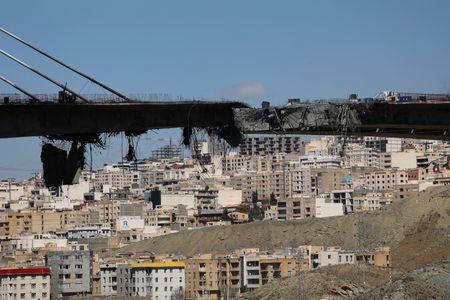
The B1 bridge damaged by a strike, as the U.S.-Israeli conflict with Iran continues, in Karaj, Iran, April 3, 2026. Majid Asgaripour/WANA (West Asia News Agency) via REUTERS
President Donald Trump threatened to extend attacks on civilian infrastructure in Iran after a U.S. strike cut a major highway bridge on Thursday, prompting a defiant response from Iran, which hit a water plant in Kuwait and said more would follow.
Attacks on transport, power and water facilities vital for the populations of Iran and the neighbouring Gulf countries risk deepening the war, which has already killed thousands and threatens to cause lasting damage to the world economy.
On Thursday, Trump posted footage on social media showing dust and smoke billowing up as U.S. strikes hit the newly constructed B1 bridge between Tehran and nearby Karaj, which was due to open to traffic this year.
"Our Military, the greatest and most powerful (by far!) anywhere in the World, hasn't even started destroying what’s left in Iran. Bridges next, then Electric Power Plants!," he wrote in a subsequent post.
In response, Iran's Revolutionary Guardc Corps said it would hit "all assets of the Israeli regime and the U.S. in fuel, energy, economic centres, and power plants across the region". It said countries hosting U.S. bases should make them leave.
The Iranian military also said it had shot down a U.S. F-35 fighter jet over central Iran. There was no immediate comment from the U.S. military.
IRAN ATTACKS KUWAIT WATER PLANT
As the two sides exchanged taunts, an Iranian attack on Friday hit a water desalination and power plant in Kuwait, a major U.S. ally in the region, causing material damage to parts of the facility, Kuwait's electricity and water ministry said.
The attack underlined a potentially devastating vulnerability for Gulf countries, which rely heavily on desalination for drinking water.
Nearly five weeks after the war started with a joint U.S.-Israeli aerial assault, Trump is under pressure to find a quick resolution. Negotiations conducted via intermediaries with new leaders in Iran have shown little sign of progress, and pessimism at home has been growing, with polls showing most Americans opposed to the war.
At the same time, the economic impact has been ratcheting up sharply around the world, with Iran's grip on the strategic shipping lane in the Strait of Hormuz giving it a choke hold on oil and gas supplies vital to the global economy.
As he threatened more attacks, Trump said Iran's leadership "knows what has to be done, and has to be done, FAST!"
But there has been little sign of acquiescence from Tehran.
"Striking civilian structures, including unfinished bridges, will not compel Iranians to surrender," Foreign Minister Abbas Araqchi said.
Iranian media have issued daily reports of attacks on civilian sites including schools, pharmaceutical suppliers and health facilities. On Thursday, the century-old Pasteur Institute in the heart of Tehran was severely damaged, the Health Ministry said.
On Friday, a drone attack hit a Red Crescent relief warehouse in the Choghadak area of the southern Bushehr province, where Iran's first nuclear power plant is located.
As the attacks have continued, over 100 American international law experts said the conduct of U.S. forces and statements by senior U.S. officials "raise serious concerns about violations of international human rights law and international humanitarian law, including potential war crimes".
For its part, Iran has continued to strike targets around the Gulf, increasing the already heavy cost of the war on the region and the global economy.
As well as Friday's attack on the water plant, Kuwait Petroleum Corporation said its Mina al-Ahmadi refinery had been hit by drones. Fires were ignited at operating units, but no injuries were reported.
Other attacks were also reported to have been intercepted in Saudi Arabia and Abu Dhabi. Missile debris landed near the Israeli port of Haifa, site of a major oil refinery.
IRAN WAR CAUSES GLOBAL ECONOMIC UPHEAVAL
Global financial markets have whipsawed in response to expectations of a possible end to the war and the re-opening of the Strait of Hormuz, which only isolated vessels have been able to transit since the start of the war.
In normal times, the Strait is the conduit for around a fifth of the world's oil and natural gas. Its closure has also squeezed shipments of fertiliser, threatening a humanitarian crisis in developing countries in Asia and Africa.
On Friday, a container ship belonging to the French shipping group CMA CGM passed through, MarineTraffic vessel tracking data showed, a sign that Iran may not consider France a hostile nation. A liquefied natural gas container ship belonging to Japan's Mitsui OSK Lines also transited the Strait.
While most markets in Asia were closed for Easter, Japan's Nikkei share average rallied to trim its losses for the week following global efforts to restore Gulf oil shipments.
Oil markets were closed after benchmark U.S. crude prices gained 11% on Thursday after a televised speech by Trump that offered no clear sign of an imminent end to the war.
On Thursday, Britain chaired a virtual meeting of some 40 countries to explore ways to restore freedom of navigation, but it did not produce any specific agreement.
Tehran has offered a competing vision for future control of the strait, and said it was drafting a protocol with neighbouring Oman that would require ships to obtain permits and licences - something other countries would be unlikely to agree to.
"International law doesn't recognise pay-to-pass schemes," European Union foreign policy chief Kaja Kallas wrote on social media.
The U.N. Security Council is set to vote on Saturday on a Bahraini resolution to protect commercial shipping in and around the strait, diplomats said, but veto-wielding China made clear its opposition to authorising armed intervention.
Any military action would be "legitimising the unlawful and indiscriminate use of force, which would inevitably lead to further escalation of the situation and lead to serious consequences", Chinese envoy Fu Cong told the Security Council on Thursday.
(Reporting by Reuters bureaux; Writing by Jonathan Allen and Lincoln Feast; Editing by Raju Gopalakrishnan)
© 2026 by Asian Media Group Inc.
Recent Articles
- US Senate Narrowly Blocks New Bid to Rein in Trump War Powers
- BYD Ramps up Battery Production in Brazil
- Intel Begins Chip Production with New Fabrication Process
- 'Wingman' Drone Key Piece of EU's Defense Self-Reliance
- Keiko Fujimori Edges Ahead in Brutal Contested Vote Count
- Chip Queen He Tingbo Subverts Moore's Law to Overturn the Global Semiconductor Hierarchy
- Only 30% of Americans Consider the US the World's Greatest Country
- US Spends $25,000 a Month to Store Unusable Contraceptives Stuck in Belgium
- AI Optical Parts Maker Zhongji Innolight Eyes $7 Billion Hong Kong Listing
- US-Iran Peace Deal Kicks the Can Down the Road