

SpaceX Could Be Dragged Down by AI Chip and Solar-Panel Ambitions
By H Y Nahm | 27 May, 2026
Taking on processes that rely more on building a labor force capable of painstaking precision reveals Musk arrogance and makes the $2 trillion market cap a crap shoot.
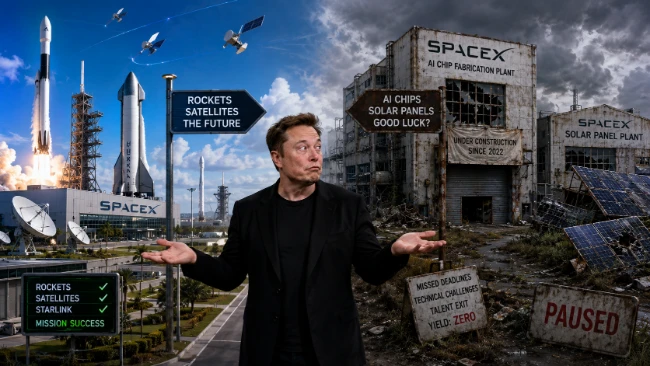
(Image by ChatGPT)
Elon Musk has never been shy about thinking big. Rockets that land themselves, electric cars that practically drive themselves, tunnels under cities, colonies on Mars — the man operates at a scale that makes ordinary ambition look timid.
But there's a version of big thinking that's genuinely visionary, and there's a version that's simply arrogant.
When it comes to Musk's plans to manufacture cutting-edge AI chips and solar panels at competitive scale, he may be drifting dangerously into the second category — and the financial consequences for SpaceX's proposed $2 trillion valuation could be severe.
Let's start with the chips.
A Monster Talent Hurdle
TSMC didn't become the world's dominant semiconductor manufacturer because its founders had a grand vision. They built it over decades through an almost obsessive culture of process discipline, workforce development, and incremental refinement. The company's fabs in Taiwan employ tens of thousands of engineers and technicians who've spent careers learning to operate in environments where a single particle of dust, a microscopic temperature variation, or a vibration from a passing truck can ruin an entire wafer run. That expertise isn't transferable via a recruiting pitch. It's cultivated.
Musk's ambition to replicate that capability — in Arizona and Texas, no less — runs headlong into a recruiting reality that no amount of Musk charisma can easily overcome. Engineers who know how to run a cutting-edge fab don't exist in surplus. They're concentrated in Taiwan, South Korea, and a few pockets of Japan and the Netherlands.
TSMC's own Arizona expansion has been instructive: the company has struggled to find locally trained talent capable of operating at its standards, and has had to fly in engineers from Taiwan at significant cost and friction. If TSMC — with its decades of institutional knowledge, its reputation, and its massive compensation packages — is struggling to staff a fab in Phoenix, the odds that Musk can poach or develop that talent faster and cheaper are slim.
Texas presents similar challenges. Austin's tech scene is real, and the state has attracted semiconductor design talent, particularly in chip architecture. But fab operations are a different discipline from chip design. You can hire brilliant engineers to design a chip; running the process chemistry, the photolithography, the etch and deposition steps at 3-nanometer tolerances requires a different kind of expertise entirely — one that's built on years of hands-on process experience in a working fab, not on a computer science degree or even a PhD in materials science.
Musk's recruiting pitch — come to Texas or Arizona, work on something world-historical, be part of the future — has worked for SpaceX's rocket engineers and Tesla's automotive teams. Those environments reward bold improvisation, rapid iteration, and tolerance for failure. Semiconductor fabrication is almost the opposite culture. It rewards patience, caution, meticulous documentation, and an almost monastic commitment to process consistency. These aren't the people who thrill to Musk's "move fast and break things" energy. In a fab "breaking things" means scrapping millions of dollars of product.
Solar Panels and the Yield Trap
The solar panel side of the equation has a different flavor of the same core problem. SolarCity — which Musk controversially folded into Tesla — was never a manufacturing powerhouse. It was primarily an installer and financier of solar systems. The Gigafactory for solar in Buffalo, New York, has chronically underperformed its production targets. The lesson there wasn't absorbed loudly enough.
Producing high-efficiency solar panels at the scale Musk envisions for his integrated space-AI-energy empire requires a workforce trained in consistent, precision manufacturing. That means process engineers who can maintain yield rates on thin-film deposition, quality control teams who can identify and eliminate defect patterns across millions of cells, and supply chain operations sophisticated enough to source and qualify materials at scale. It's not glamorous work. It doesn't make for scintillating TED talks. But it's exactly the work that separates manufacturers who achieve 22% panel efficiency at scale from those who manage 18% in a lab and 15% in production.
Recruiting and retaining that workforce in Texas — where the industrial manufacturing base skews toward oil and gas, not precision electronics — is a generational project, not a launch event. And Musk doesn't do long-term patience particularly well. His timelines are famously optimistic, which in rocketry can be forgiven because the feedback loops are dramatic and the mission is inspiring. In semiconductor fabs and solar panel production lines, missed yield targets don't make for good Twitter posts. They make for quiet, grinding losses.
Massive Financial Exposure of Failed Fabs
Here's where the $2 trillion market cap thesis gets genuinely wobbly.
Musk's integrated vision for SpaceX — linking Starlink's satellite internet, AI computing infrastructure, energy generation, and eventually Mars colonization — only holds together financially if he controls the key inputs. Specifically, it requires that he not be writing enormous checks to Nvidia for GPUs, to TSMC for advanced chip fabrication, and to Samsung or LG for solar components.
The gross margin math is brutal if he can't close that loop. Nvidia's AI chips carry margins that are eye-watering precisely because the company controls the software stack (CUDA), the architecture, and increasingly the supply chain. Every H100 or B200 that Musk's AI infrastructure has to buy from Nvidia rather than produce internally is margin that flows to Jensen Huang's shareholders instead of Musk's. At the scale of AI compute required for a serious competitor to OpenAI or Google DeepMind — the kind of scale Musk's xAI ambitions imply — that dependency is measured in billions of dollars annually.
If the chip fab and solar panel efforts fail to achieve competitive scale — which, given the talent and operational challenges outlined above, is a plausible outcome — the accounting consequences are severe to market cap, if not necessarily fatal to the entire company. The capital invested in those efforts would require impairment charges. The write-offs could run to tens of billions depending on how deep the investment goes before the reality becomes undeniable. That's not a fatal blow for a company with SpaceX's core launch business, which generates real cash and has genuine competitive moats in reusable rockets and Starlink. But it's a massive drag on the valuation story.
A $2 trillion market cap requires a coherent narrative in which all the pieces of the empire reinforce each other and generate compounding returns. Chips power the AI, the AI monetizes Starlink's network, Starlink funds the Mars infrastructure, solar panels power the whole thing cheaply. Pull out the chips and solar panels, replace them with vendor dependencies on Nvidia and TSMC, and you've got a company that's paying retail for inputs that its competitors are pricing at cost. The margins compress. The compounding story breaks down.
What Musk Gets Right — and Where That Isn't Enough
To be fair to Musk, he's beaten longer odds before. Tesla's battery manufacturing was widely assumed to be beyond the company's reach, and while it's taken longer and cost more than promised, it's real. SpaceX's reusable rockets were dismissed as fantasy until they weren't. He has a genuine track record of assembling teams that do things the consensus said couldn't be done.
But semiconductor fabrication and high-efficiency solar panel production aren't engineering moonshots in the way that reusable rockets were. The knowledge exists. The processes are understood. The bottleneck isn't inspiration — it's the slow, painstaking work of building a labor force that can execute those processes at scale, day after day, shift after shift, with the kind of discipline that doesn't make headlines. That's a workforce development challenge, and it plays out over a decade, not a product launch cycle. SpaceX's slipups or even lengthy delays open the door for ready-made competitors to fill the gaps—at a high cost.
Musk's empire is real, and parts of it are genuinely impressive. But the chip fab and solar panel components of his vision aren't just engineering problems — they're cultural and organizational problems of a type that's historically resistant to the Musk treatment. Until those pieces are credibly in place, that $2 trillion figure isn't a valuation so much as a bet, likely a long-shot one.
Recent Articles
- Ferrari Takes Lon g View with Stereotype-Busting Luce EV Debut
- Chinese EV Brands Gain as Europe Car Sales Rise
- US Plans to Halt Immigration, Customs Processing at Airports of Biggest Cities
- American Airlines Plans to Double India Tech Hub Staff
- Canada to Buy Swedish Early Warning Planes in Snub to US
- Yao Ming to Become Face of NIO's Overseas Marketing Drive
- American Airlines Sees Strong Travel Demand from K-Shaped Economy Cushioning Fuel-Price Hit
- 4th-Gen Solid-State Battery Maker ProLogium to List on Nasdaq in $3.8 Billion SPAC Deal
- Global Firms Use AI at Indian Hubs to Bring Ad Creatives In-House
- Hong Kong Overtakes Switzerland as World's Top Cross-Border Wealth Hub