

Korean MagLev Train Prepares to Enter Service
By wchung | 04 Jun, 2026
Frictionless Trains: Hyundai Rotem's maglev trains will change the economics and aesthetics of rail systems.
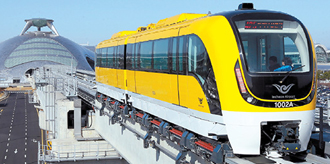
The Incheon Airport MagLev rail system, set to open in 2013, will be the first urban maglev system longer than five miles.
A magnetic levitation train completed a trial run Thursday at Incheon International Airport during the completion ceremony of the test line for a Korean-developed magnetic levitation train.
The maglev line, set to open in the latter half of 2013, will initially cover a 6.1-kilometer (3.8-mile) section that covers six stations from Incheon Airport to Yongyoo-Muui Tourist Complex currently under development. When it opens the Incheon maglev line will be only the world’s third maglev line in commercial operation, after lines in Shanghai (2004) and Nagoya (2005).
The Incheon maglev trains are designed and built by the Hyundai Rotem. They will operate at a speed of 110 kph (68 mph) and each carry up to 230 passengers. Maglev technology would theoretically allow trains to operate at far higher speeds than conventional rain lines due to the absence of rolling friction. Tests with scale models suggest that speeds of up to 450 mph is feasible. But earlier maglev test lines in Britain and Germany have been plagued by reliability issues. Until maglev technology becomes far more reliable, they will operate well below 100 mph.
The Incheon maglev line is planned to extend through two more stages of construction. The second stage will be a 9.7-km (5.9-mile) extension that continues from Yongyoo Station, past the planned Marine World and up to Dragon City. This stage was originally scheduled to be completed in time for the 2015 Asian Games but has been delayed by setbacks in the development of neighboring projects.
Once the third and final stage is completed the Incheon maglev line will run a total of 37.4 km (23 miles), continuing around the outer rim of island and loop back to the airport. It is already the first urban maglev line extending beyond 6 kilometers.
The maglev line will be operated as an unmanned system by Incheon International Airport Authority based on its decade of experience with IAT, the unmanned transport system that travels underground between terminals.
The economics of maglev systems are quite different from those of conventional rail lines. While the initial capital cost of each train is far higher than conventional trains, the maintenance cost of maintaining the lines in good working condition are less than half of conventional systems thanks to the lack of wear and tear caused by rolling friction of metal wheels riding on rails. The energy expenditure of maglev trains is also significantly less than that of conventional trains.
The other advantage of maglev trains is their level of quiet. The rumbling sound normally associated with even the smoothest trains are nonexistent as maglev trains glide a few centimeters above the track guides.
Recent Articles
- Sweden's Gripen to Face Real Test Against Russian Fighters in Ukraine
- Meta Plans Personalized Agentic AI Assistants for Users
- CATL Expects Energy Storage to Make up Half of Global Sales by 2030
- Market Reads into Broadcom's Slight Miss a Hint of AI Boom's Limits
- Jobless Claims Increase More Than Expected Despite Stable Labor Market
- CC Wei Sees Huge Growth Opportunity for TSMC in Self-Driving, Robotics
- SpaceX Upends Wall Street with $135 Price for Blockbuster IPO
- Hock Tan's Broadcom Shares Fall Despite Solid Sales and Robust AI Chip Forecast
- US House Votes to Check Trump War Powers in Iran
- GoldSea Votes: Tran to Face a Viet Candidate for All-Asian Congressional Race