
How India's 'Festival of Colors' Became Too Vibrant to Miss
By J. J. Ghosh | 09 Mar, 2026
Holi, the Indian holiday that’s celebrated by tossing colored powder, has only recently gained popularity in the US. Here’s why it’s a natural fit for Americans.
As a picky eater who didn’t like stepping out of my comfort zone, I had some apprehensions about visiting India for the first time as an elementary-schooler.
What I didn’t expect was how quickly I would be put at ease. It happened literally on the drive from Indira Gandhi International Airport to my grandparents’ house.
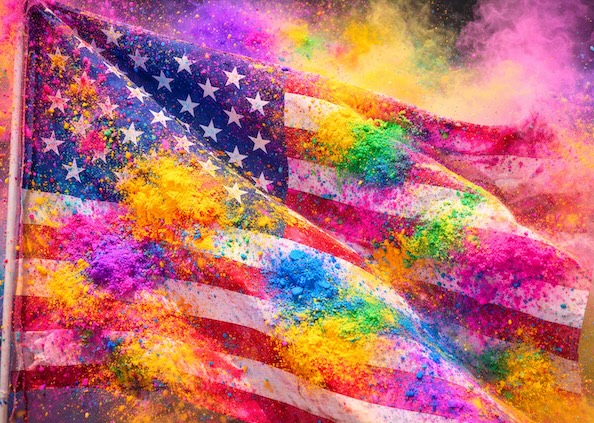
I kept noticing unexpected splashes of color on nearly everything we drove past: Benches, trees, and street lamps looked like they had been sprayed with various hues of paint.
It was about the coolest thing a little kid could witness.

Tens of thousands attend a Holi celebration at the Sri Sri Radha Krishna Temple in Spanish Fork, UT every year
This was actually powder, my mom explained to me, leftover from Holi celebrations the week before we arrived.
My immediate reaction involved a "Who's on first?" style mix-up of the words Holi and holy, particularly given that it is in fact rooted in Hinduism.
Next, I moved on to demanding an explanation for why we didn't have a magical colorful holiday at home in the US.
That was in 1995. It took 30 years, but Holi has finally become prominent in the US.
The Origins of Holi
Despite my mom’s best efforts, she was only able to give me the very broad strokes of what Holi was all about: A celebration of the start of Spring, representing hope and new beginnings. Holi is about spreading joy.

The blue skin of Hindu deity Krishna contributes to the origin of throwing colored powder on Holi
As I got a little older and learned more about Holi, which is arguably India’s second biggest holiday, just behind Diwali, I would grow an even deeper appreciation for it.
Rather than a set date, its annual timing corresponds to the full moon, which generally occurs in February or March. It was March 4 this year.
The holiday spans two days. The first is centered on fire and pays homage to the Hindu lore surrounding family members —one good and one evil —who were consumed by fire. But faithful Prince Vahalda emerged unscathed while the corrupt demoness Holika burned.
On day two come the colors.
In India crowds traditionally pour into the streets wearing white and proceed to absolutely douse one another in gulal, brightly colored powders in red, blue, green, and yellow. Each color carries meaning: red for love and fertility, blue for the god Krishna, green for new beginnings, yellow for health and happiness.
Sometimes water guns and balloons are known to join the mix as well.
There's also a love story woven into Holi's origins. According to Hindu lore, the deity Krishna — whose skin was dark blue — worried that his beloved Radha wouldn't return his feelings because of his appearance. His mother, in a stroke of playful genius, suggested he color Radha's face so they would match. He did. She fell for him. And from that single act of color-throwing, a tradition was born.
Coming to America
For much of its American history Holi was celebrated quietly within South Asian immigrant communities — in as much as you can possibly celebrate such a loud and vibrant holiday quietly.
The turning point for Holi in the US, however, arguably started in the last place anyone would guess: Spanish Fork, Utah.
In 1995 the local Hindu temple there began hosting an outdoor Holi festival.
Year after year, the festival expanded and ultimately began attracting national media. By 2014, the event was attracting 70,000 attendees a year. That number was made up at least in large part by students from nearby Brigham Young University.
Mainstream celebrations of Holi began spreading outside of Utah’s state lines and all over the place.
Holi festivals started filling up outdoor event spaces. College campuses from coast to coast launched annual celebrations. Today, major Holi events take place in Central Park, across Los Angeles, in Houston, Chicago, New Jersey, and well beyond. They usually involve DJs or live music, drinking, dancing, and of course no shortage of colorful powder.
An inclusive Holi-day
As an LA resident I can’t say I’m surprised that Americans would latch on to a holiday that’s determined by moon phases. But that’s also probably not the main reason for its recent popularity.
Part of it is demographic. Indian Americans are one of the fastest-growing communities in the country, and as that population expands, so does its cultural footprint.
But demographics alone don't explain why Holi has found such enthusiastic crowds among people with no South Asian connection whatsoever. For that, you have to think about what America, specifically, tends to respond to.
Holi is extraordinarily accessible. Yes, Holi is traditionally a Hindu holiday. But a deep knowledge or commitment to the religion is in no way required to celebrate.
There's also something more specific going on. Americans have long shown a particular appetite for celebrations that feel inclusive by design — events where the usual social barriers get checked at the door. Holi has that baked into its very DNA.
As the tradition goes, caste, age, and status are all set aside in the spirit of just having a good time together. That's not just appealing in the abstract. In a moment when so much of public life feels exhausting and divided, it's a relief.
And then of course there’s the social media aspect which is definitely not a trivial consideration in 2026. A holiday that turns every participant into a walking explosion of color was practically engineered for Instagram, even if it predates the app by about 2,000 years.
Holi without Indians?
It’s likely no coincidence that The Color Run, which began in 2011, was started by a Utah native.
The Color Run is a series of for-profit 5 kilometer races that very closely resemble Holi celebrations. Racers wear white and are pelted with colored powder throughout the race. Millions have since participated in these runs across a large number of countries.
However, there is no explicit mention of Holi involved in the color run, which has unsurprisingly drawn criticism on the grounds of co-opting a religious and cultural tradition with literally zero acknowledgement of its origins.
To be fair, I don’t think that there is any inherent issue in who celebrates Holi. The more inclusive it is, the better. And any way of spreading awareness is also a bonus.
But it also feels like a slight to see non-Indians only learning about our tradition in the context of a for-profit event with corporate sponsorship.
This is not to say that most mainstream Holi celebrations haven’t already become a for profit operation, but there is simply an argument to be made regarding who exactly is profiting.
Plus, a major source of pride for one’s culture comes with being able to share it with others. That sense of pride gets stripped away along with the cultural relevance.
Fortunately, at the rate that Holi celebrations continue to grow in the US, those of us who take pride in our holiday have little to worry about.
© 2026 by Asian Media Group Inc.
As the tradition goes, caste, age, and status are all set aside in the spirit of just having a good time together. That's not just appealing in the abstract. In a moment when so much of public life feels exhausting and divided, it's a relief.
Recent Articles
- 'I Love the Inflation,' Trump Says of Prices Rising Amid Iran War
- China's JUNO Neutrino Detector Advances Precision in Mass-Ordering Quest
- Only 11% of Europeans View US as Ally, Survey Shows
- BYD Will Be World's Biggest Automaker in 5 Years Says Its Chairman
- US Consumer Prices Increase at Fastest Pace in 3 Years
- Traders Keep Bets on Fed Rate Hike by October
- Drone Risks Keep World Cup Security Planners Frantic
- Bill Gates to Face Congress in Probe of Epstein Case Handling
- Musk’s xAI, SpaceX Hit with Class Action over Data Center ‘Nuisance’
- Downed Chopper Prompts US to Launch New Strikes on Iran