

Chinese Investor Scores Rare Win via Lobbying Firm with Don Jr Ties
By Reuters | 09 Apr, 2026
A Chinese investor kept its investment in a pharma startup from being rejected by blocking a US national security review.
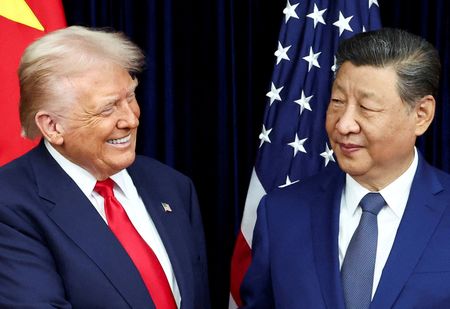
U.S. President Donald Trump and Chinese President Xi Jinping react as they hold a bilateral meeting at Gimhae International Airport, on the sidelines of the Asia-Pacific Economic Cooperation (APEC) summit, in Busan, South Korea, October 30, 2025. REUTERS/Evelyn Hockstein/File Photo
A lobbying firm led by one of Donald Trump Jr.'s hunting buddies helped a Chinese company make its case to a U.S. national security watchdog, public filings show.
The case involved a U.S. startup that was seeking to have the Chinese firm removed as one of its investors. The watchdog rejected the U.S. firm's request for a national security review of the Chinese firm's investment, according to a document seen by Reuters, handing a rare win to a Chinese company in Washington. The decision has not previously been reported.
The lobbying firm, Checkmate, helped a lawyer for China's Grand Pharmaceutical Group clinch a meeting with the head of the Committee on Foreign Investment in the U.S. (CFIUS) in early January, according to two people familiar with the matter. During the meeting, the lawyer argued that the case was a commercial disagreement with no national security implications, one of the people said.
At the end of January, the watchdog rejected the filing by Minnesota-based startup FastWave for reasons unrelated to national security, effectively siding with the Chinese firm, according to a document seen by Reuters.
FastWave, which had been granted calls with CFIUS staffers rather than senior officials that month, has been brought to the brink of bankruptcy, the company told CFIUS.
Reuters could not determine if the meeting Checkmate set up played a role in the CFIUS decision. There was no indication that Donald Trump Jr., President Donald Trump's eldest son, was involved. A representative for Don Jr. did not respond to requests for comment.
Such lobbying, by foreign or domestic companies is "very typical," according to Tim LaPira, a professor of political science at James Madison University. "If you want to speak to the party in power, you are going to need to hire somebody that has those partisan connections," he added.
Six China experts and three Democratic lawmakers who were informed of the situation by Reuters said the case raised concerns that Chinese companies could gain influence over the Trump administration by hiring lobbyists close to his orbit.
Michael Sobolik, senior fellow at the Hudson Institute, a conservative think tank, said that if a Chinese company can lobby the U.S. government into siding with it against an American firm on a national security matter, "that is the height of the swamp."
Democratic Senator Elizabeth Warren said it was "troubling that Chinese companies are hiring Trump-connected lobbyists to influence independent decisions about American national security," calling for answers on who made the decisions and what CFIUS's risk assessments of the deal found.
The White House rejected the criticism.
"Nothing has changed with CFIUS’s diligence, investigation, or enforcement operations, which continue to robustly and vigilantly safeguard America’s national security interests," said Kush Desai, a White House spokesman, adding that any implication that the Trump administration would weaken CFIUS at the behest of special interests was "categorically false."
COMMERCIAL DISPUTE OR NATIONAL SECURITY RISK
Checkmate is led by Ches McDowell, who appears in social media posts hunting with Don Jr. and co-owns a property with him. A spokesperson for Checkmate said McDowell, though listed on Grand Pharma's lobbying disclosure, did not personally work on the matter. Reuters found no evidence to the contrary.
Grand Pharma hired Checkmate in December, and paid the firm $30,000 for two weeks of work on CFIUS matters that month, filings show.
The CFIUS rejection came weeks after the early January meeting that Checkmate secured for Jeff Bialos, Grand Pharma's lawyer, with Chris Pilkerton, newly confirmed by the Senate at the time to lead CFIUS, according to the two sources.
FastWave's counsel sought a call with Pilkerton on two occasions in January, but it was only able to arrange calls with CFIUS staffers, according to documents seen by Reuters.
Bialos, a former senior Pentagon official now a partner at the Eversheds Sutherland law firm, and Checkmate acknowledged Checkmate arranged a meeting with senior Treasury officials, but declined to say with whom. In an interview with Reuters, Bialos said he could have arranged the meeting himself. Treasury did not respond to questions about Pilkerton.
Bialos described the process as "a lengthy fact-based investigation" whose outcome was not "politically driven.” He said the case amounted to "a private commercial dispute... being squeezed into the CFIUS box."
FastWave CEO Scott Nelson told Reuters "the opaque and highly irregular procedural decisions" from CFIUS made it difficult for his company to protect its critical technology from a Chinese investor.
A spokesperson for Treasury, which leads CFIUS, said CFIUS could not comment on individual cases. The Chinese Embassy in Washington declined to comment.
LASER SHIPMENTS REGULATED
In 2021, Grand Pharma invested $12 million in FastWave, which later started manufacturing a special catheter to treat calcium build-up in arteries using a laser.
U.S. shipments of that laser to China are regulated because they could also be used to enhance the Chinese military's warfare capabilities, according to U.S. rules.
FastWave, which initially welcomed Grand Pharma's investment, asked CFIUS in 2025 to review it. Fastwave hoped the committee would force Grand Pharma to divest its 40% stake or make it a passive investor, fearing that the Chinese firm could be seeking to steal its intellectual property and was blocking its attempts to raise money, according to the documents seen by Reuters.
In its 2021 agreement, Grand Pharma gained veto rights over future capital raises, a common investor request to avoid diluting its position.
FastWave became concerned about potential theft of its intellectual property after it saw a press release on Grand Pharma's website disclosing a new partnership with Jiangsu Zhenyi Medical Technology Co., Ltd, a Chinese rival to FastWave, FastWave said.
Jiangsu Zhenyi Medical Technology could not be reached for comment. Bialos said Grand Pharma was merely distributing the device for it and that the relationship did not violate Grand Pharma's commitments to FastWave. Reuters could not independently establish whether the relationship violated FastWave and Grand Pharma's agreements.
CFIUS in January rejected FastWave's filing in the case, stating that FastWave's responses included "material misstatements," according to a letter CFIUS sent to FastWave and seen by Reuters. For example, one of the alleged misstatements concerned the extent to which Grand Pharma engaged in negotiations with FastWave over its efforts to raise capital.
In its letter, CFIUS accused FastWave of contradicting itself by telling the committee in July 2025 that Grand Pharma had not provided "substantive feedback" on a financing round, while in August saying that Grand Pharma had in fact engaged in "substantive discussion." FastWave, in its response to CFIUS in February 2026, countered that Grand Pharma's feedback -- edits on a termsheet -- was not substantive and came only after FastWave's July statement to CFIUS.
In its rejection, CFIUS did not address any potential national security risks posed by the deal.
In a statement to Reuters, Treasury emphasized that CFIUS may reject any filing for "material misstatements."
FastWave could technically file a fresh petition to CFIUS but the company's "significant financial distress" means such a filing would not be feasible, FastWave said in a response to CFIUS in February.
Tatiana Sullivan, a lawyer who works on CFIUS cases, said the committee's letter was unusual. She said CFIUS normally works with companies to address any misunderstandings, only rejecting filings outright over "serious inaccuracies" tied to national security.
Nelson, the FastWave CEO, said the rejection came "months after the underlying statements were made," and that CFIUS "never informed us of these concerns, and gave us no opportunity to clarify or correct them before rejecting the filing on the very last day of an extensive review period that lasted over 200 days and included 29 question sets." Treasury did not respond to questions about the timing or process.
McDowell is a North Carolina lobbyist who met Trump Jr. at a conservative gala in 2016 and won his friendship by offering him a hunting trip better than the one Trump had just bid on, Checkmate confirmed. The two have owned a North Carolina property together since 2021, according to a deed seen by Reuters.
In one of Don Jr.'s Instagram posts from October 2024, McDowell stands beside Don Jr. and Health Secretary Robert F. Kennedy as they hold live falcons. In a January 2024 post on Facebook, Don Jr., his brother, Eric Trump, and McDowell pose with rifles on a dock above 12 dead birds.
(Reporting by Alexandra Alper; additional reporting by Andy Sullivan and Michael Martina; editing by Chris Sanders and Claudia Parsons)
© 2026 by Asian Media Group Inc.
Recent Articles
- US Senate Narrowly Blocks New Bid to Rein in Trump War Powers
- BYD Ramps up Battery Production in Brazil
- Intel Begins Chip Production with New Fabrication Process
- 'Wingman' Drone Key Piece of EU's Defense Self-Reliance
- Keiko Fujimori Edges Ahead in Brutal Contested Vote Count
- Chip Queen He Tingbo Subverts Moore's Law to Overturn the Global Semiconductor Hierarchy
- Only 30% of Americans Consider the US the World's Greatest Country
- US Spends $25,000 a Month to Store Unusable Contraceptives Stuck in Belgium
- AI Optical Parts Maker Zhongji Innolight Eyes $7 Billion Hong Kong Listing
- US-Iran Peace Deal Kicks the Can Down the Road