

Chinese Department Store Fosters Mallrats in Pyongyang
By wchung | 01 Apr, 2026
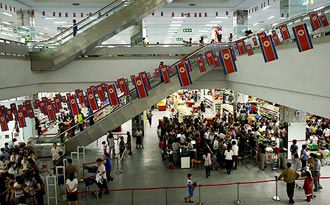
The Kwangbok Department Store mall, built by a Chinese-N. Korean joint venture, bustles with shoppers and diners.
The Kwangbok Area Supermarket in western Pyongyang has become a surprisingly bustling shopping and dining venue for Pyongyang residents as well as foreign visitors.
The supermarket — also known as the Kwangbok Department Store — is comparable to a smallish western-style indoor mall, complete with a food court and a play area for kids. It was the last public place visited by the late Kim Jong-il during the final phase of its construction in late 2011. Its main distinction is that it offers a level of quality and amenities not seen in other markets and shopping areas in N. Korea. The crowds it is attracting have made it a N. Korean rarity — an official project that is also a commercial success.
The supermarket-cum-department-store-cum-mall is the creation of a government joint venture with China’s Feihaimengxin Trading Company, providing an excellent example of how the impoverished nation can improve living standards by working with foreign partners. The venture is 65% owned by the Chinese partner and is stocked largely with Chinese imports, though it also offers products from Europe and other parts of the world, including Coca-Cola, Italian wines and kiwi imported from New Zealand.
Since its grand opening on January 5th, the mall has quickly become the city’s most lively shopping area, and is living up to its billing as the center of Changjon Street, the city’s new showcase boulevard completed last July to much official fanfare. The mall and surrounding areas feature western decadence like a cappuccino bar, beauty salons and spas with tanning booths and a variety of restaurants. Plans also call for the addition of a “miniature world” park with replicas of London’s Big Ben clock tower and Paris’ Eiffel Tower. A mini-golf park is also in the works. These new projects are billed as part of a campaign to make the city more attractive to foreign tourists.
The Kwangbok Mall would strike most Americans as being unexceptional, or even a bit spartan and downscale. For most N. Koreans its offerings are out of reach. Only the more privileged among Pyongyang’s 2.5 million residents can afford to shop or dine there. Most of its establishments prefer to accept hard foreign currency like Chinese yuan, US dollars, yen or euros rather than the official N. Korean currency, even from N. Koreans.
Upwards of $2 billion in foreign currency is estimated to be circulating in a nation with a GDP of only $30 billion, suggesting the severe threat the regime faces of seeing its official economy becoming overshadowed by an emerging real economy. At the same time, one of the few available sources of foreign exchange are foreign visitors, adding incentive to build attractions like Kwangbok mall. In the process N. Korea is spawning its first generation of consumers with access to a western-style shopping and entertainment experience.
Articles
- China Factory Growth Continued 4-Month Run Amid Price Pressures
- South Korea Enjoys Four-Decade High Export Boom on Chip Demand
- Japan Business Mood, Inflation Signs Both Rise
- TSMC to Launch 3-Nanometer Chip Production in Japan
- What's Trump's Worst Policy Mistake?
- Who Did the Most for the Asian Image in 2025?
- Sophisticated North Korean Hack of Internet Infrastructure Foiled
- US Consumer Confidence Up Despite Sharp Drop in Job Openings, Hiring
- Trump's $400 Million White House Ballroom Halted by Judge
- Toyota Joins Volvo, Daimler Truck in Hydrogen Fuel Cell Venture