

China Reshaped by High-End Manufacturing Boom
By wchung | 24 Apr, 2026
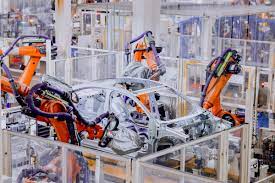
The swift rise of a sophisticated, hi-end manufacturing sector is changing life for ordinary Chinese while carving out a bigger piece of future global trade in lucrative industries, according to state-run China Economic Net.
China’s high-end equipment manufacturing sector generated revenues of 1.6 trillion yuan ($255 bil.) in 2010. By 2020 the sector is expected to become a pillar industry for the nation, according to plans released by China’s State Council.
The government defines the sector to include aviation equipment, satellites, rail systems, oceaneering equipment and intelligent manufacturing.
So far the biggest impact on the lives of ordinary Chinese is credited to the new high-speed rail systems industry. In particular, the 1,318-km (819-mile) Beijing-Shanghai High-Speed Railway, with trains moving at 300 km (188 miles) per hour, has cut travel time between China’s two leading cities to just five hours from what used to be an overnight journey. Barely a year after the route went into operation in June of 2011, its popularity has forced airlines to cut back on flights between the two cities.
Its impact will be felt by more of the nation’s population as its current total of 6,800 km (4,025 miles) expands to 18,000 km (11,250 miles) by 2015, according to the Ministry of Railways.
The high-speed rail system has done more than shorten travel time; it has created 2 million new jobs along the Beijing-Shanghai line and boosted domestic consumer spending by 1.2 trillion yuan ($192 bil.) during the first two years of the system’s construction.
Another high-end manufacturing project expected to have a big impact on China’s economy is the C919, China’s first domestically-developed large passenger jet. A prototype was unveiled at Airshow China 2010. The first test flight is planned for 2014 with delivery to begin in 2016.
Commercial Aircraft Corporation of China, Ltd. (COMAC) has already won orders for 330 C919s from 13 customers. It expects to expand orders at the upcoming Airshow China in November. By 2029 China hopes to sell over 3,000 passenger jets, according to a COMAC forecast.
The first copies of the C919 will use foreign-made engines and avionics. Ultimately, however, China plans to use domestically produced components. That should bring down the cost of buying passenger jets which, in turn, should lower the cost of air travel, putting it in reach of more Chinese.
Another high-impact project that has been in development for over a decade is the BeiDou Navigation Satellite System which China launched in 2000 with the aim of ending its dependence on the US Global Positioning System (GPS). In May of 2003 China orbited its third geostationary satellite using the homegrown Long March-3A rocket.
From April 2009 through December 2011, it orbited nine more BeiDou satellites. The system began to provide service on a trial basis on Dec 27, 2011 for use in transportation, weather forecasting, marine fisheries, forestry, telecommunications, hydrological monitoring and mapping, according to the China Satellite Navigation Office.
By the end of October six more satellites will have been launched during this year, bringing the total to 16 in preparation for providing satellite navigation, time and short message services for the Asia-Pacific regions by early 2013. By 2020 the system is expected to have 35 satellites in orbit in order to provide service globally.
Another high-end manufacturing industry that is one its way to achieving substantial revenues is oceaneering equipment. Equipment for offshore oil and gas extraction is forecast to provide annual revenues of 200 billion yuan ($32 bil.) by 2015.
In the long run, perhaps the most important of hi-end manufacturing industries for China’s future will be development of a domestic capability to produce intelligent manufacturing equipment, i.e., artificial intelligence, robots and digital manufacturing.
In a bid to compete against China’s skilled, low-cost labor force, the US, Japan, S. Korea, Germany and other advanced nations are expected to introduce intelligent manufacturing machines in large numbers. To keep from losing its share of the global manufacturing market even as the number of blue-collar workers shrink in coming years, Beijing plans to require 30% of intelligent manufacturing equipment used by factories in China to be sourced locally.
Recent Articles
- Samsung Workers Strike from Envy of $100k SK Hynix Bonuses
- Hyundai Partners with CATL, Momenta in 20-Model China Surge
- Asia's Fast-Fashion Suppliers Hit Hard by Iran Conflict
- China's Carmakers Race to Embed AI in Everything
- Nomura Posts Record Annual Profit, Sees No Prolonged Iran Impact
- Americans Blame Trump for Gas Price Surge as Midterms Loom
- DeepSeek Previews AI model to Runs on Huawei Chips
- Samsung Chip Output Plunges Overnight on Workers' Strike
- Vietjet to Take Year's First Airbus A330neo Delivery As It Expands into Europe
- BYD Offers 'Flash' Charging to Attract China's EV Holdouts