

Asian American Tech Bosses Succeed on Something Rarer than Brainpower
By Goldsea Staff | 10 Mar, 2026
The biggest successes owe to the cultural factors of ethics, long-term thinking, discipline and interpersonal style more than intellectual capacity or education.
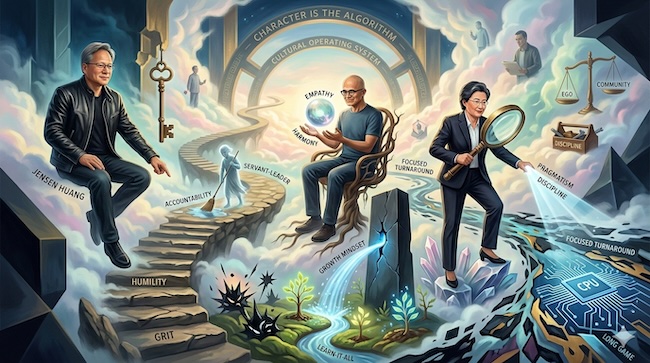
(Image by Gemini)
True, in the tech world a decent IQ is the price of admission. If you’re sitting in a C-suite in Silicon Valley, everyone assumes you can do multivariable calculus in your sleep and that your SAT scores were high enough to make your parents weep with joy. But if brainpower alone were the secret sauce, the Forbes 400 would just be a list of the world’s top Physics PhDs.
It obviously isn’t.
When you look at the current "Golden Age" of Asian American and Asian-diaspora leadership in tech—the folks running the companies that literally own the future—you notice a pattern. Whether it’s the gal making the chips that run AI or the guy overseeing the most used search engine in history, their "edge" isn't that they’re smarter than the next person. It’s about a specific cocktail of cultural grit, a "servant-leader" interpersonal style, and a level of discipline that would make a marathon runner look lazy.
The secret isn’t just what’s in their heads; it’s the "Cultural Operating System" they’re running on.
The Jensen Huang Way: The "Garbage Collector" Mentality
Take Jensen Huang. The man is currently the rockstar of the tech world. Nvidia is the engine room of the AI revolution, and Jensen is the guy making it all happen — in a leather jacket yet. Now, Jensen is obviously brilliant, but when he talks about his success, he doesn't talk about his engineering degree. He talks about cleaning toilets because no one else wants to.
His point is that no task is beneath him as the boss. That’s a cultural trait—a specific brand of immigrant humility and work ethic where the goal isn't to look like a boss, but to be the most useful person in the room. This interpersonal style is grounded in the Asian ethic of extreme accountability. He doesn't lead from a high tower; he’s known for having dozens of direct reports and engaging in "flat" communication.
While other CEOs were chasing "visionary" status, Huang was obsessing over the discipline of the supply chain and the ethics of long-term partnerships. He stayed the course for thirty years. That’s not brainpower; that’s the cultural value of patience—the ability to eat bitter (as the Chinese saying chi ku goes) today for a payoff decades later.
The Diplomacy of Sundar Pichai and Satya Nadella
Then you have the "Soft Power" giants: Sundar Pichai at Google and Satya Nadella at Microsoft. To understand their rise, you have to look at their interpersonal style.
Before Nadella took over, Microsoft was known for a culture of internal warring—literally Hunger Games with spreadsheets.
Nadella, drawing on a cultural background that prizes empathy and "Ahimsa" (non-violence/respect), pivoted the entire company toward a "learn-it-all" rather than "know-it-all" culture. His success didn't come from writing better code than Bill Gates; it came from his ability to harmonize a fractured organization.
Similarly, Sundar Pichai’s ascent at Google was fueled by his reputation as a "low-ego" leader. In a valley full of "Brilliant Jerks," Pichai was the guy who could get competing teams to actually talk to each other. This is a cultural factor—the prioritization of communal harmony over individual ego. In many South Asian households, the ability to navigate complex social hierarchies with grace is a learned skill. When applied to a trillion-dollar company, it becomes a competitive advantage that sheer intellect can’t touch.
Lisa Su and the Art of the "Long Game"
If Jensen Huang is the king of AI, Lisa Su at AMD is the queen of the turnaround. When she took over, AMD was a punchline. Most "smart" people said the company was going bankrupt.
Dr. Su (yes, she has the MIT creds though she lacks the dropout part) didn’t win by out-calculating the market. She won through disciplined focus. She made the hard, ethical choice to stop trying to do everything and instead do one or two things perfectly. There’s a specific kind of intellectual honesty in her leadership—a refusal to buy into hype. That discipline to say "no" to shiny distractions is a hallmark of the grit often instilled in immigrant families who know that resources are finite and mistakes are costly. Quite different from the mindset of the current CEO of the United States who doesn't think twice wasting tens of billions of dollars by attacking every country that doesn't pay him tribute.
The Quiet Power of Hock Tan and Lip-Bu Tan
Not every tech boss wants to be on a magazine cover. Look at Hock Tan of Broadcom or Lip-Bu Tan (formerly of Cadence). These men are the architects of the modern semiconductor landscape.
Hock Tan, in particular, is a master of the interpersonal style of efficiency. He’s often described as a frugal leader. In an industry known for bloating budgets on "moonshots," his cultural leaning toward **fiscal discipline and pragmatism** turned Broadcom into a juggernaut. It’s the sensible approach—the ethics of managing money like it’s your own.
Lip-Bu Tan, meanwhile, is legendary for his mentorship. His success is built on a massive network of trust. In many Asian cultures, "Guangxi" or relational networks are built on decades of mutual favors and integrity. You can’t "math" your way into a network like that; you have to earn it through consistent ethical behavior.
Alexandr Wang: Essentials Over Ego
Even the younger generation, like Alexandr Wang (whose company Scale AI is pivotal for Meta and the broader AI ecosystem), reflects this. While he’s a literal math prodigy, his company’s success relies on the grueling, disciplined work of data labeling—the "blue-collar" work of AI. It takes a certain kind of cultural perspective to recognize that the "glamorous" tech needs a foundation of hard, disciplined labor to actually function.
Why Brainpower is Overrated
To be clear, these people are probably all geniuses. But the tech graveyard is full of geniuses. The reason these specific leaders are standing at the summit is that they possess the "Third Culture" advantage. They’ve blended the competitive, meritocratic drive of the West with the collective, disciplined, and resilient values of their heritage.
1. Ethics of Responsibility: It’s not just about the quarterly report; it’s about the "face" of the company and the responsibility to the thousands of families they employ.
2. Discipline over Hype: While "growth at all costs" was the Silicon Valley mantra, many of these leaders focused on sustainable, "boring" excellence.
3. Interpersonal Harmony: They’ve mastered the art of being the adult in the room, using empathy and diplomacy to manage the massive egos that populate their boardrooms.
The Asian American Lesson for Would-Be Bosses
If you want to build a startup, go to a top school and study hard. But if you want to build an empire that lasts thirty years and changes the way humanity functions, you need more than a brilliant GPA. You need the grit to clean the toilets when needed, the humility to listen to your engineers, and the discipline to ignore the noise.
The success of these and many other Asian American tech titans isn't a victory for the smartest guys in the room. It’s a victory for the ones who were raised to believe that character is the ultimate algorithm.
© 2026 by Asian Media Group Inc.
Recent Articles
- 'I Love the Inflation,' Trump Says of Prices Rising Amid Iran War
- China's JUNO Neutrino Detector Advances Precision in Mass-Ordering Quest
- Only 11% of Europeans View US as Ally, Survey Shows
- BYD Will Be World's Biggest Automaker in 5 Years Says Its Chairman
- US Consumer Prices Increase at Fastest Pace in 3 Years
- Traders Keep Bets on Fed Rate Hike by October
- Drone Risks Keep World Cup Security Planners Frantic
- Bill Gates to Face Congress in Probe of Epstein Case Handling
- Musk’s xAI, SpaceX Hit with Class Action over Data Center ‘Nuisance’
- Downed Chopper Prompts US to Launch New Strikes on Iran