

Nelson Yang Turns Bananas into Textile
By Reuters | 17 Sep, 2025
A Taiwanese entrepreneur is working on a farm-to-material concept in which bananas grown for food is also used to extract fibers for clothing.
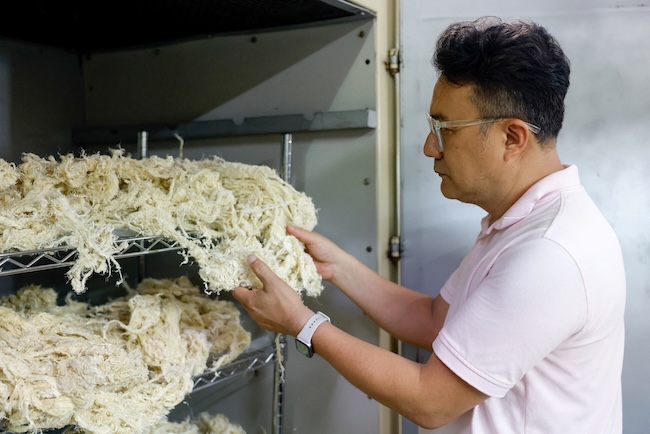
Nelson Yang, founder and general manager of Farm to Material, inspects fibers made from banana pseudostems at the company's facility in Changhua, Taiwan, August 21, 2025. REUTERS/Ann Wang
Entrepreneur Nelson Yang is reaching back into Taiwan's history to turn the humble banana plant into an unlikely sustainable textile.
Taiwan is now the world's dominant producer of advanced semiconductors but the yellow fruit, still widely grown on the island, was once a source of patriotic pride.
Yang's Farm to Material, headquartered in the central Changhua rural belt, is turning banana fibre into textiles he hopes will one day supply global sneaker brands.
"Back in 2008, European (sneaker) brands told us that they were hoping to find a way for food and materials to be produced in parallel, meaning that food and materials are yielded from the same land," he told Reuters.
"So we've been working based on that concept. What we're doing now is making sure that all our material sources come from food or leftovers from agriculture or the food industry. We then transform those leftovers into usable materials."
Under Japanese colonial rule from 1895-1945, Taiwan was renowned for its fruit, especially pineapples and bananas, and in the 1960s, the island branded itself the "banana kingdom" to boost exports, now long since overtaken by the tech industry.
Yang's company takes the middle section of the banana plant, known as the pseudostem and normally abandoned in the field after harvest, then crushes and dries it to produce the fibres that can make clothing.
Some of the fibres are turned into yarn that can be blended with cotton for socks and can also be turned into vegan leather.
The business is still in its infancy with no orders from apparel companies.
"Banana fibre actually performs better than regular cotton in terms of water consumption, absorbency, and supply stability, making it highly promising for future applications," said Charlotte Chiang, director of the innovation and sustainable design department at the Taiwan Textile Federation.
"Banana fibre could become a new highlight for Taiwan in the field of biomass fibre in the textiles industry."
(Reporting by Yi-Chin Lee and Ann Wang; Writing by Ben Blanchard; Editing by Saad Sayeed)
Articles
- Japan Sets February Record with 3.46 Million Foreign Visitors
- Microsoft Considers Suit Against Partner OpenAI Over $50-Billion Cloud Deal
- Samsung Union Approves Strike Plan to Worsen Global Memory Chip Shortage
- Japan Pressured to Violate Pacifist Constitution, Send Escort Ships
- Chinese Students Told to Fall in Love As Beijing Targets Births, Consumption
- Japan Exports Grew for 6th Straight Month on Strong Asia Demand
- China Grants Approval to Purchase Nvidia H200 GPUs
- Powerful New AI Model Appears on OpenRouter, DeepSeek Suspected
- Nvidia Sees $1 Trillion Chip Sales in 2027, Excluding Restart of H200 GPUs for China
- US Travel Demand Robust Despite Higher Fares on Rising Fuel Costs