

How to Spawn Terrorists Devoted to America's Destruction
By Tom Kagy | 07 Jan, 2026
Trump's use of the US military to bully defenseless small nations into surrendering sovereignty is a tried-and-true formula for spawning more US-hating terrorists.
History shows that if a superpower wants to manufacture generations of people who view Americans as eternal villains, the steps are painfully consistent. They've been repeated across continents and decades, often with the same moral logic, the same economic motivations, and the same disastrous results.
The process merely requires willful ignorance, arrogance, force, and a belief that humiliation can be imposed without consequence. We’ve seen this movie over and over again in modern history, and it almost always ends the same way.
Take the United States in Iraq after 2003. A fast invasion sold with talk of security and freedom quickly turned into years of occupation, broken infrastructure, and daily humiliation. The Iraqi state collapsed, young men watched foreign troops patrol their streets, and oil contracts flowed outward. Out of that wreckage came Al Qaeda in Iraq and eventually ISIS, groups that openly taught that killing Americans isn't only justified, but a sacred duty.
Afghanistan followed the same script. What began as a targeted response morphed into a long occupation propping up corrupt elites, and by the end the Taliban were no longer just fighters—they were symbols of national resistance who outlasted the strongest military on Earth.
Other powers have learned the same lesson the hard way. Russia tried to beat Chechnya into submission with overwhelming force in the 1990s and 2000s. Villages were flattened, civilians terrorized, and politics replaced with brute power. The blowback didn’t stay local. Suicide bombings and mass-casualty attacks hit Moscow itself, carried out by people who saw terrorism not as madness, but as patriotic payback.
And long before that, imperial Japan learned the same lesson when it annexed Korea in 1910. Decades of military rule, forced assimilation, and economic extraction didn’t pacify Koreans; they produced underground resistance networks, assassinations, sabotage, and attacks on Japanese officials that were celebrated as acts of national survival. Many patriotic young Koreans went to Mahchuria to fight with Chinese communists to defeat Japan on the Asian mainland while the US was fighting in Southeast Asian island chains.
Even regional powers repeating this logic get the same result. Israel’s long occupation of southern Lebanon helped create Hezbollah, a permanent armed movement built around the idea that violence against Israelis was resistance, not terror.
Turkey’s decades of military repression in Kurdish regions turned political grievances into bombings and insurgency that reached Turkish cities. In every case, the pattern is identical: when a powerful state uses soldiers instead of legitimacy, it doesn’t get obedience—it gets enemies who wrap violence in patriotism, religion or divine destiny.
When Trump openly talks about “taking the oil,” “protecting our interests,” or using American troops as a bargaining chip, he strips away the polite language past empires used to hide the same behavior. To a domestic audience, it sounds tough and refreshingly honest. To people on the receiving end, it confirms exactly what radicals have been telling them all along: that America sees their country as loot and their lives as leverage. That kind of clarity doesn’t deter terrorism—it recruits for it.
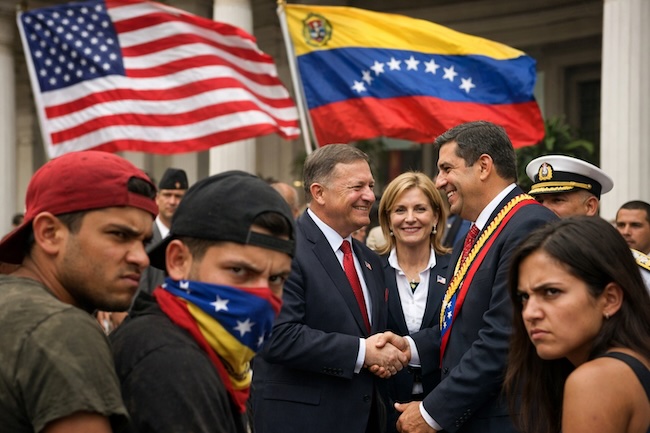
Trump has already taken the first step toward spawning terrorist reprisals against the US and Americans by publicly reducing Venezuela to a commodity. When a powerful country signals that another nation’s primary value is its oil, gas, or minerals—and that its political independence is conditional on “cooperation”—it sends a message that tells Venezuelans, "Your land is not yours, your government is tolerated only if it serves foreign interests, and your future will be decided elsewhere."
That's the kind of message that hardens proud and patriotic young hearts.
The second step is to use overwhelming military power to enforce this worldview. Using US special forces to abduct Nicolas Maduro and using the Coast Guard to commandeer oil tankers works well.
Next comes the destruction of legitimacy. When a superpower backs pliant leaders, rigs political outcomes through pressure, or undermines existing institutions in the name of “stability,” it shatters faith in self-government.
Then comes humiliation, the most underestimated accelerant. Inevitably Venezuelans will start to see the US set up military checkpoints and dictate how to extract oil and where to ship it. Funds the US releases back to the puppet government won't go toward their intended purposes but will be siphoned off by layers of corrupt officialdom while ordinary Venezuelans will suffer. Their children won't have any doubts as to which evil foreign force was behind their suffering.
Their anger will be channeled by new rebel leaders who see their destiny in destroying all traces of the US, including Americans and local collaborators. Nationalism, or revolutionary mythology will form as the framework that transforms resentment into action. Violence becomes framed as sacred duty, historical correction, and divine justice. The more overwhelming the original power imbalance, the more absolute the moral language becomes. If you can't defeat an empire materially, you defeat it spiritually.
Of course Trump and his ilk will then see the rebels as irrational xenophobes and help collaborators suppress them. This refusal to acknowledge cause and effect allows the cycle to continue. Each attack is treated as proof of barbarism rather than blowback. Each reprisal creates new recruits faster than any propaganda video ever could.
Trump’s blunt, transactional rhetoric made this process unusually visible. When leaders openly speak of “taking the oil,” “protecting our interests,” or using troops as leverage in negotiations, they remove the fig leaf that once concealed imperial behavior. For domestic audiences, this candor can sound strong and decisive. For people on the receiving end, it confirms every accusation extremists make about American intentions.
Be patient. Terrorist movements don't emerge overnight. Children who grow up under occupation, direct or indirect, or coerced dependency absorb stories of loss long before they can articulate politics. By the time they're adults, violence feels less like a choice and more like inheritance. At that point, even if policies change, the damage is already done. Grievance has become identity. The US has become the evil foreign force that must be destroyed at the cost of life itself.
There you have it: the birth of another terrorist enemy of the United States. And we can thank Trump and his narcissistic need to bully small, weak dysfunctional nations to grab what he thinks will give him stature and immunity from a bad economy and emerging scandals.
Of course, none of this was inevitable. Nations rich in resources don't have to become breeding grounds for anti-American extremism. But avoiding that outcome requires abandoning the fantasy that dominance produces obedience. It requires recognizing that sovereignty isn't a bargaining chip and that military power can't turn cowardlay bullying into legitimacy and stability.
Above all, it requires understanding that foreign-sourced humiliation, once inflicted, never dies.
Asian American Success Stories
- The 130 Most Inspiring Asian Americans of All Time
- 12 Most Brilliant Asian Americans
- Greatest Asian American War Heroes
- Asian American Digital Pioneers
- New Asian American Imagemakers
- Asian American Innovators
- The 20 Most Inspiring Asian Sports Stars
- 5 Most Daring Asian Americans
- Surprising Superstars
- TV’s Hottest Asians
- 100 Greatest Asian American Entrepreneurs
- Asian American Wonder Women
- Greatest Asian American Rags-to-Riches Stories
- Notable Asian American Professionals