

Gang Ren Creates First 3-D Image of Single Molecule
By wchung | 20 Mar, 2026
Gang Ren has rigged up a cryo-electron microscope to produce the first detailed 3D image of an individual molecule.
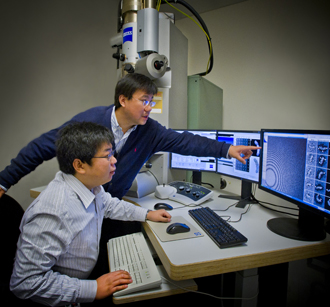
Lawrence-Berkeley Laboratory researcher Gang Ren has rigged up a conventional electron microscope to produce 3-D images of a single molecule.
Gang Ren has rigged up a cryo-electron microscope (cryoEM) to do what no one thought it could do — produce a detailed 3D image of an individual molecule. Until now the only way a molecule could be imaged was to use computer averaging of data on thousands or even millions of the same molecule.
Using a technique Ren calls “individual-particle electron tomography” (IPET), he produced 3D images of the IgG antibody and apolipoprotein A-1 (ApoA-1), a protein involved in human metabolism. Now that he has demonstrated the feasibility of using his technique to image individual molecules, Ren hopes to use it to get snapshots of a molecule that has so far eluded scientists using far more powerful imaging devices — the HDL or the so-called “good cholesterol” that’s supposed to provide a protective effect on the cardiovascular system.
“We are well on our way,” says Ren.
Ren’s feat required focusing the microscope on a spot less than 20 nm across to produce an image of a protein as small as 70 kDa. Kilodaltons is a unit of mass tiny enough to measure atoms, molecules and DNA snippets. Ren’s image does more than provide an outline of a molecule. It allows scientists to see which parts are flexible and moving.
“This opens a door for the study of protein dynamics,” says Ren. “Antibodies, for example, are not solid. They are very flexible, very dynamic. This allows you to see the personality of each protein. It is a proof of concept for something that people thought was impossible.”
To achieve his first with a Libra 120 — not considered a very high-end model in research circles — Ren paired it with a $300,000 CCD camera, a powerful image-processing software, special contrasting agents, and a device called an energy filter to sift through camera data from multiple angles and cull out weak signals.
“All images are noisy,” Ren explains. “In physics, the noise is inconsistent among the images, but the signal—the object or protein—is consistent. By using this approach, we find the consistent portion (the signal) can be enhanced, while the inconsistent portion (the noise) will be reduced substantially.”
Ren was recruited in August 2010 to work at the Department of Energy (DOE)‘s Lawrence Berkeley National Laboratory’s Molecular Foundry from the University of California at San Francisco, the nation’s top medical university. While at UCSF he had used more conventional data averaging techniques to delineate the structure of LDL—the “bad cholesterol” implicated in heart disease.
Ren received a bachelors in theoretical physics from China’s Lanzhou University in 1990, followed by a masters at the same university in 1993 while focusing on general theory of relativity. He received a PhD in materials physics, specializing in electron microscopy, from the University of Science and Technology in Beijing in 1997.
Ren has been a postdoctoral fellow with the American Heart Association and University of California in cell biology at the Scripps Research Institute in La Jolla, CA. He was a staff scientist for the National Center for Macromolecular Imaging at the Baylor College of Medicine in Houston. He was a Keck Fellow in the Dept. of biophysics and biochemistry at UCSF.
Articles
- Xpeng Launches EVs in Mexico, Aims to Double Overseas Sales in 2026
- Netflix to Livestream Saturday BTS Concert from Seoul
- Tesla to Buy $2.9 Billion Worth of Chinese Solar-Panel Production Equipment
- OpenAI to Combine ChatGPT, Codex and Browser into One Superapp
- Jeff Bezos Seeks $100 Billion to Transform Manufacturing with AI-Based Automation
- Americans Think Trump Lying About Not Sending Ground Troops to Mideast
- The Real Difference Between Luxury Living in New York and China
- Takaichi Pressed to Join Hormuz Escort Service with Pearl Harbor Comparison
- Xiaomi's Lei Jun Quadruples AI Budget to $8.7 Billion As MiMo-V2-Pro Excites Developers
- Samsung to Supply HBM4 Chips for OpenAI's Custom Processor Project