

Feng Zhang Created the Toolbox for Today's Synthetic DNA Advances
By Reuters | 23 Dec, 2025
Jurassic Park inspired young Feng Zhang to pursue molecular biology and learn how to apply CISPR to edit the genomes and RNA of mammalian cells.
Feng Zhang can fairly be credited as the pioneer who enabled today's synthetic DNA technology, enabling everything from engineering microbial pathways for sustainable biomanufacturing to developing personalized cancer vaccines and new-generation diagnostics.

Feng Zhang speaks about his work in a Broad Institute video. (National Science Foundation Video Frame)
By transforming an obscure bacterial defense system into a universal synthetic tool, Feng Zhang didn't just lay the groundwork—he handed the world the high-speed, high-precision construction kit necessary to begin truly programming the code of life. The future of synthetic DNA, whether through more precise base editors, new diagnostic systems, or entire de novosynthetic pathways, continues to be defined by the versatility of the molecular toolboxes Zhang built.

Zhang’s most profound contribution is the successful harnessing and optimization of the CRISPR-Cas9 system for use in eukaryotic cells, which include human cells. This single development shifted the paradigm of synthetic DNA, moving it out of the slow, laborious era of older technologies like Zinc Finger Nucleases (ZFNs) and TALENs, and into the age of fast, cheap, and programmable genetic engineering.
Accelerating the pace of genetic engineering from decades to mere months was done mostly while working as a molecular biologist and neuroscientist based at the Broad Institute of MIT and Harvard. Zhang’s work is less about buildingDNA from scratch and more about creating the ultimate molecular toolboxes that allow scientists to precisely read, write, delete, and replace the genetic code inside living cells, thereby enabling the sophisticated applications we see in medicine and biotechnology today.
From Bacterial Defense to Mammalian Tool
The true genius of Zhang’s work lies in his vision to adapt an ancient bacterial immune system into a universal tool. The CRISPR system, an adaptive defense mechanism in bacteria and archaea, was a biochemical curiosity until Zhang recognized its potential as the biological equivalent of a text editor for the genome.
In early 2013 Zhang and his lab published a seminal paper in Science demonstrating that the CRISPR-Cas9 system could be successfully engineered to function in mammalian cells. This knocked down the critical hurdle. If the system only worked in simple bacterial cells, its impact would have been limited. By showing that a synthetic guide RNA (sgRNA) could direct the Cas9 "molecular scissors" to a precise location in a complex human genome, he provided the scientific community with a tool that was:
Programmable: Simply changing the 20-nucleotide guide sequence allowed the system to target virtually any gene. This accessibility contrasted sharply with ZFNs and TALENs, which required complex, de novo protein engineering for every new target.
Efficient: It achieved highly specific edits, reducing the chance of unwanted cuts, known as "off-target effects."
Scalable: The ease of programming meant that gene editing could be performed across an entire genome, paving the way for large-scale genetic screening used in drug discovery.
This single achievement was the catalyst for today’s synthetic DNA advances, transforming genetic engineering from an art mastered by few into a technique available to nearly every biological research lab in the world.
Expanding the Synthetic DNA Toolbox with CRISPR-Cas13 with RNA Editing
Zhang didn't stop with Cas9. Recognizing that genome editing required a diverse set of tools for different jobs, his lab quickly became a hub for the discovery and engineering of novel CRISPR-associated systems, constantly expanding the definition of what synthetic DNA could accomplish:
In a major leap for synthetic biology, Zhang's team identified and characterized CRISPR-Cas13, a variant that targets RNA instead of DNA. This was a crucial synthetic DNA advance because it allowed for reversible, transient gene modulation. Unlike DNA edits which are permanent RNA edits can be used to temporarily block the production of a problematic protein without altering the underlying genome.
This led directly to the development of the REPAIR (RNA Editing for Programmable A to I Replacement) system, which can correct disease-causing mutations at the RNA level. This concept—a programmable, non-permanent edit—is a cornerstone of modern, safer gene therapies and diagnostics, demonstrating Zhang’s commitment to expanding the synthetic toolkit beyond simple DNA cutting.
CRISPR-Cas12/Cpf1 and Beyond
The constant discovery of new Cas proteins (like Cas12a/Cpf1) in Zhang’s lab has continually refined the genome editing process. Cas12a, for example, produces staggered cuts (sticky ends) in DNA, which are often easier for the cell to repair by inserting new, synthetic genetic material—a process vital for complex gene insertion in synthetic biology applications.
These new systems are often smaller, making them easier to package into viral vectors (like AAVs) for delivery into human cells, directly addressing one of the biggest challenges in developing synthetic DNA therapeutics. More recently, Zhang's lab has continued to mine natural microbial diversity, uncovering new, compact systems like NovaIscB, an OMEGA editor that is smaller and highly versatile for gene therapy applications, and TIGR-Tas systems, which offer modularity that could further simplify the complexity of in vivo synthetic gene delivery.
Jump-Starting Commercial and Clinical Translation
Perhaps the most tangible evidence of Zhang’s impact on synthetic DNA is the rapid clinical and commercial translation of his discoveries. Unlike many foundational academic breakthroughs, CRISPR moved almost immediately into industry, driven largely by Zhang’s involvement and his philosophy of making the technology widely available.
Founding Companies: Zhang is a co-founder and advisor to several pioneering biotech companies that are now leading the charge in synthetic DNA and gene therapy. These include Editas Medicine, focusing on Cas9-based therapeutics; Beam Therapeutics, which specializes in base editing (a highly precise form of synthetic editing that changes a single DNA letter without making a double-strand break); Sherlock Biosciences, which commercializes the SHERLOCK diagnostic platform; Pairwise Plants, focusing on agricultural applications; and his latest venture, Aera Therapeutics, focused on solving the vexing challenge of delivering genetic medicines into the body.
SHERLOCK Diagnostics: This synthetic DNA platform, based on Cas13, uses guide RNAs to program the system to look for specific nucleic acid sequences (like those from a pathogen or a cancer biomarker). Upon finding the target, the system releases a fluorescent signal, providing a highly sensitive, cheap, and rapid diagnostic tool. SHERLOCK showcases the power of synthetic sensing—programming a molecular system to perform a complex logic function.
Therapeutic Approval: The first Cas9-based therapeutic was approved for clinical use to treat sickle cell disease in 2023. This drug design was based on the foundational technology developed in Zhang’s lab, illustrating the direct pipeline from his synthetic tool development to life-saving patient treatment. The continued development of smaller, more adaptable tools like the recently engineered NovaIscB is focused entirely on making these clinical treatments safer and more accessible.
From Hebei to Harvard and MIT by Way of Jurassic Park
Feng Zhang was born in Shijiazhuang, Hebei Province, China, in 1981 and moved to Des Moines, Iowa, with his family at the age of eleven. His early exposure to science and engineering came through a supportive school environment. While attending Theodore Roosevelt High School, he developed a deep interest in molecular biology after seeing the movie Jurassic Park, which led to a volunteer position in a local gene therapy lab. This high school experience, where he worked with molecular biologists every day after school, was crucial in shaping his future path.
Zhang continued his education at Harvard University, where he received a bachelor's degree in Chemistry and Physics. He then pursued his doctoral work at Stanford University in chemistry, joining the newly formed lab of Karl Deisseroth. There, Zhang played a central role in developing optogenetics, a revolutionary technique that uses light-sensitive proteins to control brain cell activity, thus laying the groundwork for his future work in engineering biological systems. This foundational work in engineering biological components became a signature of his career.
After earning his PhD in 2009 Zhang held a prestigious Harvard Junior Fellowship, during which he focused on developing early gene-editing tools based on TAL effectors (TALENs). He joined the MIT faculty in 2011 and became a core member of the Broad Institute of MIT and Harvard, where he soon learned about the microbial CRISPR-Cas systems. By January 2013, his team published the landmark paper that first demonstrated how to harness and apply CRISPR-Cas9 for genome editing in human and mouse cells, initiating the CRISPR revolution and the massive acceleration of synthetic DNA capabilities.
Feng Zhang's pioneering work has been recognized with numerous prestigious awards, including the National Medal of Technology and Innovation in 2025.
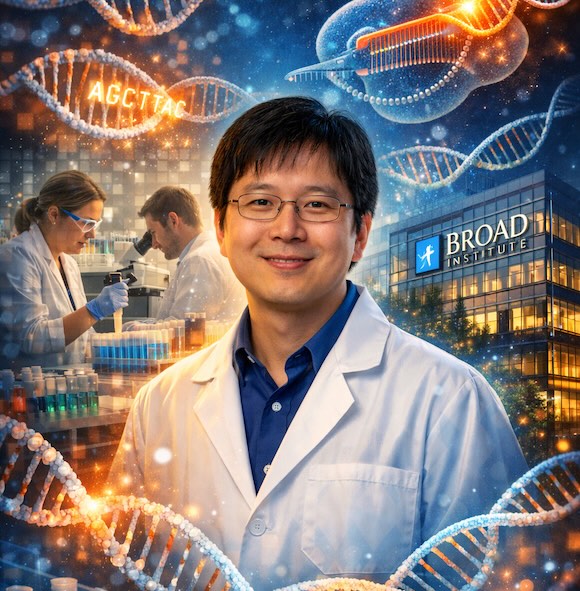
(Image by Gemini)
Articles
Asian American Success Stories
- The 130 Most Inspiring Asian Americans of All Time
- 12 Most Brilliant Asian Americans
- Greatest Asian American War Heroes
- Asian American Digital Pioneers
- New Asian American Imagemakers
- Asian American Innovators
- The 20 Most Inspiring Asian Sports Stars
- 5 Most Daring Asian Americans
- Surprising Superstars
- TV’s Hottest Asians
- 100 Greatest Asian American Entrepreneurs
- Asian American Wonder Women
- Greatest Asian American Rags-to-Riches Stories
- Notable Asian American Professionals