ANCHORING CALIFORNIA
PAGE 3 OF 7
"My mom was the classic Japanese American wife and [my father] was a very
dominating, strong man," Tokuda recalls. "She told me once , 'The last
significant decision I made was when I said I do.'" The couple lived in a
one-room hotel. Soon after the marriage Tama developed a kidney infection
for which the only medical care she could get was painkillers. She developed
a sustained high fever and, eventually pneumonia. Later she discovered she
was pregnant. Her first child, a son, was born developmentally disabled. He now lives in a
protected apartment north of Seattle.
|
"When you're third generation Japanese American, there are a lot of things
about your family and about your own behavior that when you go out into
the rest of the world, you don't quite fit."
|
"You could say it was the war, the fever, the painkiller," says Tokuda of her
older brother's condition which she blames on the treatment given to
Japanese Americans during the war. "It had a profound effect on me. While
I was growing up, if I had to pick the one thing that had the biggest effect, I
always thought it would be race." She denies bitterness. "You could make
yourself crazy with a bitter attitude. I just think it had an effect."
After the war the Tokudas moved back to Seattle where George eventually
became a pharmacist and opened his own pharmacy. "My mom had a big
influence on me, but Dad ran the house," she recalls. "I wouldn't call him a
tyrant, but he was a strong personality. Mom pretty much bowed to his
will."
Growing up in a lower-middle class area in southern Seattle, the Tokuda
children were among the more affluent. Wendy was an all-around success
at Cleveland High where about 30% of the student body was Asian, mostly
Japanese Americans. Wendy was a cheerleader and an honor student. "I
was socially oriented," she recalls. She dated regularly, mostly Japanese
Americans, and had a steady boyfriend from the age of 15. They were
together for four years, but Tokuda denies he played a significant role in her
life and identifies him only as a Japanese American.
"The year I graduated, the entire top ten was Asian," she says. She was
among them. "The newspaper came out and did a story on it." Despite her
academic promise, her parents never tried to push her into any field. "I
think the pressures are different for males and females," she says.
Yet in considering her career options, she did rebel against the typical expectations
placed on her classmates. Graduating in 1968, Tokuda spent a year at
Whitman College in nearby Walla Walla, Washington. She then went on to
major in political science at the University of Washington. She found herself
focusing less on studies than she had in high school.
"I graduated with honors, but barely," she says. She blames "life" for having
distracted her from studies.
Entertaining the notion of becoming a lawyer, she spent a year working at a
legal services clinic. "I enjoyed talking with the people that came in and
hearing their stories," she recalls. "What I did not enjoy was sitting in the
law library pulling out books." Just as she was concluding that law wasn't a
field she wanted to pursue, a friend asked if she knew anyone who wanted to
spend a year in Japan teaching English to a high-level corporate executive in
exchange for room and board. Here was the perfect opportunity, Tokuda
felt, to learn Japanese, acquire a sense of her cultural roots and decide what
she wanted out of life.
"I taught people in his company English for spending money, and I kind of
helped wash dishes and keep the house clean. It was a very nice
arrangement and a wonderful year that I wouldn't trade for anything.
"When you're third generation Japanese American, there are a lot of things
about your family and about your own behavior that when you go out into
the rest of the world, you don't quite fit. When I was in Japan, all of a
sudden I saw where all of that came from, and I realized the broader
context where I belonged. It added a dimension to my life for which I'll be
forever grateful."
Upon returning to the States Tokuda decided on a career in broadcast
journalism and started in early 1974 as a secretary to the public affairs
department for Seattle's King TV. She was 24.
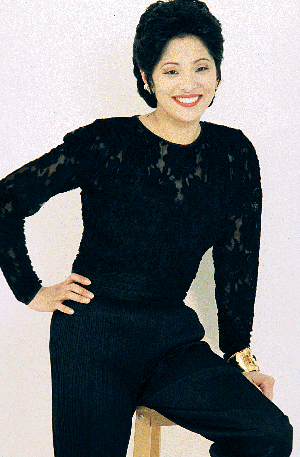
"I was being trained to write and I was learning what film was — in those
days we shot on film — and what tape was and what TV was all about," she
recalls. "That very first day when I walked in and they started taking me
through this orientation, I remember thinking, 'I am absolutely in the right
field. This is it!"
It took Tokuda only a year and a half to get herself promoted to an on-air
reporter. Getting herself that first big break was the real start of her
career, and Tokuda enjoys telling the story.
"There was a news director who was very scary. I'd go down there and he'd
be in his office reading The New York Times [behind the glass partition
of his office]. I would force myself to dress up, to wear makeup — I never
wear makeup unless I'm at work, and I don' wear a lot of jewelry except my
wedding ring — and I would be like terrified because there's a part of me
that's very shy. It would take a lot of energy for me, it would take a lot of
work, determination. It was very hard for me to go into his office and just
say, 'I thought I'd just check in and see if you had anything coming up, an
opening or anything like that.' Sometimes he'd say no. Sometimes he'd tell
me, 'I really need somebody with more experience.' He turned me down six
times.
"Finally, one time he said there was like an audition for a job. He told me to
be there at 10 in the morning. He gave me a bunch of wire copy and said,
'Write these into stories and I'll put you in front of the camera and you read
them.' So I wrote the stories and they put me in front of the camera and it
was just the most terrifying thing. I read these stories and I was shaking.
They were all watching and it was embarrassing and it was awful. [The
news director] came down and said, 'You look very nervous, but I think you
showed promise. I want you to try reading again and try to relax this time,
really try to see if you can relax.' The next time I just put all my energy into
trying to figure out a way to relax, and I took a deep breath and read it and
they gave me this job as a consumer reporter."
PAGE 4
| PAGE 1 |
2 |
3 |
4 |
5 |
6 |
7 |