ANCHORING CALIFORNIA
PAGE 2 OF 7
Tokuda directs me to a tiny Italian restaurant not far from the NBC studios.
She is apparently a regular. The owner, a former print journalist, places
before her a complimentary glass of white wine. Surprised and a little
flustered that the same courtesy hasn't been extended to her guest, Tokuda
immediately asks if I wouldn't like a glass as well. She isn't one to keep her
guest waiting while chatting up the restauranteur. Each time the owner
comes to lavish attention on her, she is polite but dismissive. At the end of
the meal I have the pleasure of watching her parry off the owner's efforts to
foist a doggy bag on her.
|
"I'm not insecure about it.
I've been in this buisness now for almost 20 years. "I've already paid my dues."
|
"You've done better than that," the man cajoles, pointing out three shellfish
still on her plate.
"I've done better," Tokuda responds, "but we're having a very intense
conversation."
"Why don't I put that in a doggy bag for you," the man suggests.
"I would, but I don't think seafood is going to get home in condition to eat,"
Tokuda says trying to return to our conversation.
"Oh sure, it will," the man insists.
"I might get salmonella or something."
"Oh no," the man says chuckling. "This is cooked seafood. You don't get
salmonella from cooked seafood." He is so insistent about the doggy bag, I
start to wonder if Tokuda hasn't established a big reputation as a recyler of
leftovers as well.
"It was wonderful," says Tokuda firmly, turning away from the man.
Clearly, she has nothing left to say on the doggy bag issue. The man beats a
smiling retreat back to the kitchen.
It is 9:30, time to hurry back to the studios so she can prepare for her 11
o'clock broadcast. Discovering that I have two young children, she suggests I
come up to her office so she can send me home with a gift for them. As is the
case for most TV journalists, Tokuda's office is really a doorless, acoustically
padded workstation though somewhat larger than most. On the walls hang
school art created by her two daughters and framed posters of Japanese
American events. Most of the other cubicles in the cavernous newsroom
seem to have emptied, and it is quiet. After some rummaging, Tokuda finds a
children's book titled Shiro in Love which she co-authored with Hall.
It is about a white Japanese dog who falls in love. Tokuda inscribes a
message for my children before handing me the book. She promises to send
me the other children's book which she has written with her husband called
Humphrey the Humpback Whale.
Wendy Tokuda is the newest of L.A.'s three Asian female anchors, having
been here only since December of 1991. Unlike Tritia Toyota of Channel 2,
the CBS affiliate, and Joanne Ishimine of Channel 7, the ABC affiliate, Tokuda
isn't home grown, having made her mark in San Francisco. There, for 12
years she was on the prettier half of the nation's longest running anchor
team.
Here she is the junior half of an entirely new team in her current time
slots. According to Tokuda, co-anchor Paul Moyer is a proven draw in the
L.A. market while she remains something of an unknown quantity. Her
anchor spot, she feels, is the one that would be vulnerable to the ratings. The
knowledge that she could be reshuffled at any moment's notice doesn't seem
to cost her lost sleep.
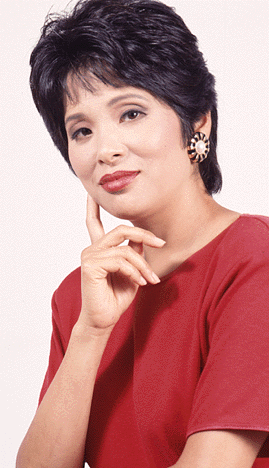
"I work at the station's pleasure," Tokuda says. "I'm not insecure about it.
I've been in this buisness now for almost 20 years. "I've already paid my
dues."
 endy Tokuda was born in Seattle in 1950, the fourth of five children. Her
father George and her mother Tama met in Minedoka, one of the infamous
internment camps to which West Coast Japanese Americans were forcibly
relocated after the start of World War II. At the time she was sent there Tama
was a literature major in her last year of college. She had already
shown enough talent to have articles published in Harper's Bazaar.
"Imagine what that means for a Japanese American woman at that time,"
Tokuda says.
endy Tokuda was born in Seattle in 1950, the fourth of five children. Her
father George and her mother Tama met in Minedoka, one of the infamous
internment camps to which West Coast Japanese Americans were forcibly
relocated after the start of World War II. At the time she was sent there Tama
was a literature major in her last year of college. She had already
shown enough talent to have articles published in Harper's Bazaar.
"Imagine what that means for a Japanese American woman at that time,"
Tokuda says.
As war hysteria subsided, internees were allowed to leave camp if they
secured employment on the East Coast or Midwest. George Tokuda found
work as a welder in Chicago. Tama joined him there and the two were
married. The marriage put an end to her writing career.
PAGE 3
| PAGE 1 |
2 |
3 |
4 |
5 |
6 |
7 |